admin
admin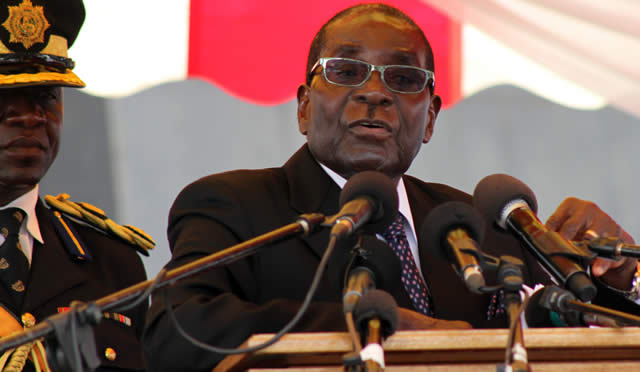
WE commend President Robert Mugabe for clarifying the confusion over the interpretation of the indigenisation law which had undermined market confidence and led to further increase in the cost of doing business and weakening the country’s competitiveness.
His intervention, through a statement issued by the Minister of Information, Media and Broadcasting Services, Cde Christopher Mushohwe, was timely and put to rest squabbles pitting Finance and Economic Development Minister Patrick Chinamasa and Youth, Indigenisation and Economic Empowerment Minister Patrick Zhuwao pertaining to the financial services sector.
We applaud the President for showing astute leadership skills and moving in to calm the nerves of investors who had become jittery in the wake of war of attrition between Treasury and the Youth, Indigenisation and Economic Empowerment Ministry. Reserve Bank of Zimbabwe Governor John Mangudya, in a letter dated March 30 addressed to the Zimbabwe Investment Authority and copied to Zhuwao, said six foreign-owned banks operating in Zimbabwe had complied with the indigenisation law.
Chinamasa also reiterated the RBZ position that all banks had complied with the indigenisation law following the March 31 deadline set by government.
But Zhuwao differed with the Treasury and Central bank positions and issued a contradictory statement in which he slated Chinamasa and Mangudya. “It’s unfortunate that Chinamasa has chosen to engage in the media on an issue that ought to have been clarified outside the glare of the public given the sensitivities that may adversely affect depositors and shareholders in the financial services sector,” he said.
Zhuwao claimed only BancABC and Ecobank satisfied the specific requirements of the legislation and accused Mangudya and Chinamasa of trying to shield non-compliant banks from complying with the law. “The RBZ can’t shield their [banks] illegality by submitting that the letter that was written by the governor constitutes compliance with the laws of the land,” Zhuwao said.
“It’s unbelievable and astounding that a national institution can be used as an accomplice to subvert the principle of indigenisation which is enshrined in the Constitution of Zimbabwe.”
He warned that if the foreign-owned banks did not comply with the law, they risked depositors’ money as they would be shut down.
“These foreign-owned financial institutions cannot, in perpetuity, remain with only 20-31 percent indigenous shareholding. Such a situation is in clear violation of the law,” Zhuwao said. “It’s, therefore, my view that the statement by Chinamasa is incorrect and it doesn’t outline the correct compliance position of the foreign-owned financial institutions as is required by law.”
The President on Tuesday moved to swiftly deal with the matter as it was threatening economic recovery efforts and sending jitters throughout the financial services sector.
In his statement, Cde Mugabe said: “The banking sector shall continue to be under the auspices of the Banking Act, which is regulated by the Reserve Bank of Zimbabwe, and the insurance sector under the auspices of the Provident and Insurance Act.
“This policy position is essential for the promotion of financial sector stability, confidence and financial inclusion. These institutions will, nonetheless, be expected to make their contributions by way of financing facilities for key economic sectors and projects, employee share ownership schemes, linkage programmes and such other financial empowerment facilities as may be introduced by the Reserve Bank of Zimbabwe from time to time.”
We welcome the clarification as the conflicting positions on the interpretation of the law had caused confusion among Zimbabweans, the business community, current and potential investors thereby undermining market confidence.
The financial services sector is a sensitive area which reacts negatively to market volatility and has the potential to cause an economic disaster if not handled properly. We also note that the President’s intervention limits the role of the Youth, Indigenisation and Economic Empowerment Ministry by allowing line ministries to come up with models of compliance. This is crucial in that there won’t be a blanket approach to implementation of the indigenisation policy.
The President’s statement is also unequivocal in reiterating the government position on indigenisation which is meant to grant Zimbabweans ownership and control of the means of production. In this regard, the economy had been divided into three main sectors namely resources, non-resources and reserved sectors.
Cde Mugabe said the government attached great importance to the indigenisation of the resources sector due to the finite nature of minerals and as such the State would hold a 51 percent stake in businesses in this sector with the remainder going to partnering investors. The President also said for existing businesses in the natural resources sector where the government does not have 51 percent ownership, compliance with the Indigenisation and Economic Policy should be through ensuring that local content retained in Zimbabwe by such businesses is not less than 75 percent of gross value of the exploited resources.
He also said the non-resources sector should exhibit economically desirable strategic objectives that contribute towards turnaround and sustainable socio-economic transformation, among them beneficiation and value addition of minerals.


 Online Reporter