admin
admin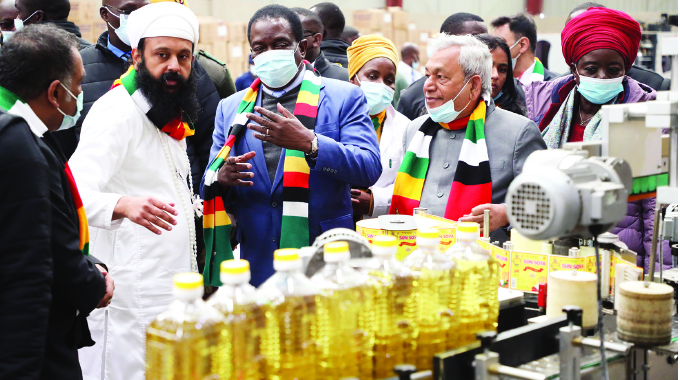
Rutendo Jiri Correspondent
The country’s rural communities are set to be the major beneficiaries of rural industrialisation programme through job creation and infrastructure development as the country moves towards attainment of Vision 2030.
Under the programme, industrial activities are being launched across the country’s rural areas, on factor endowments in each rural area.
Factor endowments rely on utilising rich resources in a specific area for economic development.
For example, if an area is rich in soyabeans, sorghum, cotton, gold and platinum among others, a whole industry will be created centred on those resources the community can easily provide.
In that regard, recently, President Mnangagwa officially launched Tanzanian multinational company, Mount Meru Miller’s US$20 million oil refinery plant in Mahusekwa, Mashonaland East, amid whistles and ululations from hundreds of locals who thronged the official ground breaking ceremony.
The event was also graced by the Meru family and shareholders represented by Mr Atui Mittal who was overjoyed after the family business was being given Government support to establish their edible oil plant in Mahusekwa.
Speaking at the official launch of Mount Meru Millers, Mr Mittal said their “presence in the country was testament of President Mnangagwa’s mantra that Zimbabwe is open for business.”
He implored other investors to take opportunity of the country’s open for business policy to establish long term strategic businesses that partner and empower locals. The benefits of Government’s ongoing rural industrialisation drive are exponential.
Under the programme, established industries are implored to prioritise locals for employment in both skilled and unskilled labour.
Relatedly, Mount Meru Millers assistant general manager, Mr Simon Chimbundo buttressed these sentiments highlighting that, established industries should give priority to local employment which would be a sustainable approach to empowerment.
“We are still operating below full capacity. Currently we have 50 employees. We hope that when we increase our operations, we will be employing up to 400 people,” he said.
During his presentation, Mr Mittal said that when fully operational, their company had the potential of employing 1 000 people.
Also speaking at the event, President Mnangagwa emphasised that apart from direct job creation through employment in locally established industries, locals and Zimbabweans at large could benefit contracts to supply raw materials needed for edible oil production.
Locals could provide raw materials such as cotton, soya beans and sun flowers to Mount Meru Millers and earn money thereby cutting down on importing the same raw materials locals can grow.
President Mnangagwa revealed that local farmers could benefit from farming inputs such as seed, chemicals and fertilisers which will be availed to them by Mount Meru Millers to capacitate them to grow inputs such as soyabeans, sunflower and cotton.
Farmers would thus be empowered through having access to inputs and direct markets. When the country’s edible oil inputs are locally produced and fed into local plants, the country’s traditional reliance on imports would thus be lessened.
Moreover, ordinary Zimbabweans would benefit immensely from the availability of edible oil products on our shelves at low affordable prices.
With time, local manufactures can also earn the country the much needed foreign currency through exporting the same, of course after satisfying local demands of the product.
Local communities are also set to be among the major beneficiaries of rural industrialisation projects.
For example, Mount Meru Millers promised that once fully operational, they would be responsible to the community through their Corporate Social Responsibility (CSR) projects among the community.
Schools and clinics would be among the major beneficiaries through CSR projects.
Also, another major benefit brought about by rural industrialisation apart from local job creation is reducing rural to urban migration.
Historically, the country’s rural to urban migration was necessitated by job searches as hordes of rural folks to urban areas in search of jobs.
After independence, rural to urban migration continued right to 21st century Zimbabwe.
In this regard, rural industrialisation will combat rural to urban migration through local job creation at a large industrial scale which would attract like businesses in the value chain, thus creating a whole local industry.



 Online Reporter