admin
admin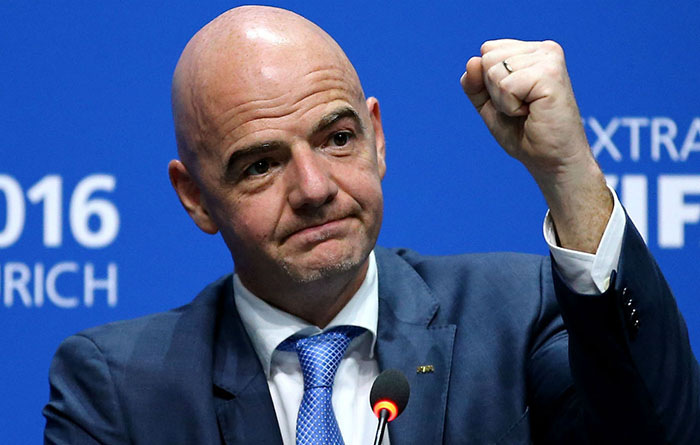
JOHANNESBURG. — FIFA president, Gianni Infantino, has stressed the importance of unity among member associations, regional organisations and continental confederations in Africa.
He said this when he addressed COSAFA annual general assembly in Johannesburg, South Africa, prior to attending a meeting with South African President Cyril Ramaphosa in Cape Town.
“COSAFA is very important in this part of the world, and as part of the FIFA Forward programme, in which we introduced a strong support to the zonal organisations,” the FIFA president said.
“Nevertheless we can and want to do more so we need to be united and work together in a true spirit of cooperation.”
The FIFA president highlighted that African football should look to prepare to optimum levels for the 2026 FIFA World Cup, which will see the number of African teams participating in the competition increase from five to nine or ten.
“Doubling the number of teams participating in the World Cup is crucial because it can have an impact on youth and the entire football community as it gives many more countries a concrete chance to qualify.
“This can trigger investments from governments and the private sector, which can help the member associations further develop football in their respective countries,” he added.
“In order for African teams not only to participate, but to shine at a world stage, the work has to start now. Africa should be united to get back what it has given to global football, and this can only happen if we all work together.”
In Cape Town, the FIFA president discussed the importance of football as a vehicle for positive development in society with President Cyril Ramaphosa.
The meeting also referenced Saturday’s productive meeting held with the President of the Democratic Republic of Congo and current AU chairperson, Félix Tshisekedi, and the imminent launch of a pan-African schools football tournament.
The duo also talked about the unifying power of football, throughout the continent, while emphasising the importance of South Africa as hub for football in the region, one of the reasons why FIFA decided to locate one of its four African FIFA regional development offices there.
The stance by some sections in the continent that FIFA’s interest in the beautiful game in Africa is driven by a colonialism narrative is a misconception.
These deepening ties indicate a major shift in FIFA’s objectives since 2016, under the leadership of Infantino, who succeeded the controversial Sepp Blatter, under whose watch the game in Africa was synonymous with individuals misusing FIFA funds to enrich themselves.
Spending has increased considerably to FIFA’s 211 football federations under the administration of Infantino, who assumed office in 2016.
Before Infantino, FIFA allocated between US$250 000 and $300 000 every yearly to each federation.
The irony is that under Infantino, revenues to FIFA have not increased significantly but under a similar budget, the global mother body have increased allocations to the federations fivefold.
FIFA now channel up to US$1,5 million every year to each of their member associations.
“That’s more than US$300 million every year, five times more than in Blatter days,” tallied an African federation president.
The increase in allocations is in line with Infantino’s electoral manifesto, via the Forward Programme.
The financial outflows have raised questions as to why, with the more or less the same revenue, FIFA now distributes five times more than in the past.
The distribution of money, under the aegis of the Forward Funds, is to grow the game worldwide.
“This is a key part of Gianni Infantino’s vision to make football truly global,” said a longtime observer of African football.
“He (Infantino) doesn’t mean that he wants football to become popular worldwide. This is already a reality. What he means is that he would like to see countries and clubs outside Europe to be football powerhouses and to democratise competitiveness in all the continents.”
The Confederation of African Football, with 54 member associations, is FIFA’s biggest confederation in terms of country members.
“Some sectors of African football occasionally cast doubts on why FIFA is interested in CAF and African matters and use a dated “colonialism” narrative,” said a CAF official.
The official said such people represented the past in which a handful of officials were enriching themselves at the expense of football.
“The future should be made in partnership. Taking the future in its own hands and in full independence doesn’t mean Africa should be ashamed of working hand in hand with FIFA. African and world football will only have to win with it,” he added.
Infantino recently embarked on a tour of Africa.
One of the highlights of his itinerary has been the inauguration of a regional development office in the Republic of Congo and Rwanda.
It furthers FIFA’s commitment to support member associations in the delivery of infrastructure, competitions, development and education projects.
Four of these offices are located in Africa.
They are in Dakar (Senegal), Johannesburg (South Africa), Brazzaville (Congo) and Kigali (Rwanda).
Infantino reminded that FIFA had increased the number of African national teams eligible to qualify for the FIFA World Cup in 2026 from five to nine or ten.
“FIFA wants to see African football reach the highest of heights and we are certain that our network of regional offices will complement the work already underway to elevate African football,’’ said Infantino. — APO Group.


 Online Reporter