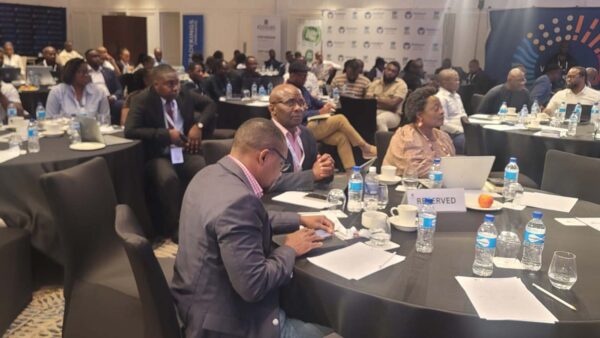
The Zimswitch Payments Conference, which took place earlier this week in Victoria Falls, was a resounding success. Delegates left with ideas and insights that should revolutionize the payments industry for the next 30 years and beyond.
A Focus on Innovation and Growth
Running under the theme, “Thriving and Shaping the Future in An Era of Continuous Change,” the conference saw presenters from across the continent and from diverse facets of the payments industry share insightful presentations that should go a long way in driving meaningful change within the sector.
A total of 150 delegates from 10 different countries, representing 77 different organizations and providing 20 unique services, attended the conference.
A total of five regional clearing houses were also in attendance, making the conference richer in all aspects.
Various topics covering regulatory, security, and innovation were discussed through presentations, panel discussions, and question-and-answer segments.
Zimswitch chief executive officer Mr. Zabron Chilakalaka kicked off the conference and said that despite the operating environment continuously changing, sector players must continuously embrace the change and find “opportunities within and take a leading role in shaping the future.”
“It is about developing a mindset of resilience, agility, and forward thinking to navigate the challenges of an ever-changing landscape,” said the Zimswitch boss.
He said there is a need for sector players to embrace emerging technologies “to unlock innovative payment experiences that create value for all stakeholders and future-proof our businesses.”
“Our work extends beyond mere transaction processing; it enables financial empowerment, fosters economic growth, and promotes financial inclusion, giving financial superpowers to our communities,” said Mr. Chilakalaka.
The Reserve Bank of Zimbabwe’s Deputy Director of Financial Markets, Dr. Josephat Mutepfa, was the guest of honor and, in his keynote address, called on all the payments and equity participants and players present at the conference to converse on the key issues in the landscape “to bring inclusive and sustainable solutions.”
He revealed that Zimbabwe, before the introduction of ZiG, had achieved 96 percent digital transactions and acknowledged the positive impact the payment players had made in achieving this financial inclusion and digital financial services in the country.
“As we try to shape the future in an era of continuous change, new risks are emerging, and they need to be mitigated to maintain financial stability and integrity, which are key goals of the economy,” said Dr. Mutepfa.
This year’s conference was held at a time when Zimswitch is celebrating its 30th anniversary, a journey that started with the institution providing services to just six players but has since grown to supporting 29 players.
The journey has seen Zimswitch increase and diversify its product range including the flagship point of sale (POS) and the new E-Commerce platform.
All this success is being achieved in collaboration and in partnership with other key industry players, including international firms such as VISA and Mastercard, as well as regional and local financial institutions and fintechs such as NovaPay.
The payments conference was an opportunity to forge meaningful partnerships and to collectively shape the trajectory of the payments industry.
Addressing Industry Challenges
Patson Gasura, chief executive of Topline Research Solutions, laid the groundwork for the conference with his survey highlighting the state of the payments industry.
According to the survey, most Zimbabweans prefer using cash and rarely shop online.
The survey revealed that 83 percent of the respondents do not conduct online shopping and the remainder who do buy mostly groceries (26 percent) and clothing (23 percent). Most of the surveyed (83 percent) receive payments in cash.
Mr. Gasura attributed the low levels of online shopping at just 17 percent to the frustrations that come with high transaction charges, the long banking processes, network unreliability, and technological barriers, among others.
The SMEs Association of Zimbabwe chief executive officer, Farai Mutambanengwe, shared similar sentiments in his presentation under the topic “Lessons from the frontline.”
Mr. Mutambanengwe said customers do a cost-benefit analysis when they transact and if the costs are higher than the benefits, they are unlikely to use the service.
He said customers consider platforms that are cheaper, faster, accessible, and always up. Trust can also be a factor, according to Mr. Mutambanengwe.
He said customers would want to see lower costs and less bureaucracy for external payments.
While the challenges presented by both Mr. Gasura and Mr. Mutambanengwe seemed insurmountable, speakers at the Zimswitch Payments Conference were up to the task and proffered solutions.
It was a platform for players to learn from one another. It also gave an opportunity for the players to forge meaningful partnerships and to collectively shape the trajectory of the industry.
Collaboration and Partnership
The conference answered Mr. Chilakalaka’s call to “seize the power of now to foster collaboration, share insights, and explore innovative strategies.”
Hopefully, the interventions shared over the conference’s two days will help shape the future of payments, creating an ecosystem that is reliable, secure, seamless, inclusive, and customer-centric, as expected by Mr. Chilakalaka.
Professor Robert Ebo Hinson, Pro Vice-Chancellor of Ghana Communication Technology University, said the industry can only deliver, as per expectations, if it has a customer-focused mindset.
There is a need to understand what customers need and gain the necessary product knowledge to meet their needs, Professor Hinson said.
With the issue of costs being topical throughout the conference , Professor Hinson urged players to deliver cost-effective products and solutions that help customers make cost-effective decisions.
Still on the issue of costs, Mr. Saul Chin’anga, Managing Director of Solten Financial Services and Chairman of the Zimbabwe Association of Microfinance Institutions, said that by embracing digital platforms and minimizing the need for physical branches and reducing paperwork, MFIs can operate more efficiently and pass on cost savings to clients through lower interest rates and fees.
“This affordability can encourage more people to engage with formal financial services,” he said.
Mr. Chin’anga also touched on the issue of cybersecurity, which he said, with the increased use of digital platforms, ensuring the security and privacy of clients’ data is paramount.
He said issues to do with hacking of bank or wallet accounts are also being recorded.
As one of the solutions, Collin Franco, Chief Information Security Officer at EFT Corporation, said, “The pervasiveness of cyber risk means that information security must be managed at executive level with board oversight.”
Dr. Mutepfa had also weighed in on the issue of cybercrime, which he said is a reality.
“In this regard, we innovate, as we innovate let us not lose sight of the need to ensure that effective systems to manage risks including cyber are put in place.
“This is essential to ensure that customers are provided and protected to enhance trust and confidence in the economy,” Dr. Mutepfa said.
He said the central bank continues to encourage banking institutions and the payments ecosystem to embrace new technology but put in place necessary risk management structures to mitigate risks, including AML-CFT issues.
“As we navigate into the future, the central bank will ensure that there is an enabling environment to support responsible innovations by players in our market in line with local, regional, and international best standards and practices,” said Dr. Mutepfa.
Fellow regulator, Annah Masoga, Divisional Head: Policy and Regulation Department, South African Reserve Bank called for responsible innovation.
“The solution is basically to manage the tension between the private sector and the regulator. The regulator has the responsibility to make the regulatory environment conducive while the innovators have the responsibility to make sure that their innovation is responsible.
“The solution is that there has to be a culture of compliance.”
She however said regulation must not stifle innovation and must transition from reactive to proactive regulation.