

 dyton mupawaenda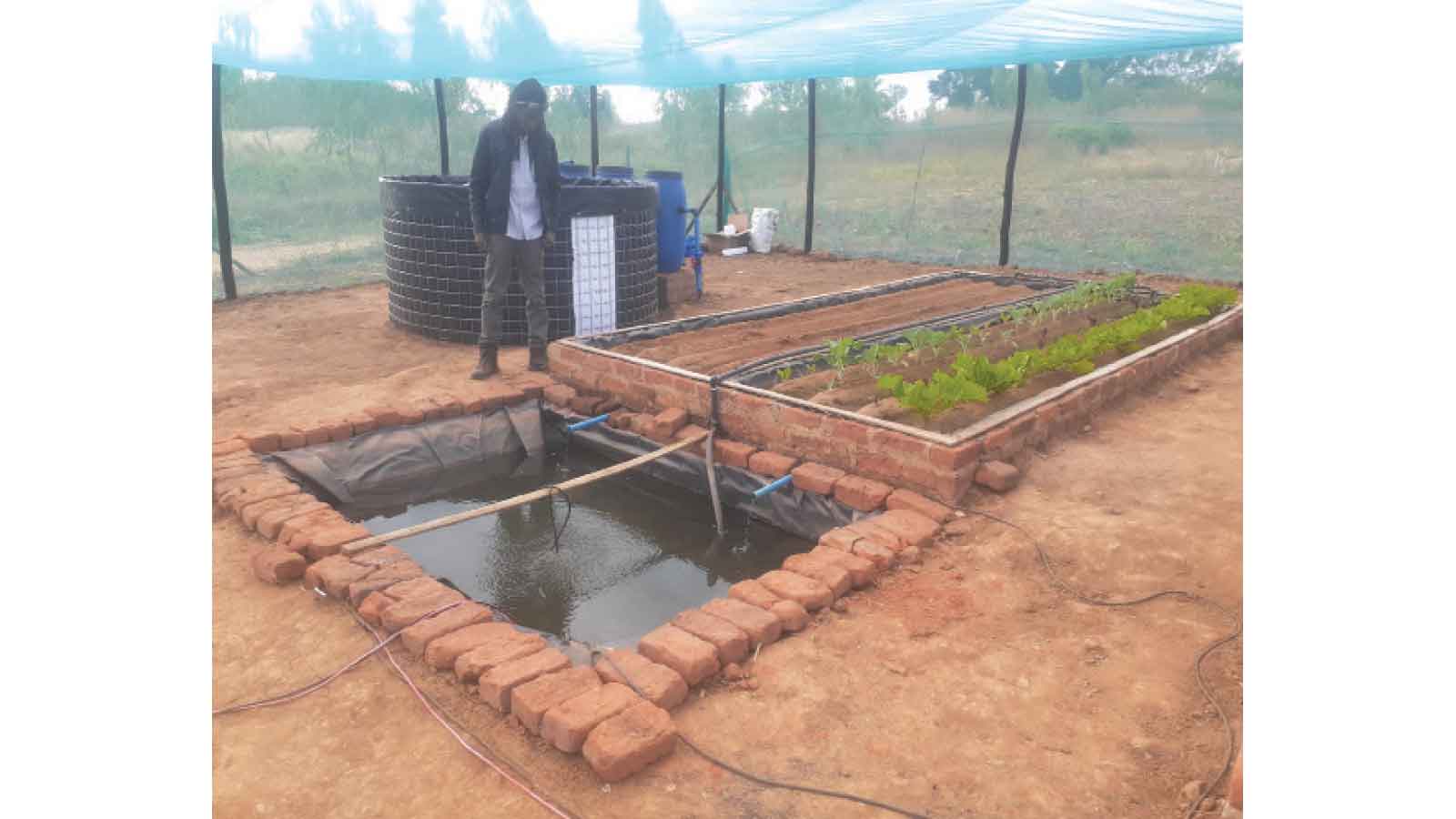
Theseus Mauruki Shambare-Features Writer
IN a corner of Shamva District in Mashonaland Central Province, a quiet hum rises from a small water pump beside a fish tank.
The fish surface first, then the vegetables.
A few metres away, rows of leafy green vegetables flourish in growing beds filled not with fertile soil, but with river sand and biochar.
Water trickles steadily through the system and fish dart beneath the surface. Vegetables sway gently in the afternoon breeze.
At first glance, it appears unremarkable. Yet in a region where climate change is making rainfall increasingly unpredictable and droughts more frequent, this modest installation offers a glimpse into a different future for African agriculture.
It is one of eight pilot Bio-sandponics systems established across Southern Africa by Zimbabwean innovator Killian Ruzande — four in Zimbabwe, two in Botswana and two in Lesotho.
The system combines fish farming and vegetable production in a single ecosystem, producing protein and vegetables while using a fraction of the water required by conventional agriculture.
However, for Ruzande, the story did not begin in Shamva. It began in Mbare.
Growing up in one of Harare’s oldest suburbs, Ruzande developed an early fascination with fishing and aquatic ecosystems.
After completing Ordinary Level studies at Harare High School and Advanced Level studies at Lord Malvern High School, he ventured into entrepreneurship, helping to establish a business focused on angling and fishing tours.
But fishing eventually became more than a business, becoming a pathway into innovation.
Years later, Ruzande travelled to South Africa, where he trained in aquaculture and aquaponics at the Aquaculture Technology Demonstration Centre. There, he encountered a technology that immediately captured his imagination.
Aquaponics, the integration of fish farming and soilless vegetable production, promised a sustainable way of producing food using limited resources.
Yet there was a problem. The systems were expensive.
Many relied on imported materials and sophisticated components that placed them beyond the reach of ordinary African households. Instead of accepting those limitations, Ruzande began searching for an alternative.
“I realised that most aquaponics systems were simply too expensive for ordinary people,” he said in a recent interview. “I wanted to create something that could work for communities in Africa, especially people in rural areas and those with limited resources.”
That determination led to the development of Bio-sandponics in 2019.
The innovation is built around simplicity.
Water from a fish tank is pumped into beds containing river sand mixed with biochar, a carbon-rich material known for its ability to retain both moisture and nutrients.
Fish waste provides nutrients for the vegetables. The vegetables absorb those nutrients while helping to clean the water. The filtered water then returns to the fish tank, and the cycle continues.
No chemical fertilisers. Minimal waste. Two sources of food from one integrated system.
A household unit can support around 100 fish and 100 vegetable plants. Larger commercial systems can produce tonnes of fish and vegetables annually.
“The idea was to create a system that guarantees households access to protein and vitamins while remaining affordable and easy to operate,” said Ruzande.
His vision arrives at a time when food production systems across Southern Africa are facing unprecedented pressure. For generations, many rural communities depended on predictable rainfall patterns to sustain agriculture.
Today, those patterns are changing. Delayed rains, prolonged dry spells and recurring droughts have become increasingly common.
According to the Food and Agriculture Organisation’s (FAO) flagship publication, The State of Food Security and Nutrition in the World, climate variability and extreme weather events remain among the leading drivers of food insecurity worldwide, disproportionately affecting smallholder farmers who depend on rain-fed agriculture for their livelihoods.
The report notes that recurrent droughts, erratic rainfall patterns and other climate-related shocks continue to undermine agricultural productivity, highlighting the need for climate-resilient interventions such as irrigation development, improved water management and climate-smart agricultural practices.
The challenge is especially acute in Southern Africa, where millions of households continue to rely on farming for both food and income.
For Ruzande, the answer lies in developing production systems capable of thriving despite climate uncertainty.
“The future of agriculture is resilience,” he said. “We need systems that can produce food using fewer resources while adapting to changing climatic conditions.”
Bio-sandponics appears to align closely with that vision.
Research cited by the FAO shows that integrated aquaculture-agriculture systems can significantly reduce water consumption compared to conventional farming because water is continuously recycled within the production process. In regions where every drop matters, that efficiency could prove transformative.
The timing is significant.
The FAO’s State of World Fisheries and Aquaculture report identifies aquaculture as one of the world’s fastest-growing food production sectors.
Africa’s aquaculture sector has recorded remarkable growth over the past two decades, yet still possesses enormous untapped potential for contributing to food security, nutrition and economic development.
For countries seeking climate-resilient agricultural solutions, fish farming is increasingly becoming part of the conversation.
Among those paying close attention is the African Women Fish Processors and Traders Network Zimbabwe (AWFISHNET-ZIM).
Its director, Ms Tendai Rugare, believes innovations such as Bio-sandponics could play a critical role in expanding opportunities for women and young people in aquaculture.
“What excites us about this system is its practicality,” she said. “It combines fish production and vegetable production in one ecosystem while remaining affordable and adaptable to different communities.”
AWFISHNET-ZIM is currently working with Ruzande to explore the integration of catfish production into the system.
Catfish are widely regarded as one of the most resilient aquaculture species, capable of tolerating a broader range of environmental conditions than many other fish.
“As we promote catfish production, we are looking for technologies that lower barriers to entry and improve productivity,” Rugare said.
“Women and youths often face challenges related to access to land, capital and infrastructure.
“A system such as Bio-sandponics creates opportunities for them to participate meaningfully in aquaculture while simultaneously improving household nutrition.”
She believes the innovation represents more than a farming technology.
“It is about building resilient food systems. Climate change is forcing us to rethink how we produce food. We need solutions that are efficient, affordable and environmentally sustainable,” she said.
Government officials share a similar view.
Director of the Livestock and Fisheries Production Department, Mr Milton Makumbe, said locally developed innovations will play a critical role in the future growth of Zimbabwe’s fisheries and aquaculture sector.
“The future of agriculture will be shaped by innovation, technology and inclusivity,” he said. “The participation of women and young people is essential if we are to unlock the full potential of the fisheries and aquaculture sector.”
According to Makumbe, Zimbabwe is pursuing ambitious growth targets as part of broader efforts to expand the livestock and fisheries industry into a US$2,37 billion sector by 2030.
“To achieve those targets, we need production systems that are efficient, climate-resilient and accessible,” he said.
“We also need to ensure that women and youths are actively involved because they represent a major driver of future growth.”
For him, innovations such as Bio-sandponics demonstrate how local knowledge, entrepreneurship and science can converge to create practical solutions.
Back in Shamva, the fish continue to circle beneath the water and vegetables keep growing as the pump maintains its steady rhythm.
The system appears deceptively simple. Yet behind it lies years of experimentation, learning and persistence. It also reflects a broader truth about Africa’s development journey.
For decades, solutions to agricultural challenges have often been imported from elsewhere.
But increasingly, innovators across the continent are demonstrating that some of the most effective answers emerge from local realities.
They are developed by people who understand drought because they have lived through it; those who understand food insecurity because they have witnessed it; and those who understand resilience because they have practised it.
As climate change continues to rewrite the rules of agriculture across Southern Africa, adaptation is no longer optional.
The question is how quickly communities can respond.
For Ruzande, the answer is clear: build systems that ordinary people can afford — systems that conserve water — and produce nutritious food. Such systems must work for Africa.
The fish, the vegetables and the flowing water in Shamva may not look revolutionary.
But as a unified force, they tell the story of a boy from Mbare who refused to import the future and instead set out to build one.



 Online Reporter