Patrick Chitumba [email protected]
FARMERS at Insukamini Irrigation Scheme in Lower Gweru have formalised a new governance framework aligned with Statutory Instrument 38 of 2021 in a move expected to strengthen accountability, resolve resource disputes and transform the scheme into a viable commercial agricultural enterprise.
Statutory Instrument 38 of 2021 provides a regulatory framework for the management of irrigable land.
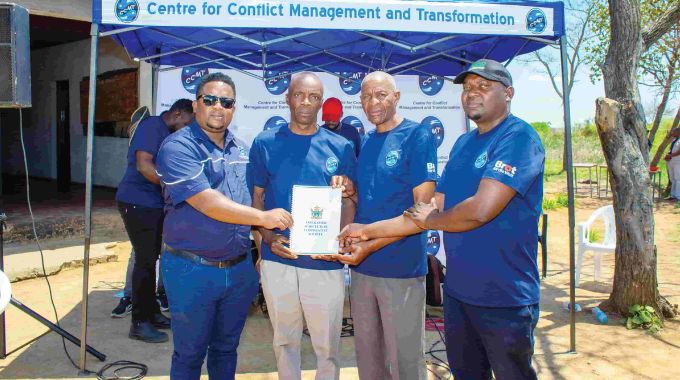
The signing of the terms of reference for the Insukamini Agriculture Cooperative Society Irrigation Management Committee marks a significant step towards improving water management, protecting irrigation infrastructure and boosting agricultural productivity as the country intensifies efforts to achieve food security and promote climate-resilient farming.
The development also positions Insukamini as a potential model for other irrigation schemes seeking to operate as business entities under the Government’s drive to commercialise agriculture and build an empowered upper-middle-income society by 2030.
Midlands provincial irrigation engineer Engineer Shingi Zano said the scheme had adopted a new constitution aligned with Statutory Instrument 38 of 2021, providing a legal framework for managing irrigable land.
“The scheme has been turned into a cooperative and is now operating as a full business entity. Today, we’re witnessing the signing of the Terms of Reference for the new committee, which will serve as an example for other irrigation schemes in this district and in Mberengwa District,” he said.
Eng Zano said the initiative was being implemented with support from the Centre for Conflict Management and Transformation (CCMT), which had partnered with the Ministry of Agriculture in regularising irrigation scheme constitutions.
“The framework is expected to promote transparent financial management, equitable water allocation and the collection of maintenance fees to ensure that infrastructure remains functional,” he said.
Speaking at the same ceremony, Midlands provincial director for the Agricultural and Rural Development Advisory Services (Ardas), Ms Busiso Olga Mavankeni, said sustainable irrigation development depended not only on infrastructure but also on sound governance systems.
“However, infrastructure alone cannot guarantee productivity; robust, transparent and legally aligned local governance structures are equally essential,” she said in a speech read on her behalf by Shurugwi district head Ms Musa Gozho.
Ms Mavankeni said aligning the scheme’s operations with Statutory Instrument 38 of 2021 and the National Development Strategy 2 (NDS2) would help clarify farmers’ responsibilities, strengthen financial accountability and ensure equitable access to water.
She said irrigation schemes were strategic national assets capable of transforming smallholder farmers from subsistence producers into commercial agricultural entrepreneurs.
“Water is wealth, but only when governed with fairness, transparency and accountability,” she said, urging farmers to comply with agreed rules and maximise crop production per unit of water used.
CCMT executive director Mr Xavier Mudangwe said the signing ceremony marked the culmination of consultations, negotiations and collective efforts by farmers to establish governance arrangements that reflected their needs and circumstances.
He said unclear management structures could fuel disputes over water and arable land, undermine infrastructure maintenance programmes and reduce agricultural productivity.
“Alignment with S.I. 38 of 2021 matters for three reasons. First, it gives the Irrigation Management Committee legitimacy, its decisions rest on law, not personality. Second, it gives members certainty: everyone knows the rules and everyone is bound by them equally. Third, it gives the scheme credibility with Government, development partners and investors,” he said.
Mr Mudangwe said well-managed irrigation schemes could enable farmers to produce throughout the year, withstand droughts and climate variability, and transition towards commercial agriculture.
He urged the newly constituted committee to maintain proper records, hold regular meetings and report transparently to members, while encouraging farmers to meet their obligations and use established mechanisms to resolve disputes.
Insukamini Irrigation Scheme chairperson Mrs Moleen Majazi said the transformation had changed how farmers viewed themselves and their operations, with members increasingly positioning themselves as businesspeople rather than subsistence farmers.
She said the scheme, located in Ward 19 of Lower Gweru, about 25 kilometres west of Gweru, was established following the construction of Insukamini Dam in 1987, with farming activities beginning in 1988.
According to figures she presented, the scheme covers 40,1 hectares, comprising 38,1 hectares of cultivated land and one hectare each allocated to non-arable land and a fishpond.
Mrs Majazi said the scheme had 126 members, comprising 79 women and 47 men, who were producing a range of crops under irrigation.
The current cropping programme includes 17,6 hectares of maize, 10 hectares of wheat, nine hectares of butternut and one hectare of potatoes.
She said the scheme was managed daily by the irrigation committee in collaboration with officials from the Ministry of Agriculture.
Chief Bunina of Insukamini commended the Government and CCMT for helping farmers appreciate the importance of unity, collective responsibility and adherence to agreed rules in improving agricultural production and productivity.
“Working together and following the constitution is a noble thing that will see you progress from mere farmers to business farmers,” he said.
Chief Bunina said formalising the governance framework would strengthen the scheme’s capacity to manage shared resources, maintain infrastructure and increase agricultural output in line with the country’s food security and rural development objectives.