admin
admin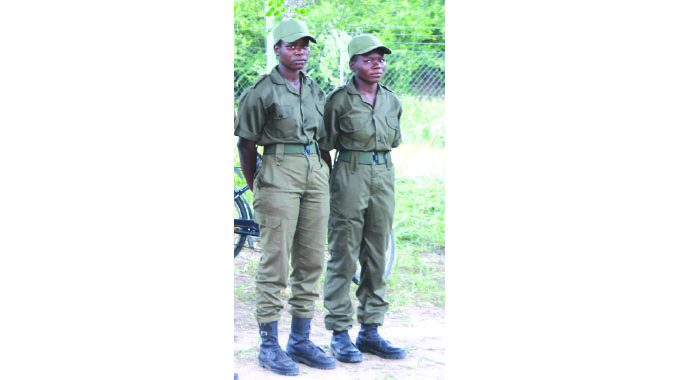
Fidelis Munyoro recently in Binga
IT is mid-morning in Sinakoma village in Binga. The sky is a vast expanse of cobalt blue and the sun’s rays heartlessly send plummy white clouds scurrying for cover at a distance.
Here, the heat has imbibed moisture from mother earth.
It is baking hot.
People and their livestock feel sweltering heat.
In the dense savanna forests, wildlife from huge mammals to birds and little everything else like cicadas, fight for survival.
But for 20-year-old Trinity Mugande, it is a normal mid-morning.
As she walks out of her mud-and-pole grass thatched hut, the deep green camouflage of her dressing make her blend with the verdant forest on the fringes of her village.
In trots and half-trots, Mugande hurriedly saunters to a well-beaten narrow path to a rendezvous where she joins her colleagues for parade under the vigilant eye of their commander, Peter Mdenda.
After the inspection, the team comprising four men and two women get their orders from the commander, who split them into pairs. They embark on their daily routine of patrolling the local area.
Mugande, from Sinakoma village, is one of the 18 young women and men who were selected to undergo training as Natural Resources Monitors at Mushandike Wildlife College in Masvingo, last year.
Now, she has hope for a better future after acquiring an NRM certificate.
“I feel very much empowered,” she says with a smiling face. “I take this as a stepping stone to one day becoming a game ranger.
“I want to upgrade myself through supplementing for at least three subjects and apply for a job at the Zimbabwe National Parks and Wildlife Authority.”
Having grown up in the area where the communities co-exist with wild animals, Mugande says, the training she got enhanced her knowledge about conservation of biodiversity and the importance of sustainable use of wildlife and natural resources.
And the development of natural resource management roles to local communities is the thing she will always champion.
This, she believes strongly, is more than an empowerment to the local people and the future generation.
“Once you have the ownership of your resources you become accountable and sustainably use such resources thinking about the future generation,” she says.
Her workmate, Chipo Munsaka, echoes the same sentiments.
She feels that allowing communities to have control of their natural resources will change the face of Binga, which has been on the outer edge of the country’s economic development for decades, given its geographical location in the Zambezi valley escarpment.
But the coming in of Sustainable Wildlife Management (SWM) Programme ostensibly transformed the mind-set of the communities, who now appreciate the significance of wildlife and natural resources in their areas.
SWM Programme follows a community rights-based approach, which puts people’s rights at the centre of wildlife management.
Local community participation and involvement is critically important and all SWM activities require the free, prior and informed consent from the local population before activities begin.
“Ever since we completed our 21-day basic training last year, we embarked on sensitizing our communities on the sustainable use of our natural resources,” says Munsaka.
She, however, believes that given their background of growing up in communities that co-exist with wildlife, coupled with the basic skills they have acquired, the National Parks and Wildlife Authority must consider them for employment.
“We know what most of the game rangers do,” says the pint-sized 20-year-old girl. “Some of the things we knew before we even went for training. There is nothing much new. If there is anything, we need a few panel-beating to fit into their operations.”
Sustainable use of biodiversity benefits people and enables species and ecosystem conservation.
To help protect wildlife, it is important for communities to understand how species interact within their ecosystems and how they are affected by environmental and human influences.
SWM programme technical assistant, Mr Maxwell Phiri, says they are working with Binga local authority in pushing forward their agenda on community conservancies.
“We need to support the communities where possible and within the framework of the law of the country in regard to governance of the wildlife they have here because without institutions of governance it is difficult to achieve the co-ordinated management of wildlife,” he says.
“SWM programme has done a number of activities in the past but moving forward, the thrust is to capacitate the communities in having an institution that will guide them in terms of managing their wildlife resources.”
Around the world, overhunting for game meat is threatening wildlife species with extinction.
As wildlife populations decline, many rural communities and indigenous peoples are being left without food and an income.
The situation is becoming more critical as the demand for wild meat grows in towns and cities.
But Mr Phiri says they will work closely with the local authority and see the options and scenarios that work well in the context of Binga district, to ensure that the project is a success.
“We are drawing this mainly from the experience we have seen elsewhere,” he says, citing Namibia that has successfully implemented the community conservancies concept.
In Namibia communities were able to put in place water infrastructure and bought agriculture equipment and machinery from the proceeds of the revenue they realized from wildlife management.
“They are empowered at their level to control their wildlife resources,” says Mr Phiri. “So, we have confidence that the environment becomes empowering in the country, in terms of the law, and see the communities getting to a different level than they are now.”
SWM Programme KaZa Site communication officer, Mrs Martha Katsi, weighs in saying the landmark project will aid animals and natural resources by communities while also providing increased benefits to local communities.
Community conservancies are about local people’s rights to use their natural resources for their own purposes.
They (conservancies) contribute crucial local knowledge of the area, provide manpower and finances for wildlife monitoring efforts, and decide if they wish to use their hunting quotas.
Other conservancy roles include reducing poaching, monitoring the hunting off-take, and land-use zoning to minimise human-wildlife conflict and demarcate exclusive wildlife areas.
Elephant attacks make up the bulk of attacks followed by crocodiles, lions and buffalos.
In 2021, about 90 percent of people who died in human-animal conflict in Zimbabwe, were killed by elephants.
Zimbabwe Parks and Wildlife Management (ZimParks) said last year there were 72 deaths and 50 injuries against 60 deaths and 40 injuries in 2020.
The rise in human-wildlife conflict cases was fuelled by lack of resources to provide watering points within game reserves, poor infrastructure and poaching activities around wildlife sanctuaries.
And local community participation and involvement could be the answer to reducing the impact of human-wildlife conflict on livelihoods and the conservation of wildlife resources.


 Online Reporter