Chronicle Editor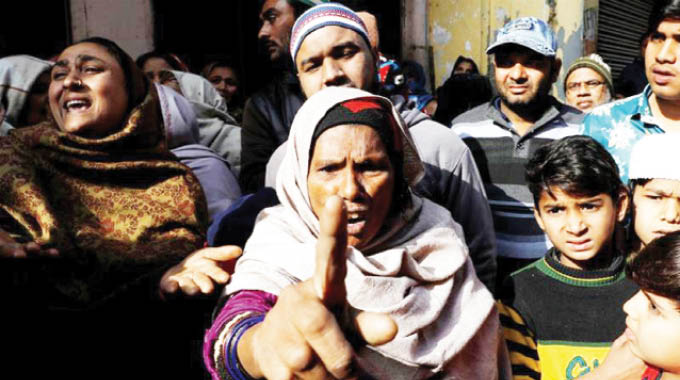
Indian authorities have stepped up security in major cities and mobile data services were suspended in some places amid nationwide protests against a new citizenship law.
The administration of Uttar Pradesh, India’s most populous state, banned mobile internet services in many parts of the state on Thursday night, including the provincial capital Lucknow, the state government said.
Some television channels reported that police had imposed emergency law in some parts of the capital, New Delhi, that prohibits gatherings.
Such prohibitions have been in place for more than a week in Uttar Pradesh, which has witnessed the worst crackdown. The state’s police force has been accused of killing 19 people there, most of them Muslims.
At least 27 people have been killed in protests across the country since the Citizenship Amendment Act was adopted on December 11. The law is seen as discriminatory towards Muslims, who make up about 14 percent of India’s 1.3 billion population.
The legislation makes it easier for people from non-Muslim minorities in Afghanistan, Bangladesh and Pakistan who settled in India prior to 2015 to get Indian citizenship.
Critics say the exclusion of Muslims violates India’s secular constitution by making religion a basis of citizenship.
The backlash against the law pushed through Parliament by the Bharatiya Janata Party (BJP) government of Prime Minister Narendra Modi is the biggest challenge he has faced since he was first elected in 2014.
Violence peaked last Friday as police clashed with protesters in several cities, especially in Uttar Pradesh, where Muslims form nearly 20 percent of its 204 million people.
More protests were held yesterday, with hundreds demonstrating at New Delhi’s historic Jama Masjid, where a protest march last week ended in violence.
In Mumbai, India’s financial capital, authorities denied protesters permission to conduct a 6-km (3.7-mile) march. Elsewhere in the city, the BJP held a rally in support of the law.
Meanwhile, distrust and anger among Muslims in areas where most deaths happened have deepened, as protests against the law enter their third week.
In Uttar Pradesh’s Meerut town, 70 kilometres from New Delhi, Zaheer Ahmed had just returned home from work on December 20 and stepped out for a smoke before lunch.
Minutes later, he was dead, shot in the head.
His death, and the killing by gunfire of four other Muslim men in the same afternoon in the mainly Muslim neighbourhood, made it the most intense burst of violence in two weeks of protests.
The families of the five dead men say they were shot and killed by police as a protest flared against the new law.
Reuters said it could not independently verify those accounts, and none of the more than 20 individuals the agency interviewed saw police open fire.
Police say they used baton charges and tear gas, and opened fire to control the crowd but did not kill anyone. Polie added that the men must have been killed by violent armed protesters whose shots went astray. An investigation into the violence is under way.
Residents say police broke several security cameras in the area before the violence began.
Reuters was unable to independently verify those accounts but did review security camera footage from two cameras at shops in the area. In both cases, the footage ends abruptly after a policeman waving a baton is seen trying to hit the cameras. — AFP


 Online Reporter