admin
admin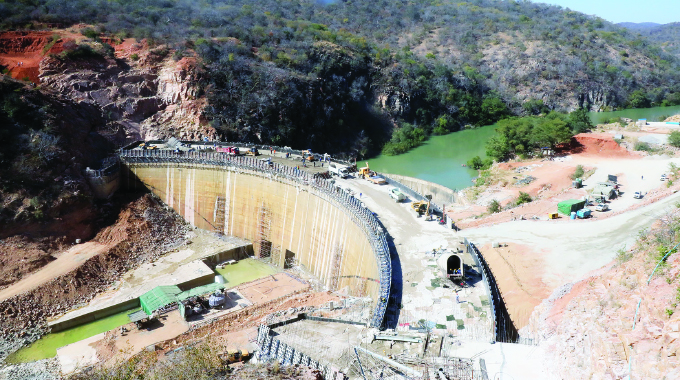
Precious Manomano Herald Reporter
Zimbabwe’s massive investment in dams and irrigation has shown that the country is in the right direction as it has begun to enjoy the fruits with a record wheat production of about 375 000 tonnes being realised last year from 80 000ha and that created home-grown carryover stocks as well as meeting local demand for the first time ever.
But after scaling up the hectarage to 86 000 this year with more progressive interventions by the Government led by President Mnangagwa, there are hopes of an even higher output in the region of 420 000 tonnes this year.
The Second Republic has continued to make investment in infrastructure such as dams and irrigation as a solution to economic growth with results in the agriculture sector beginning to show an upward trajectory.
The year will go down in history as the farming season where Zimbabwe once again recorded its highest wheat harvest since production of the cereal started in 1966. And this time enough wheat is being grown to allow exports for the first time.
All these efforts of the Government’s Agriculture Recovery Plan are aimed at boosting food security and nutrition in line with Vision 2030 which has been anchored by the National Development Strategy 1.
Government also promulgated a policy position wherein every off-taker of agricultural commodities is obliged to support local production of at least 40 percent of what they require annually. Such kind of localisation of agricultural value chains support the “grow local and buy local” mantra that resonates with the import substitution thrust. This is strategic in driving more investments in production support by the private sector.
This means millers and others in the agro-industrial value chain usually need to contract farmers to grow their raw materials, although there are other routes open that involve detailed co-operation with the Ministry of Lands, Agriculture, Fisheries, Water and Rural Development. We saw this at the beginning of the last season with a major oil seed processor linking up with the ministry to boost several fold the production of sunflower.
The Ministry is driven by the need to ensure maximum land use, which is indeed the hallmark of consolidating the gains of the land reform programme, as such, it is also finalising the Zimbabwe Agriculture Investment Plan and the Agriculture Investment Prospectus to attract more investment into the sector.
Private sector participation in food production enabled the country to attain food security with a slant towards self-sufficiency in all products, with positive spin-offs in employment creation, increased raw materials supply to the industry and import substitution which result in significant savings in foreign currency every year. After local needs, including reserves and carryover stocks are met, then exports become possible.
A framework of crowding in the participation of banks in supporting local primary production was consummated under the banner of National Enhanced Agricultural Productivity Scheme (NEAPS) and rolled out in 2020-2021.
Teaming up of banks and the private sector including the Food Crops Contractors Association led to a combined contribution of 85 percent (close to 70 000ha) of the record wheat planted (80 000ha) in 2022.
Following the success of the wheat production last season, the value chain has the potential to increase its production reaching national sufficiency and export the surplus. The Russia and Ukraine conflict has revealed the need for nations to rely on locally produced food as these two countries used to be the major wheat producers globally and the conflict meant disruption of food supplies.
Zimbabwe is considering exporting surplus wheat to Mozambique from this year’s anticipated harvest of 420 000 tonnes, well above the country’s requirements of 360 000 tonnes a year.
Speaking during a wheat field day at Mema Estates in Banket, Mashonaland West recently, Secretary for Lands, Agriculture, Fisheries, Water and Rural Development Dr John Basera said farmers should take advantage of massive markets that are in Mozambique to increase output. Conflicts in Eastern Europe have taught Africa to look more inward, since Russia and Ukraine control 30 percent of global wheat supply, but the product cannot move seamlessly from those countries due the disturbances.
“This time we want to export wheat for the first time. Just because we did it last year, we have to do it again this year,” said Dr Basera. “Recently, a delegation from Mozambique visited Mashonaland West so that they can appreciate how we grow wheat. There is a big market in Mozambique so we need to aim for that. We need to produce our own food as Africa.” Dr Basera said for the country to stand a good chance to attain Vision 2030, that of an upper middle income society, there was a need to crowd in participation of the private sector.
This year, the private sector funded 23 000 hectares out of the targeted 25 000 hectares, which is encouraging. Mashonaland West was praised for doing well in wheat farming, adding that the province planted wheat on 27 000 hectares out of the 86 000 hectares national hectarage for this year.
A survey carried by Herald in Mashonaland west revealed that wheat condition is currently in good condition and is at vegetative stage although farmers are afraid of veld fires and qualia birds menace.
Statistics from Agricultural and Rural Development Advisory Services (ARDAS),indicate that 57 percent of the crop is coming from A2, 13 percent from A1 and 11 percent from large scale while 10 percent was planted by women farmers
A farmer at Mema Farm, Mr Cleopas Mhakayakora, said wheat is a crop which does not require more effort but correct good agronomic practises are needed for one to produce quality wheat.
He said pests are the only threats in wheat production urging authorities to scale up efforts to reduce them.
”Some of the fertilisers do not respond well to the type of our soils so this year we made an arrangement with experts to prepare fertilisers that suit our soils. Our crop has changed and we are hoping that this year we can produce between 6 tonnes to 7 tonnes per hectare. We appeal for authorirties to interfere and control quelea birds,”he said.
Another farmer, Mrs Rudo Makoni of Raffingora, said veld fires and quelea birds were the only threats in wheat production, adding that if controlling measures are implemented and strengthened, a bumper harvest is likely to be achieved.
“We are happy that so far, there no serious power cuts and we appeal to authorities to implement measures that will control veld fires and quelea birds because these are the only menaces we are afraid of otherwise we are sure that this season we can do it again,” she said.
Government has been targeting increases in wheat production to meet the national requirement in line with the Agriculture and Food Systems Transformation Strategy, the Agriculture Recovery Plan and the National Development Strategy 1 for the attainment of a prosperous and empowered upper middle income society by 2030.
While maize and traditional grains are largely dry land crops in Zimbabwe, and so decent reserves and carryover stocks have to be part of the planning so the country can cope with a drought, wheat is almost entirely an irrigated crop. This means that output can be precisely calculated long before the first seed is planted. So long as dams and acquifers have enough water, farmers can grow the crop with yields again fairly precisely calculated. This means carryover stocks need largely to be at the useful level, a couple of months or so, and that means wheat might well be the first grain crop to resume exports.
Zimbabwean farmers are given guaranteed markets and preset prices, but generally are paid at least global wheat prices and usually a bit more to cover their irrigation costs, with East European farmers getting enough free water from snow and rain not to need pumps. But the very short distances from a Zimbabwean farm to a Zimbabwean miller means there is some slack in the transport costs to cope with this without undesirable subsidies to either producers or consumers. This though means that export markets have to be about the same distance away, hence the targeting of Mozambique where the main centres of demand are very close to Zimbabwean farmers so the same sort of slack in transport costs makes the landed price in say Beira very competitive, along with the guaranteed supply.


 Online Reporter