Online Reporter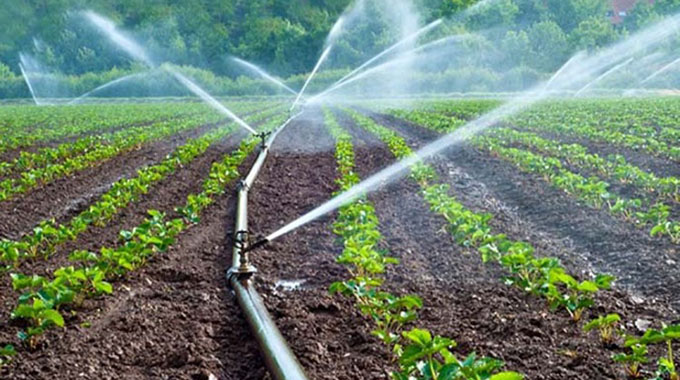
Theseus Shambare Recently in MWENEZI
IN Mwenezi District — long associated with drought and hunger — something extraordinary is growing: not just crops, but hope, dignity and resilience.
Where cracked soils and failed harvests once told a tale of despair, neat rows of green maize, sugar beans and now even winter wheat stretch across the arid landscape.
This transformation is thanks to the Pikinini-Jawanda Irrigation Scheme, a flagship model of climate-smart agriculture that is reviving both land and livelihoods in one of Zimbabwe’s driest provinces.
Situated in Agro-Ecological Region V, where rainfall is often too sparse to sustain even subsistence farming, the scheme is a long-awaited dream finally realised.
The idea dates back to the early 1980s, when Manyuchi Dam was constructed nearby. For decades, however, the water sat idle while surrounding villagers waited — and prayed — for rain.
Fast forward to 2020.
With close to US$1.1 million in funding from the Green Climate Fund (GCF), the Government of Zimbabwe and the United Nations Development Programme (UNDP), the sleeping giant was awakened.
The project was implemented under the broader “Building Climate Resilience of Vulnerable Agricultural Livelihoods in Southern Zimbabwe” initiative.
A media tour recently was an eye-opener. Today, the 156-hectare irrigation scheme — equivalent to more than 230 soccer fields — directly supports over 300 households from Pikinini and Jawanda villages.
For people like Mavis Chauke, the scheme has changed everything.
“Before this scheme, we would wait for clouds and still have nothing to harvest,” she said, her voice full of conviction as she stood next to a flourishing green maize crop.
“Now, we can farm throughout the year.”
For Eurita Mahove, food insecurity used to be a daily burden.
“These days, my children are well-fed,” she said with a smile.
“We even sell the extra produce and buy what we need. It’s not just farming — it is a livelihood.”
Remarkably, despite Mwenezi’s long history as a “rain-cursed” district that traditionally grew only drought-tolerant grains like millet and sorghum, farmers at the scheme have ventured into new territory.
This season, they have planted over 50 hectares of winter wheat — a rare crop in the region made possible only through reliable irrigation.
This diversification signals a seismic shift in local agriculture, one that could unlock new markets and income streams.
The game-changer?
A floating pontoon abstraction system that draws water from the Manyuchi River.
Unlike traditional fixed pumps that often fail in low water levels, the pontoon system adjusts with the river’s fluctuations, ensuring constant water access — even in dry spells.
This innovation is critical in a district that, according to the CLAFA-2 climate risk report, is among Zimbabwe’s top five most climate-affected, with over 70 percent of households requiring food aid.
From Desperation to Climate Resilience
Smart technology has been pivotal to the scheme’s success.
More than 40 percent of the irrigated area is under centre pivot systems, while the rest is watered via semi-portable sprinklers — both of which minimise water wastage and maximise crop yields.
Mercy Vambire, a young farmer, is one of many locals who now sees agriculture as a permanent profession.
“I no longer want to leave Mwenezi in search of jobs. Farming is my career now,” she said confidently.
Supporting this transition from traditional to commercial farming is Jonah Bukuvani, an irrigation business advisor with ARDAS, the Agricultural and Rural Development Advisory Services.
“This is not just about giving people water,” Bukuvani said.
“It is about empowering them with knowledge, skills, and the mindset to treat agriculture as a business.”
The scheme is no isolated success story — it forms part of a larger national effort to climate-proof Zimbabwe’s agriculture.
Lands, Agriculture, Fisheries, Water and Rural Development permanent secretary Professor Obert Jiri said:
“Our goal is to have 350 000 hectares under irrigation by 2025, up from about 173 500 hectares in 2020.
“Irrigation is how we climate-proof our agriculture, guarantee food security and drive economic growth.”
He added that such programmes form the backbone of National Development Strategy 1 (NDS1) and align with Vision 2030, which aims to make Zimbabwe an upper-middle-income economy.
“Irrigation will help us produce at least 1.8 million tonnes of summer cereals, reduce food imports and catalyse rural industrialisation,” he said.
Schemes like Pikinini-Jawanda are central to this strategy — proving that smallholder farmers, with proper support, can thrive commercially and contribute meaningfully to national food security.
One unique aspect of the scheme is the public-private collaboration at its core. Farmers are working with SeedCo, a leading agricultural input supplier, through a contract farming arrangement for seed production.
The entire 156-hectare irrigation scheme is now fully functionalvand as part of its cropping plan, 30 hectares have been dedicated to seed sugar bean production under this partnership.
Wendy Madzura, a chief agronomist with SeedCo, explained: “After seeing great things being done here, we saw it fit for us to associate ourselves with these organised farmers.
“We have entered into a contract farming agreement with the Pikinini-Jawanda Irrigation Scheme to produce certified seed for sugar beans.
“SeedCo is committed to buying the entire yield, provided it meets our quality standards. This arrangement gives the farmers a guaranteed market and fair pricing, while we secure a reliable supply of high-quality seed.”
She added that SeedCo also provides technical assistance, seed inputs and agronomic guidance throughout the growing cycle to ensure the crop meets certification requirements.
This partnership, she said, is transforming farmers from vulnerable producers into strategic players in the national seed value chain.