admin
admin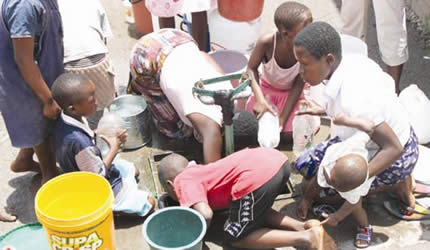
like black coffee or strong tea. Looking closer, one discovers that it is, indeed drinking water. The colour insults the eye and sends the stomach rumbling. Is this article an excerpt from a hydrological report prepared after a heavy storm? No! It is a nightmarish chronicle of the type of water residents of Harare are expected to drink by the beleaguered city council.
One can be forgiven for assuming that ground water has found its way into the water pipes via a broken pipe and comes out through taps neatly installed in several homesteads.
The failure by the city council to deal effectively with problems being brought by outdated water pipes and storage tanks is an affront to fundamental rights of the people of Harare who are often required to pay ridiculous for rates. The drilling of boreholes by some at their homes has saved them from the nightmare.
The proliferation of water-borne diseases such as typhoid and cholera has been blamed on the contaminated water. The well up have saved themselves from the misery of drinking smelly and brownish water, by buying the most precious liquid from the water bottling companies. What it simply means is that the city council is failing to deliver and its service delivery strategy is certainly questionable.
What with reports of the powers that be squandering taxpayer’s money on luxuries while its “house is on fire”. Kuwadzana Extension is located 14km west of Harare along Bulawayo road, home to about 5 000 households and an estimated population of 17 000.
This community is being serviced by a single borehole sunk at Kuwadzana 8 Primary School after people complained of stomach problems, which they say is caused by drinking contaminated water. Unfortunately, the borehole does not have the capacity to serve the whole community including the primary school.
Other residential areas in Harare have benefited from an Unicef initiative that has witnessed the drilling of boreholes to circumvent water woes. At least 4 000 people reportedly died in Zimbabwe in 2008 as a result of water-borne diseases. Kuwadzana Extension is one of the residential areas which did not benefit from the Unicef scheme; hence it is at the mercy of the council’s miserable service delivery.
“The water cannot be used for laundry as clothes with light colours will be tinted. We are now using borehole water to wash light coloured clothes, but it is very difficult to get because of long queues. We stopped using tap water a long time ago but surprisingly we are billed by on monthly basis by the city council,” complained Mrs Loswitter Chipfunde, a resident of Kuwadzana Extension.
The complaints that the city cannot offer services to residents because of lack of capacity and financial muscles, is in light of the above, a flimsy excuse for incompetence. Another resident, Moses Phiri, said tap water is negatively affecting residents and called on the powers that be to intervene and save them from a looming health hazard. “I only use this water to irrigate my vegetable garden as it is not fit for drinking.
“Each time I use tap water for bathing I will have an itchy feeling all over my body and I suspect that it is caused by the brown substances coming out of the tap,” he said.
He added that sustainable measures must be put in place and shun the blame game currently being enjoyed by the city fathers at the expense of the lives of people. He further highlighted that the council must stop citing inadequate funding as the cause of this problem as it is now an old trick dull with overuse.
“We are paying for the water that we are not using and the council is being insensitive for demanding payment for this brownish water. “We are now spending most of our time queueing for water at the borehole and we want the council to stop demanding bills from us,” said another resident of Kuwadzana Extension who identified herself as Nyasha.
She added that she is interested in knowing the impact of the rust-like substances coming out of taps. Too much has been done to push the city to put its house in order but it would seem that the advice is falling on deaf ears as the shoddy services are now the order of the day.
This seemingly contagious attitude has not spared even the city’s public relations lieutenants. Efforts by this reporter to get an explanation from Harare City Council were fruitless as the public relations department professed ignorance, choosing to say they had other important matters to attend to and they are not at liberty to waste precious time. Journalist work on a hunch and failure by a public figure to attend to media requests is very shameful and gratuitous.
City council’s public relations department’s diplomatic stance has cost the residents of Harare their lives for too many a time. Such an attitude makes it impossible for the media to inform the public on issues of service delivery and measures being taken to address obtaining problems. The Press always find it a challenging undertaking to perform its surveillance role and the public will not be alerted on impending health risks. The Ministry of Water Resources Development and Management decided to join the city council in singing the excuse tune, choosing to distance itself from issues to do with provision of water to residence.
“No, it is not our responsibility, the city council owns water works hence is answerable to anything on this matter,” said a source in the ministry (name withheld). The fact that city councils fall under the ambit of the ministry’s responsibilities raises more questions than answers.
One wonders if this is a reflection of the poor intergovernmental relations that have resulted in the suffering of the residents. The public is always disadvantaged as it will be lacking important information imperative to their day-to-day survival.
The situation on the ground shows that there is no solution in sight from the responsible authorities and residents must not expect any form of salvation either.
There is need for a paradigm shift in the way things are run at the city council if a sustainable solution is to be found to Harare’s unending string of problems.


 Online Reporter