admin
admin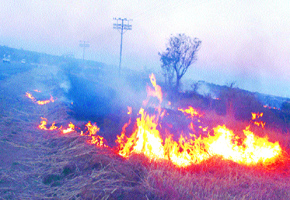
That means, in fact, less food for the world’s human population whose phenomenal increase will have to be curbed sooner than later as some nations can no longer feed themselves due to repeated spells of drought.
What do we understand by climate?
Climate means the atmospheric conditions of an area as recorded during a period of usually not less than 50 years. The elements that make the climate atmospheric conditions are sunshine, wind, temperature and moisture.
Climate does not mean the same as weather in that the former means the average weather conditions over a long period whereas the latter simply means the atmospheric condition of a country, area or region at any given time such as a day or two.
Climate is also vastly affected by the latitude in which lies the area concerned, and so does the region’s altitude. Both these greatly affect the temperature of the area.
In both cases, we should remember that the source of heat that affects the earth is the sun. Regions that are close to the equator receive heat from the sun’s rays that are more vertical than those further away, and are thus, hotter.
It is for this reason that all regions lying near the equator, that is to say the tropical areas have higher temperatures than those situated far away from the equator which, because they are not directly under or very near the sun, receive its oblique rather than vertical rays.
In fact, within the tropics, the sun’s rays spread over less than just about half the surface that it covers within the polar circles. The polar circles are about 6 400km farther from the sun than the equator.
Another important factor that influences the temperatures of regions is their height above sea level, or altitude. The earth is covered by a sort of umbrella of air through which the rays of the sun pass very easily to reach and warm up the earth’s surface, the seas and oceans.
The same air umbrella does not, however readily allow the radiated sun’s heat to return whence it came but keeps it in either the soil or in the water. As we move higher up from the sea level, we get into thinner air. That simply means we are leaving a thicker blanket of air with more heat as we ascend into higher altitudes with thinner air, thus with less heat. It is because of this scientific fact that geographers say: “The higher you go, the cooler it becomes.”
It is much cooler at the summit of Mt Everest than down below on the banks of the River Ganges or at the mouth of the Zambezi precisely because of this fact.
It would appear, however, that this basic scientific fact is now being adversely affected by industrial smoke, fumes and smog which are heavily laden with dangerous gases such as carbon dioxide.
These gases, especially carbon dioxide, have the power or the effect of trapping the sun’s warmth in the lower atmosphere of the earth because they are more transparent to solar radiation than to the reflected radiation from the earth. These are what are called greenhouse gases, and their accumulation results in higher temperatures particularly where they occur, but generally globally as well.
An accumulation of greenhouse gases negatively affects (atmospheric) humidity, evaporation and inevitably rainfall patterns.
As already stated, sunshine is also adversely affected by these gases, resulting in negative effects on plant life and human ecology.
The wind is of immense importance to the world’s climatic conditions in that many regions depend on rain brought by moisture laden winds that would have blown across warm ocean currents. But for those winds to deliver the rains they have to be deflected upward to cooler atmospheric regions.
The deflection could be caused by high mountains or thick forests. Should the forests be destroyed for whatever reason, the winds will blow across unhindered taking the much needed moisture away with them. But if there is a forest or a reasonably high range of mountains or hills such as the Zimbabwean Eastern Highlands, the winds are deflected to the higher cool atmospheric levels where they condense and then rain falls.
Destruction of forests occurs either as a deliberately planned industrial or social development programme or as a result of irresponsible arsonists who cause veld fires.
Many natural and man-made forests such as those found in Swaziland and Australia have been destroyed this way creating two climatic hazards: a massive accumulation of greenhouse gases and a destruction of wind deflection barriers.
Moisture as an element of climate is vital to certain types of plants whose foliage or bulbs or dark or tubers are eaten by some animals and insects. The circulation of the wind, all natural factors being equal, plays a major role in creation and maintenance of moisture as vapour or in a condensed or solid condition on the earth’s surface.
Industrialisation and uncontrolled population increase are two factors that play a role in the deterioration of the world’s climate.
That as it may, some people who strongly believe in the theory of evolution think that the perceived climatic changes are merely a continuation of that process climatically.
They refer to geological fossil studies that divide the past into three periods: the Paleozoic Era which obtained on the globe from about 960 million to about 480 million years BC. During that time, fish and some mollusks comprised what existed as life.
They could have been some terrestrial vertebrates as well but most living things were aquatic and the terrestrials were not mammals.
The Paleozoic era was overtaken by the Mesozoic Era, occurring from about 320 to about 120 million years BC. During that time dinosaurs are believed by fossil historians to have roamed and ruled the world.
The Mesozoic Era gave way to the Cenozoic Era which lasted from about 80 million to about 40 million years BC when some terrestrial, warm blooded animals dominated the earth. There is a school of thought that holds the view that warm blooded vertebrates (not necessarily mammals) emerged towards the end of the Paleozoic era.
Early humans emerged towards the end of the Cenozoic Era, shortly after the horse and the donkey had begun to neigh and bray as they grazed in warm lush plains
The Cenozoic is also called “Cainozoic” Era, both orthographic variations being derived from two Greek words: “Kainos” which means “new”, and “zoion” which means “animal”.
The new animals emerged because the climatic conditions had become warmer than before. Could it be that the world is slowly but inexorably moving (as it were) to another climatic era?
l Saul Gwakuba Ndlovu is a Bulawayo-based retired journalist. He can be contacted on cell 0734328136 or through email [email protected]



 Online Reporter