

 admin
admin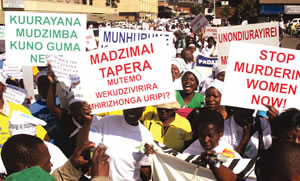
Vaidah Mashangwa
ONE magazine alluded to the fact that indeed barricades have fallen for women and for the first time women have won their battle for gender equity and equality. For the first time the world over women seem to claim what they have lost over the years be it in the social, political or economic arena.
Accordingly, women can now enroll at any college or university, own land, join any law firm, pursue courses of their choice, be at any decision making position both in the public or private sector, apply for credit at any bank and venture into any business activity, the list is endless.
It seems there are too many opportunities for women that some men feel threatened. Women have become powerful leaders, business persons, bankers, engineers, pilots, managers and so on.
The Zimbabwean legislation is also very supportive of the women agenda as postulated in the new Zimbabwe constitution. According to section 17 there shall be no discrimination. Never in the history of mankind have gender issues been highlighted in such a vivid and profound manner.
Amidst all this, one author pointed out that while women are ululating, behind the scenes women are actually suffering in silence from numerous hidden problems. These include among others infertility, loneliness, man shortage, stress disorders, breast and cervix cancer, lack of capital, divorce, domestic violence just to mention but a few.
An answer ought to be sought. In other words women seem to be enslaved by their own liberation. While they are liberated, they have meagre savings, eating disorders, they carry out abortions, commit suicide, wear hip enhancing costumes, apply skin lightening creams and they are enslaved by pornography. The question is, are women really free?
Of course I do not agree with an attorney general who maintained that women have more opportunities than before as such they get raped and are easily exploited. He maintains that unlike before there are more women now at work places, colleges and universities and they are more liberated than before and as such they travel on their own in the evening and they come home late. Surely to rape women because they are independent is not justified.
Some authors argue that gender inspired legislative reforms have stripped women of special protection as there are equal rights and opportunities with their male counterparts. Some women have also applied the equality issue into their marriage and motherhood thereby bringing misery and suffering into their once concrete and stable unions and marriages.
It has been observed that some women have fast tracked the issue of gender equity and equality to the extent that they have lost their identity as wives, mothers, aunts and grandmothers. Some relatively independent and educated executives have to bear solitary nights and closet drinking due to loneliness as men keep a distance from them. This has created sugar mummies in some instances and a lot has been published about the issue in the print media of late.
The book Blame it on Feminism highlighted that is there equality therefore when women are poorer than men? Why is it that women are still far more likely than men to live in poor housing and twice as unlikely to draw pension? If women have it all, then why don’t they have the most basic requirements to achieve equality in the work force? If there is equality how come very few women are in top-decision-making positions in both the private and public sector?
Maybe for now is it suffice to say that women are just liberated because most of their demands are yet to be realised? Progress yes. Improvements yes. Women should continue to press for their own advancement be it in the home, work and in the public spheres.
The debate continues as women’s reproductive health is in greater jeopardy today than a decade ago as expecting mothers still travel long distances to access pre-natal treatment or examination. At times they stay at hospitals while they await delivery, the case of Murambinda Hospital is a good example.
Apart from that, despite their freedom, women still shoulder 70 percent of the household duties. In addition in over 30 states, husbands still rape their wives and continue to physically abuse them leading to most injuries among women.
All this is an indication of how far women are from equity and equality issues. It seems the women’s rights war is still far from being won. In the political realm, the 50/50 representation is still far from being achieved considering that 2015 is just around the corner.
In the private arena divorced and single women continue to look after children on their own as men refuse to pay maintenance in some instances. According to research, the average amount men pay for maintenance has fallen by 25 percent from the late seventies to present.
It seems instead of progress, there is a continued counter-assault on women’s rights, freedom and attempts towards gender equity and equality. At times men and society are there to retract the small hard won gains and activities that women have tried to earn over the years.
There is sudden upsurge in what one author terms a laundry list of personal, social, political and economic problems for women. The laundry ought to be washed and ironed with urgency. At times according to social observers it might not be an issue of backlashing against women’s freedom and equality but the general societal resistance to women’s equal rights. Generally men and society have always been hostile to female independence and freedom. When women assume leadership positions some men feel threatened.
At times such symptoms subdue and resurface periodically depending with events at hand. If there is an election for an example, this triggers on as men grapple with real threats to their political and social wellbeing and masculinity.
All attempts to thwart women’s advancement shows that women have made progress and that their efforts have had an effect highlights feminist psychiatrists Dr Baher. However, a larger percentage of women are still typists, cashiers and tellers in departmental and fashion shops. Most of them are still in office supporting roles even in government departments.
It is high time society and men recognise that women are not decorative ornaments but that women have the ability to define who they are instead of having their identity defined for them. Soon equity and equality gaps will be something of the past.
l The writer, Vaidah Mashangwa, is the Provincial Development Officer in the Ministry of Women Affairs, Gender and Community Development, Bulawayo. She can be contacted on 0772111592, email: [email protected]


 Online Reporter