

 admin
admin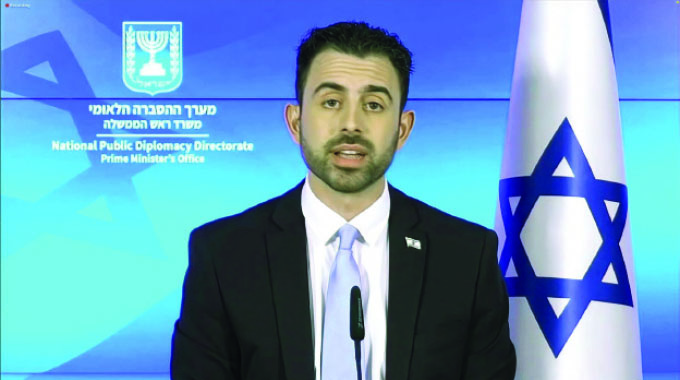
Gibson Nyikadzino-Correspondent
A few days ago, this writer and five other journalists from Ethiopia, Kenya, Nigeria and Tanzania were invited by the government of Israel on a four-day trip to “see the other side” of what some are referring to as war, but can be clearly understood as a genocide against the Palestinians.
Before setting off, in a conversation with an official from the Embassy of Israel in South Africa, she hinted that during this trip no one is going to be criminalised or censured for writing their views.
Of course, that was diplomatic talk.
Without fear of contradiction, from this writer’s perspective, the trip was a philosophical excursion that besides giving insights to the other side, also sought to ideologically conquer and intellectually paralyse critical African thought from creating liberating narratives about what is currently obtaining in the Gaza Strip against Palestinians.
It, therefore, becomes difficult for one to fully understand the state of affairs without an ideological lens to interpret why African journalists were finally remembered as a vital cog in this critical moment when international public opinion towards Israel is heading south.
Two things are clear, either the Israeli government is losing international credibility, or wants to use Africans to manufacture consent on its behalf.
Africans ought to be careful not to be co-opted or indoctrinated into believing there is salvation in venturing into narratives that do not fit their profile and history. It is also important to realise that it is irreconcilable for Israel to play a role as a regional hegemon in the Middle East and also play the victim card on the other hand.
Comparatively, where African journalists are expected to “see the other side” and know what is going on, conversations and interactions with the Israeli government spokesperson Mr Eylon Levy proved that he was not acquainted with events in Africa.
Therefore, how can African journalists be the ones to carry the Israeli narrative, when its government mouthpiece was not for instance aware of elections in the DR Congo?
Holocaust
From December 16 to December 20, 2023, the tour of Israel was a well-guided one, methodically and systematically executed to give an impression that sought to expunge existing ideological orientations. Before the October 7 attacks, Israeli forces had killed over 140 Palestinians resisting occupation.
First, we toured one of the 18 villages that were attacked by Hamas fighters on October 7; later met representatives whose family members were kidnapped by Hamas; watched a compiled 47-minute film of atrocities by Hamas fighters against Israeli civilians at the Israeli Defence Force (IDF) headquarters and later on visited the Holocaust Museum where there is documentation through books, video, pictures and other memorabilia of the holocaust against the Jews by Nazis in Germany and other territories they conquered.
The Jewish holocaust cannot be denied, it is condemnable and should not be wished on any people, group or race.
However, the methodology of the execution and implementation of military strategies by Israel and its disproportionate use of force and indiscriminate bombing of Palestinian civilians is tantamount to the same holocaust, genocide or ethnic cleansing under international law.
In these circumstances, facts on the ground are horrible. The inescapable tragedy common to both Israelis and Palestinians is that human suffering is happening on both sides. What can be debated is the magnitude of the human suffering.
In the Gaza Strip, Palestinians are being pounded by military hardware, thousands have been killed and 1,9 million people from the territory’s 2,2 million population have been displaced in that enclave and open-air prison. It is tragic and consequences facing both sides should be avoided.
Palestinian liberty,
Africa’s priority
In Africa, the history of oppression is understood from the days of colonialism. The struggle against colonialism is the premise on which Africans have generally been sympathetic to the issue of Palestinian liberation.
During the colonisation of the Congo Free State, Belgium’s King Leopold II killed and maimed more than eleven million Africans while the French killed more than one million Algerians in a colonial history that spanned more than 130 years.
Israel supported colonial regimes that entrenched the oppression of the black majority. It supported the racist regime in Southern Rhodesia, and the apartheid regime in South Africa and gave financial and military support to colonial dictatorships that resented majority rule.
Since 1948, the struggle for Palestinian recognition remains key in Africa’s quest to understand this situation. The situation is telling.
In Europe where governments have legislated laws banning solidarity marches with Palestinians, the same governments have been overwhelmed by the defiance of people sympathetic to Palestinians for as St. Augustine said “an unjust law is no law at all”.
Terrorism through ‘retaliation’
Of course, the October 7 attacks by the Hamas fighters, which are designated as a terrorist group by the USA, EU, Britain and Israel among other countries had ramifications in understanding the Israeli response to the attacks.
The genesis should therefore not be read from the October 7 attack, but as a 75-year-old struggle for Palestinian independence against apartheid occupation by Israel.
Hamas attacks on October 7 have been labelled “terrorism”. To designate one person’s freedom fighter as a “terrorist” is a familiar label that the West uses to denigrate the trajectory of liberation by the oppressed people.
As it stands, Israel is not winning against Hamas. To match Hamas, Israel has resorted to terrorism, or targeting civilians as a strategy. They intend to also subdue the Palestinian political ideology for it has become a genuine intellectual effort to find an answer to the challenges posed by the West’s cultural, political and economic dominance in the region.
What Israel is doing is terrorism through “retaliation”. As US media critic Norman Solomon said: “When terrorists attack, they are terrorising. When we attack, we are retaliating. When they respond to our retaliation with further attacks, they are terrorising again. When we respond with further attacks, we are retaliating again.”
What is Hamas’ idea?
To those who see Hamas as a terrorist group, its actions are condemnable.
Those who justify its actions embrace them. Hamas has shown that it is an ideology, an idea that will never die or perish.
It is projecting itself as a broad and diverse movement of resistance against Israeli occupation that has a cohesive and structured system that is no longer perceived as the lunatic fringe. Instead, they are now standard bearers whose language of resistance is the dominant discourse in modern Islamic political activism. Their idea of resistance, possibly, shall never die!
To African journalists from different paradigmatic persuasions, it is important to primarily view the ongoing situation in the Gaza Strip from a pragmatic, historical and colonial point of view by an occupying army against the oppressed.



 Online Reporter