admin
admin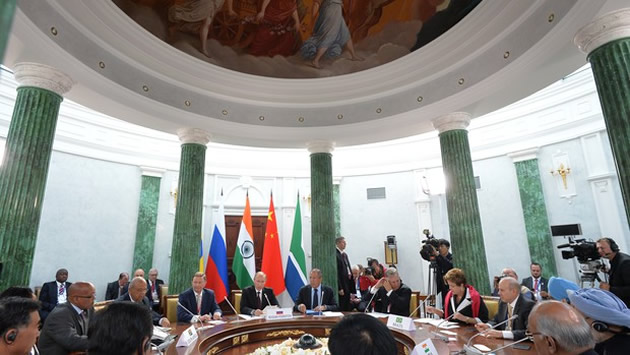
Pepe Escobar Correspondent
Fasten your seat belts: the information war already unleashed against Russia is bound to expand to Brazil, India and China. Brazil, Russia, India and China, as it’s widely known, are the top four members of the BRICS group of emerging powers, which also includes South Africa and will incorporate other global south nations in the near future. The BRICS immensely annoy Washington — and its think tank-land — as they embody the concerted global south push towards a multi-polar world.
Bottles of Crimean champagne could be bet that the US response to such a process couldn’t be but a sort of total information war — not dissimilar in spirit to the NSA’s deep state total information awareness (TIA), a crucial element of the Pentagon’s full spectrum dominance doctrine. The BRICS are seen as a major threat — so to counteract them implies domination of the information grid. Vladimir Davydov, director of the Russian Academy of Sciences’ Institute of Latin America, was spot on when he remarked; “The current situation shows that there are attempts to suppress not only Russia but also the BRICS given that the global role of this association has only intensified.”
Russia’s demonisation has quickly escalated in the US from sanctions related to Ukraine to Putin as the “new Hitler” and the resurrection of the time-tested Cold War scare “the Russians are coming”.
In the case of Brazil, the information war already started way before the re-election of President Dilma Rousseff. As much as Wall Street and its local comprador elites were doing everything to tank what they define as a “statist” economy, Dilma was also personally demonised.
Not so far-fetched steps in the near future might include sanctions on China because of its “aggressive” position in the South China Sea, or Hong Kong, or Tibet; sanctions on India because of Kashmir; sanctions on Brazil because of human rights violations or excess deforestation. Selected Indian diplomats, off the record, deplore that the first BRICS nation to buckle under pressure will be India. As the BRICS are the de-facto key bricks in building a more democratic, inclusive global system of international relations and financial system — there are no others in the market — at least they seem to be alert enough. If they are not, each nation is bound to be knocked out one by one.
Georgy Toloraya, executive director of the Russian National Committee on BRICS Research, points out that at least there’s “more and more communication taking place through BRICS channels today.” Brazilians, for instance, are particularly interested in investment co-operation. The BRICS Development Bank will be a reality in 2015. And a Russian team is preparing a detailed report on the future prospects of BRICS co-operation bound to be discussed in-depth in Beijing in over a week, concomitant to the APEC (Asia-Pacific Economic Cooperation) summit.
From energy war to currency war
The new Saudi oil shock — which got at a minimum a green-light by the Obama administration — totally fits the pattern of a TIA-style offensive against the BRICS, with two of them as key targets: Russia and Brazil. Over 50 percent of Russia’s budget comes from revenue from oil and gas. Every $10 drop in the price of a barrel of oil means Russia losing up to $14,6 billion a year. This may be offset somewhat by the weakening of the ruble — more than 25 percent against the US dollar since early 2014. And Russia of course still has around $450 billion in reserves. Still, Russia’s economy may grow by just 0.5 to 2 percent in 2015.
With each $1 drop in crude oil prices, Brazil’s number one company, Petrobras, loses more than $900 million. At current oil price levels, Petrobras will be losing around $14 billion a year.
So the price drop does undermine Petrobras’ long-term expansion to fund new infrastructure and exploration projects linked to its valuable “pre-salt” oil deposits. Petrobras was a key target linked to the demonisation of Rousseff.
Iran is not part of the BRICS but shares the group’s push towards a multi-polar world. Iran needs oil at $136 a barrel to balance its budget. A nuclear deal with the P5+1 to be struck in three weeks, on November 24, could lead to the easing of sanctions — at least from Europe — and allow Iran to boost oil exports.
Yet in Tehran there are no illusions about how the manipulation of oil prices has been engineered to further destabilise Iran’s economy and undermine its position in the nuclear negotiations.
On the economic front, TIA manifests itself via the Fed ending of QE (quantitative easing): this means the US dollar will keep going up, and more US dollars will be departing emerging markets. Xinhua has seriously tackled the issue. The US dollar and the yuan are effectively linked. When the US dollar goes up, the yuan also goes up. Yet it’s the Chinese economy that suffers. — RT
- Pepe Escobar is the roving correspondent for Asia Times/Hong Kong, an analyst for RT and TomDispatch, and a frequent contributor to websites and radio shows ranging from the US to East Asia.


 Online Reporter