Chronicle Editor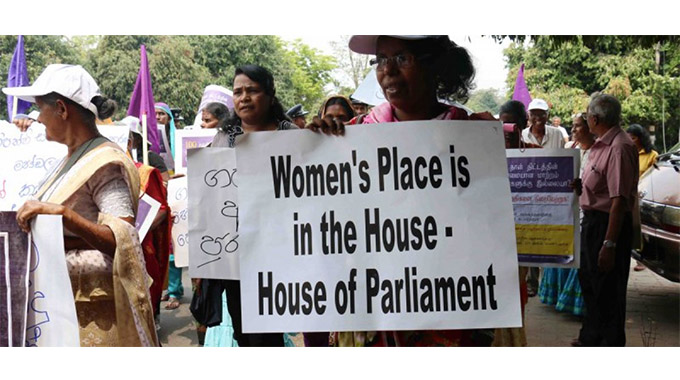
Gibson Mhaka, Senior Features Reporter
WHEN Racheal Mahlangu (21) from Bulawayo’s Mpopoma suburb declared her ambition to her family that when she finished her university education, she wanted to venture into politics and become president, her brothers burst out laughing saying she was daydreaming.
“The fact that I said I want to be a president they thought that the post is not meant for us women,” she exclaimed while clasping her hand over her mouth.
“This is despite the fact that women everywhere are breaking the glass ceiling in politics but their voices still go unheard and their contributions are too often sidelined. The power that females need in politics is still elusive and this has jarred the confidence of many women in their ability to participate in political processes”.
Racheal’s position in regard to politics is not isolated. It stands as a textbook example of how women are still seen as incapable of taking on responsibility in political spaces.
This is often the case in parliaments where women are given “women’s only” portfolios or only allowed to sit in women committees and are being pushed away from the other committees because of their gender.
At every socio-political level, women especially those in developing countries like Zimbabwe and others in the Southern African Development Community (Sadc) countries find themselves under-represented in parliament and far removed from decision-making levels.
South Africa ranks highest in the Sadc region in terms of representation of women in parliament with 45 percent, and is third in the global ranking.
A highlight of the 2018 Zimbabwe elections shows that all the 47 political parties that fielded candidates ignored the commitments to gender balance in the Constitution and national gender policy of Zimbabwe.
Out of the 47 political parties that fielded candidates in the National Assembly, only 27 fielded at least one woman candidate. Approximately 15 percent (243) of 1652 candidates contesting in the National Assembly were female and 146 women out of 290 candidates contested for Senate seats.
This is despite the country’s commitment to Sadc’s Declaration on Gender and Development which seeks 50-50 representation of men and women in parliament.
Research has shown that despite many countries signing and committing themselves to promoting gender parity in political participation, they end up shelving the agreements thereby leaving women to play outside the political ground.
The Government’s commitment to promote women’s inclusion in politics as enshrined in conventions, protocols and international agreements went a gear up at the inaugural Zimbabwe Local Government Association of Zimbabwe (Zilga) women councillors’ indaba which was held recently in Victoria Falls under the banner of the Women in Local Government Forum (WILGF).
In her presentation during the event which was officiated by President Mnangagwa, WILGF president for the Midlands chapter, Councillor Idirashe Dongo said the forum’s desire was to improve representation of women in local government as they have been on the margins of power for decades.
“Women’s representation at the local level is thus critical for prioritising women’s practical and development needs as well as localising the Sustainable Development Goals (SDGs) through policy decisions on education, primary healthcare, water and sanitation, transport and a host of other services.
“Accordingly, Women in Local Government Forum is appealing to you Your Excellency for consideration of our key concern. The same provision of extending a quota in the National Assembly be extended to local government with a 30 percent quota,” said Cllr Dongo.
She said women were being under-represented in local government in Zimbabwe despite the Constitutional provisions under Section 17 on gender balance.
President Mnangagwa welcomed the plea saying it was necessary to consider extending the women’s quota to councils.
The move by President Mnangagwa was of great concern because women have been relegated to the background politically for a long time, which made them lose their rightful place in local governance.
Cabinet has also considered and approved principles for the Amendment of the Constitution on proportional representation in local authorities following intense lobbying at the inaugural Women Councillors Indaba.
As noted in the 2030 Agenda for Sustainable Development (SDGs), women’s equal participation with men in power and decision-making is part of their fundamental right to participate in political life, and at the core of gender equality and women’s empowerment.
It is important to note that strategies to increase women’s participation in politics have also been advanced through conventions, protocols and international agreements for gender mainstreaming, but they are yet to prove effective in achieving gender parity in the highest government rankings.
Given the fact that many developing countries have ratified international conventions and protocols on gender equality and women political participation, the low level of women’s representation in government and politics may be considered as a violation of their fundamental democratic rights.
Zimbabwe Gender Commission Chief Executive Officer, Ms Virginia Muwanigwa said despite the fact that many governments and political parties have committed themselves to promoting gender parity in political participation, women have repeatedly been excluded from all areas of political decision-making.
“Although governments do commit themselves through signing the instruments, unfortunately, not enough will manifest to take advantage of emerging opportunities to reduce the gender gap. Even though, political participation already shows that a majority are women however, most leadership positions are in the few men.
“Governments have the responsibility to implement measures in line with the instruments but sometimes their constitutions, structures, electoral processes and outcomes do not align. When it comes to political parties their manifestos do but this is not translated into action,” said Ms Muwanigwa.
A report by the UN (2011) states:
“Women in every part of the world continue to be largely marginalised from the political sphere, often as a result of discriminatory laws, practices, attitudes and gender stereotypes, low levels of education, lack of access to health care and the disproportionate effect of poverty on women”.
Padare/Enkundleni Men’s Forum on Gender is also pushing for the enactment of electoral laws that compel political parties to implement the 50/50 gender representation in their structures before being allowed to contest in an election.
Padare/Enkundleni programmes development and fundraising manager Ms Thando Makubaza concurred with Ms Muwanigwa saying on paper political parties have brilliant gender policies which are however not being implemented.
“As Padare/Enkundleni we seek to achieve gender justice and this thinking came after realisation that there are few women that participate in politics and take decision making positions.
“Our thinking is that there should be laws that compel political parties to implement regional and international conventions such as the Maputo Protocol on Women’s Rights and Sadc Framework for Achieving Gender Parity in Political and Decision-Making Positions as well as the country’s and respective political parties’ constitutions,” said Ms Makubaza.
Women’s full participation in political and electoral processes originates in the principles of non-discrimination and equal enjoyment of political rights enshrined in the Universal Declaration of Human Rights (UDHR) adopted in 1948, the Convention on the Political Rights of Women (CPRW, 1952) and other regional conventions that explicitly state that the enjoyment of such rights shall be without distinction of any kind, including sex or gender.
A number of international human rights instruments also include provisions that recognise women’s political rights, in light of the principles of non-discrimination and equal enjoyment of rights.
A member of the African Women Leaders Network Zimbabwe National Chapter Resta Dzvinyangoma who is councillor and gender chairperson for Ward 1, Murewa Rural District Council in Mashonaland East Province, said fundamental to the constraints that women face in their participation in politics is an entrenched patriarchal system in which family control and decision-making powers are in the hands of males.
“Despite the fact that in Zimbabwe we are happy that our Constitution Amendment Number 20 of 2013 is one of the best in Sadc with provisions that promote or encourage gender equality in Zimbabwe, traditional beliefs and cultural attitudes—especially as regards women’s roles and status in society-remain strong, particularly in rural areas.
“Social norms make it more difficult for women to leave their traditional domestic roles for more public roles outside of the home,” said Cllr Dzvinyangoma who is also chairperson of Women in Local Government Forum in Mashonaland West.
It is worth noting that while legal and policy frameworks have been advanced for women to exercise their political rights, lack of awareness of the existence of these gender-sensitive policies is an obstacle to full enjoyment of their human rights and the attainment of equality.
Cllr Dzvinyangoma also alluded to the fact that although women’s equal and leadership participation in politics and governance is guided by strong UN, African Union, and Sadc Conventions and protocols women were still struggling enter politics due to lack of awareness of these legal and policy frameworks that are made for them.
Clerk of Parliament Mr Kennedy Chokuda said the legislature through the Zimbabwe Women’s Parliamentary Caucus (ZWPC) was promoting and sensitising all parliamentarians and members of the public on the principles related to gender equality in local, regional and international politics.
“A Women’s Parliamentary Caucus is a noble group and part of the work they do is sensitising female MPs, male legislators and members of the public of the various gender-sensitive protocols that we have signed as a country. Part of their duties is also to bring the messages of those protocols to the generality of the people and urging our government to domesticate those protocols because once a protocol or agreement is signed the next stage is to have it ratified by parliament so that the people can benefit,” said Mr Chokuda.
On the effectiveness of the sensitisation campaigns Mr Chokuda said:
“In my view they are effective because you don’t expect a change to happen overnight, it’s a process. As an institution, these are the things we are continually doing so that we get to all the people in such a way that they change their attitudes.


 Online Reporter