

 dyton mupawaenda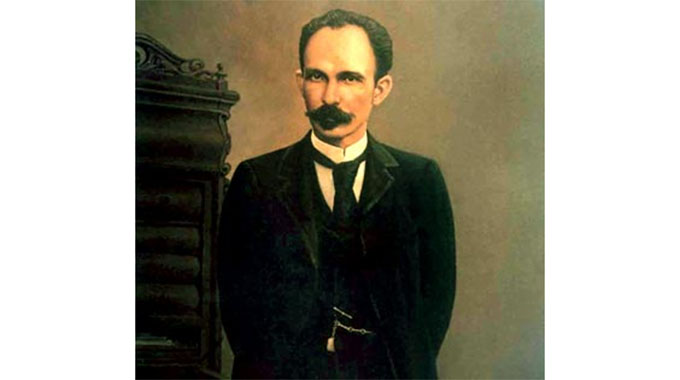
@Jamwanda2 on Saturday
Our Americas
I am reading Jose Marti’s essay, Our America.
Reading it for the umpteenth time. It continues to speak to me with the freshness and forcefulness of a newly penned piece. Yet the angry essay, written by this Cuban revolutionary, was written in the late 19th Century.
False erudition
There is this one paragraph in which Marti rails against borrowed minds, imposed models, artificially fastened and festooned on pretentious native personalities in colonial milieux.
For Marti, the struggle was never between civilization and barbarity, both states invented by narratives from the dominant West. The real struggle has always been between “false erudition and Nature.”
A people’s Thought
For Marti, Nature stood for everything indigenous, home-grown; the opposite of that which is borrowed, imported, acquired and thus artificially engrafted onto native personality.
Nature meant native thoughts, wisdom: the recognition that a People have a definite Thought which is native and inherent to them.
A worldview hewn out of centuries of home experiences, hewn in collective struggle against the elements, a struggle to tame flora and fauna in order to assume dominion.
In Yankee spectacles
Asserts Marti: “In a new nation, a Governor means a creator.”
He is referring to how nations emerging from a colonial spell should be governed.
I cannot think of anything simpler, yet so persuasive. He rails at Yankee copycats: “The young go out into the world wearing Yankee or French spectacles, hoping to govern a people they do not know. In the political race entrance should be denied to those who are ignorant of the rudiments of politics. The prize in literary contests should not go the best ode, but for the best study of the political factors of one’s country. Newspapers, universities, and schools should encourage the study of the country’s pertinent components.”
Marti is going beyond mental enslavement; he is warning against enslaved minds ever capturing and assuming power, to govern a people whose constitution they have deserted and forsaken.
When you see how nowadays leaders who come to assume power often come from afar, as long interns of foreign, imperial powers, this warning is prescient.
Their Greece or our Great Zimbabwe?
Gentle reader, bear with me as I continue to quote Marti liberally.
He speaks to the disease which afflicts us; a disease for which we have no name. He says: “Knowing is what counts. To know one’s country and govern it with that knowledge is the only way to free it from tyranny.
The European university must bow to the American university [universities of the Americas].
The history of America, from the Incas [of Mexico] to the present, must be taught in clear detail and to the letter, even if the archons of Greece are overlooked.
Our Greece must take priority over the Greece which is not ours. We need it more.
Nationalist statesmen must replace foreign statesmen. Let the world be grafted onto our republics, but the trunk must be our own.
And let the vanquished pedant hold his tongue, for there are no lands in which a man may take greater pride than in our long suffering American republics.”
Barricades of ideas
I could go on and on. Anything Marti wrote is compelling and quotable.
Gentle reader, when Marti refers of America, he means the geographic Americas; he is not referring to the United States of America, an imperial foreign State he correctly contends is planted on the Americas.
Marti then clinches it all, with characteristic rhetorical flourish: “These are not the times for sleeping in a nightcap, but with weapons for a pillow, like the warriors of Juan de Castellanos — weapons of the mind, which conquer all others.
Barricades of ideas are worth more than barricades of stone.” He is referring to knowledge, for him the strongest gun in human struggles.
The Marti, Bolivar we do not know
I have decided to cite Jose Marti in extenso because it is my good guess that few — very few Zimbabweans — know anything about him, let alone his writings.
Yet his stature is iconic in the Americas, more intensely in Cuba: that small, great Island!
The only personality who rivals Marti by way of historical stature, is Simon Bolivar. Again another important unknown to most Zimbabweans.
For here in our Zimbabwe, “the archons of Greece” are better known than the enduring walls of Great Zimbabwe and Khami.
Here the “pedant” dares not “hold his tongue”, but prances about “wearing Yankee or French spectacles, hoping to govern a people they do not know.”
Family whose children went away
Let me draw up one tragic vignette through an anecdote.
Recently I had the misfortune to listen to the sob-tale of an 85-year-old Zimbabwean.
Born in Rhodesia, wasted under the same milieu, he only worked for a few years after our Independence, before going into long retirement. Even as he bowed out of active life, Independence opened doors for him.
He sent his children to best schools — which meant “A” Schools or former white schools at early Independence.
By the time his brood finished high school, they spoke perfect English executed in affected tones, English that was whiter than their white contemporaries.
Before long, they all left for top ace British and American universities, aided by the fortune that their parents spent some time as expatriates in several Western capitals.
The kids did well, soon to join big, multinational corporations where they scaled up the radar, at meteoric speed and blinding style.
To crown it all, they soon got pale-coloured spouses, to drop mongrels for scions. Not too bad for an aspired sophisticated family colour scheme!
Holiday home in the East
During which years, the old man and his dear wife sweated and invested here at home.
A home in the Brooke, several others in leafy suburbs of Harare.
Above all, a holiday home somewhere in the Eastern Highlands.
The old couple sat back, admiring the bounty which sweat rewarded; deservedly!
They quietly gloated, occasionally letting that gloat spill over through occasional missives they swapped with their fast-miscegenating issue, all of it so far away from home.
With time, their gloat soon sounded like some old, tedious tale to their three-dimensional, digital children.
More years went by; hitherto sinewy muscles gradually gave way: slowly, imperceptibly but always inexorably, as does all things and limbs mortal. And with each year that passed, the Holiday Home in the Eastern Highlands seemed to recede; to steal into a retreat that soon made it too far.
Baba, what do we do?
One day, a sad evening descended on their sumptuous home, one among several. “Baba, chewing this ever vaster distance between here in Harare, and our Holiday Home in the Eastern Highlands is becoming increasingly painful and an impossible feat. My body now aches and I cannot do it anymore, darling!” – “Neither can I, Amai Mucha; both of us are no longer young. Yet we are all by ourselves, like in the beginning when we started.” – “The boys and the girls are away — long away — and will not come home. Not only any time soon, but ever at all”, responded the despondent wife. “What do we do, Mother of Mucha?” They both agreed to sleep over the imponderable; did so for several weeks, with neither ever daring to reopen the discussion. Time, that unfaithful wench, took on the speed of desertion. More years went by, with old age gripping every limb harder. During which time the Holiday Home kept receding, itself also getting older with neglect, and matching its truant owners. As we all know, nothing decays faster than an uninhabited home. The termites, rodents, lizards and many other unmentionables!
Giving it up
Eventually, the matter could not be postponed or ducked any longer.
With manly equanimity, Baba Mucha broke the silence: “Mai Mucha, zvitori nani kuti titengese zvedu the Holiday Home tizvidyire mari yedu tichiri tose!”
It turns out Mai Mucha was of the same view; had long been, but only without the courage to say so, lest the thought was an abomination to her husband.
She feared and savoured a quiet life. But the husband had now broken the ice, mercifully. She readily agreed and the idea was soon set in train.
By the time I got whiff of this unhappy tale, the couple was at a friend’s law firm, finalising papers for the long-delayed sale.
Home is another country
I called this a vignette. Advisedly.
This is a typical dilemma facing several couples, several homes.
They find themselves all alone, in advanced age.
The children are gone, permanently living in the diaspora with no thought of “home”, or ever coming back.
Home has become another country, farther, even menacing.
What is at stake need not be a holiday home.
It could be a rural home, with all its fields; it could be some modest property in the townships.
Or worse, some dearly acquired farm in some verdurous, well-watered part of agricultural Zimbabwe.
Zimbabwe today is living through a succession crisis.
Inter-generational succession at a time the old are bowing out of this life, the young and new equally gaping out to foreign lands they now call home.
Raise your hand any amongst you who does not find this couple’s dilemma not just typical, but re-enacting itself in your own family, even in your household? Raise your hand, even as it wilts in despondency!
Backs on heritage
Why are our children giving their backs on their heritage?
Why?
Swapping Eastern Highlands for Maryland?
I am not talking about national heritage; not yet. I am talking about children deserting family assets which mom and dad have sweated to build so painstakingly? And have done so for the very children — the very generation which is now deserting it?
Done so in order that the generation escapes the fate of indigence and want my generation and those before us, who grew up in colonial Rhodesia, could not escape and from which we valiantly struggled to break free?
So they do not start off from some one room in the townships like our generation did?
Initially sleeping on the hard floor and, mid-career sleeping on some bed for which a head-board was a matter of whim or caprice, both often decided by intoxicants as we sought to escape some hard social circumstances? We had no golden spoon; not even a wooden one.
These now have gold, which they kick about as they hurry past, happily into foreign bondage!
Deserting the House Jack built
I am not talking about national heritage which might look distant, abstract, impersonal. I am talking about the house that Father Jack, and Mother Jill, struggled for so many years to build, buy or service through a tough mortgage.
Which house their issue now stands to inherit, without a bead of sweat. A house falling into their un-caroused, tender hands, thanks to laws of mere human mortality.
I am talking about a farm bought on usurious terms, acquired through deals that almost broke parental backs and homes.
I am talking about the rural home where mom and dad mated to conceive these “stowaways” of this digital cosmopolitanism.
Talking, I am of this strange generation which elects for a servile life of bondage in foreign lands, while giving up and giving a truculent, indignant back to assets beckoning here at home.
Assets acquired without a dime from them, but now an easy, unpaid yet priceless heirloom to them. All that has no appeal to them.
What has drawing appeal is the persona of “vanquished pedants”, pedants whose tongues coil to blurt out sounds from a language totally alien, unknown to their forbears.
A real succession crisis playing out microcosmically but pointing to a frightful macrocosm!
Who stands to inherit Zimbabwe when we go?
A generation without a stake?
Leaving where foreigners kill to live
As they go into self-exile, they meet at the door countless foreigners struggling to come into the very home they are running away from. Britons, Germans, French, Swedes, Italians, Portuguese, Chinese, Arabs, Indians, you name them — they are ready to kill for a mere Acre of Zimbabwe; struggling to reach this wonder-country our kids are running away from.
A land of gold, diamonds, lithium, platinum, the dollar, rich agricultural land, cheap homes, stupendous, unclaimed prospects! Where did the rain start beating us?
Was it during colonial yesteryears? Was it yesterday as we “ate” Uhuru, swallowing it together with Nationalism and national pride? Chewed and swallowed until we no longer knew our “country’s pertinent components”? Until we got to that stage where “foreign statesmen” now replace “nationalist statesmen”?
Indeed where “the Greece which is not ours” took priority over “our Greece”, and we no longer crave to claim our easy heritage, craved to create?
As Marti says, the Struggle “is not between civilization and barbarity, but between false erudition and [our] Nature.”
We must confront this succession crisis before it engulfs more. Some blame it on the big, foreign book we ate which, to use late Gabriel Okara, has made our heads incorrect! Eons of years later, including now in the so-called digital age, donkeys still bray.



 Online Reporter