Chronicle Editor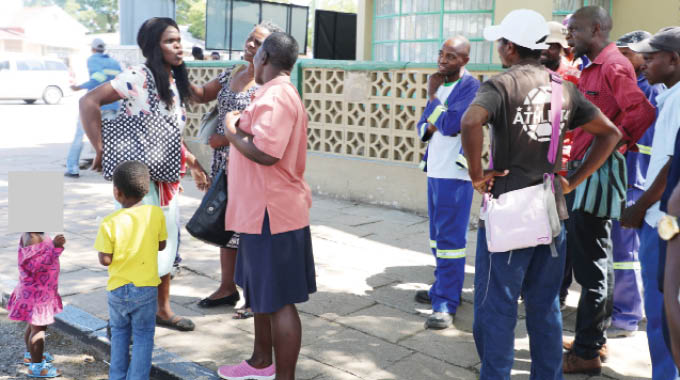
Michell Zvanyanya/ Natasha Adam, Chronicle Reporters
AS a slow-moving vehicle passes at the corner of 4th Avenue and Robert Mugabe Way in Bulawayo, a group of men and women rushes towards it shouting their anthem “Sidinga umsebenzi! (We are looking for a job!)” .
The spot has turned into an escape zone for some of the city’s jobless. On a lucky day, they can get a day’s work and some money.
According to the International Labour Organisation (ILO) an unemployed person is “a person not working, who is currently available for work and is actively seeking work”.
With the closure of industries in Bulawayo, once the country’s industrial hub, finding a job is an uphill task.
For those who are prepared to do menial jobs, the corner of 4th Avenue and Robert Mugabe Way is an employment centre of some sort.
It’s now a daily phenomenon that groups of people gather at what has turned into a “touting spot” to look for potential employers in the form of motorists passing by.
Mrs Mildred Ncube (47) one of the job- seekers, described people who gather at the street corner as a community that looks out for each other.
“We are a community here; we all know each other and look out for one another. We take note of who went into what car so we can check to make sure they came back because we have heard some scary stories that happen out there,” Mrs Ncube said.
She said the community has a zero tolerance for workers who gather at the corner under the pretext of looking for work yet are there to steal because it gives the rest of them a bad reputation. “Once it is known that a person steals, we either chase them away or hand them over to the police,” she said sternly.

What about being picked up by strangers on a promise of a job?
Mrs Ncube said she fears for her safety but she has no option because she needs to fend for her family.
“There are so many risks associated with the job because you do not know where they will take you or what will happen when you get there but there’s nothing I can do except pray because I need the money to take care of my family,” she said.
Her face suddenly warps with disdain as she told the news crew how some of the maids she worked with provided male employers with “extra services” that went beyond their required duties to earn extra bucks.
“Some of the women here have been known to provide employers with sexual services after they have finished cleaning to earn more money. When the employers drive past here looking for workers, they are now familiar with which women are willing to provide sexual services and which women are not,” she said.
Ms Jane Dlamini (32) a single mother of three whose life took a turn for the worst when her husband of over five years turned his back on her is among the job seekers. She said some passing drivers hurl insults at them.
Ms Dlamini frequents the corner in the company of her three children: a five-month-old baby seeking protection in her hands and twin boys aged five years. Having the three children with her reduces her chances of getting the job as most employers fear she might not be able to work properly while looking after her children.
“I have three children that I need to fend for and as a single parent without anyone to help me is very challenging. I have resorted to hunting for piece jobs in the street just to ensure that my children have something to eat. I now fear for their future because with the few piece jobs that I get I cannot raise money for their school fees. I bring them along with me in the streets every day,” said Ms Dlamini.
She earns about $150 per month from the menial jobs, an amount that can hardly sustain her and her three children.
Ms Zodwa Manzunzu (45), also a single mother looking after four school-going children, poured out her bitter heart. She claimed she used to work for a local textile company which was closed in 2018, leaving her and other former employees jobless.
For the past two years Ms Manzunzu has faced challenges securing a job.
She said she also found herself in the streets like other women to fend for her four children.
“Failing to get a proper job since then (2018) has turned me into a beggar in the streets because I am always on the lookout for piece jobs from everyone who passes by. It is even very difficult to get piece jobs because I personally get one once a week. There are some who also spend the whole week without any luck,” she said.
Another woman who only identified herself as Mai Tatenda of Entumbane suburb narrated how the place has turned them into vulnerable beings with no power to protect themselves from the dangers that come with being in the streets.
She said they now live in fear for their safety as they meet and get hired by strangers every day and have fallen prey to them.
Mai Tatenda said some women are raped by their “employers” but they do not report as police blame them for being hired by strangers on the street.
“Hunting for piece jobs in the streets is not safe at all particularly for us women. We normally get hired by strangers who pass by and we get into their cars without knowing where we are heading to. There are many incidents of women who get raped but cannot report to anyone,” she said.
Mr Steven Ngwenya (33) of Old Magwegwe suburb said sometimes he gets hired once a week but can spend the whole week without getting any job. He however said during the festive season chances of getting jobs are high because of a lot of activities that take place.
“We live in fear for our safety in this area because some of the employers who hire us are criminals and we are made to do their illegal activities unknowingly. There is an incident which occurred in 2017 when two men were hired by the serial killer Rodney Tongai Jindu from this place to dig a shallow grave at Burnside suburb where he buried the body of a person whom he had killed. The men were only told that they were digging a pit for throwing in rubbish,” said Mr Ngwenya.
“The men were involved in a criminal activity unaware and because they were in dire need of money, they carried out the job without questioning. Such incidents create fear in us every day because we are subjected to great danger in the streets but we do not have other sources of income that we can resort to.”
Mr Rodwell Dube (45) of Pumula South suburb said he goes on an empty stomach on a daily basis just to keep the little money he gets for his children.
In most cases he and other men are hired for gardening, offloading haulage trucks and for work in farms outside the city.
“We do any type of jobs as long as it gives us money. When we get hired, we do not face challenges of getting paid from some employers but there are some who ask for our labour but run away without paying us. I have lost huge sums of money because of such acts. The maximum pay that we usually get is $150 but it all depends on the type of job that I would have done. When we get lucky there are some who pay US$$10 or R100,” he said.
“I am a father of three school-going children. With the little money that I get I fail to pay for their school fees and I have arrears at their school. I appeal to the Government or donors to assist in job creation to enable us to secure sustainable jobs that can help us take care of our families.”
Mr Dube said he sometimes spends three weeks without getting any job and is forced to get in and out of town on foot without any bus fare. — @michellzvanyanyan2



 Online Reporter