
Tawanda Musarurwa-Check Point Desk
IN 2021, as Zimbabwe’s economy emerged from the Covid-19 pandemic, the number of workplace accidents surged to 5 641 — the highest level in more than a decade.
But the spike was not an anomaly.
It exposed a deeper reality: For over 15 years, workplace injuries have rarely fallen below 4 000 cases a year, pointing to risks that have become structurally embedded in the country’s economy.
Behind those numbers are moments whose brutal reality cannot be described by official data — a miner caught in a shaft collapse, a driver ending up in a high-speed crash, a factory worker pulled into unguarded machinery.
And yet, even these figures may tell only part of the story.
A close examination of more than 15 years of data from the National Social Security Authority (NSSA) shows a consistent pattern.
Workplace accidents fluctuate with economic activity, but the overall level of risk has remained stable — suggesting that while some progress has been made in reducing fatalities, everyday hazards continue to affect thousands of workers each year.
Injury cases refuse to fall
NSSA’s dataset shows workplace injuries following a cyclical, but stubborn trajectory.
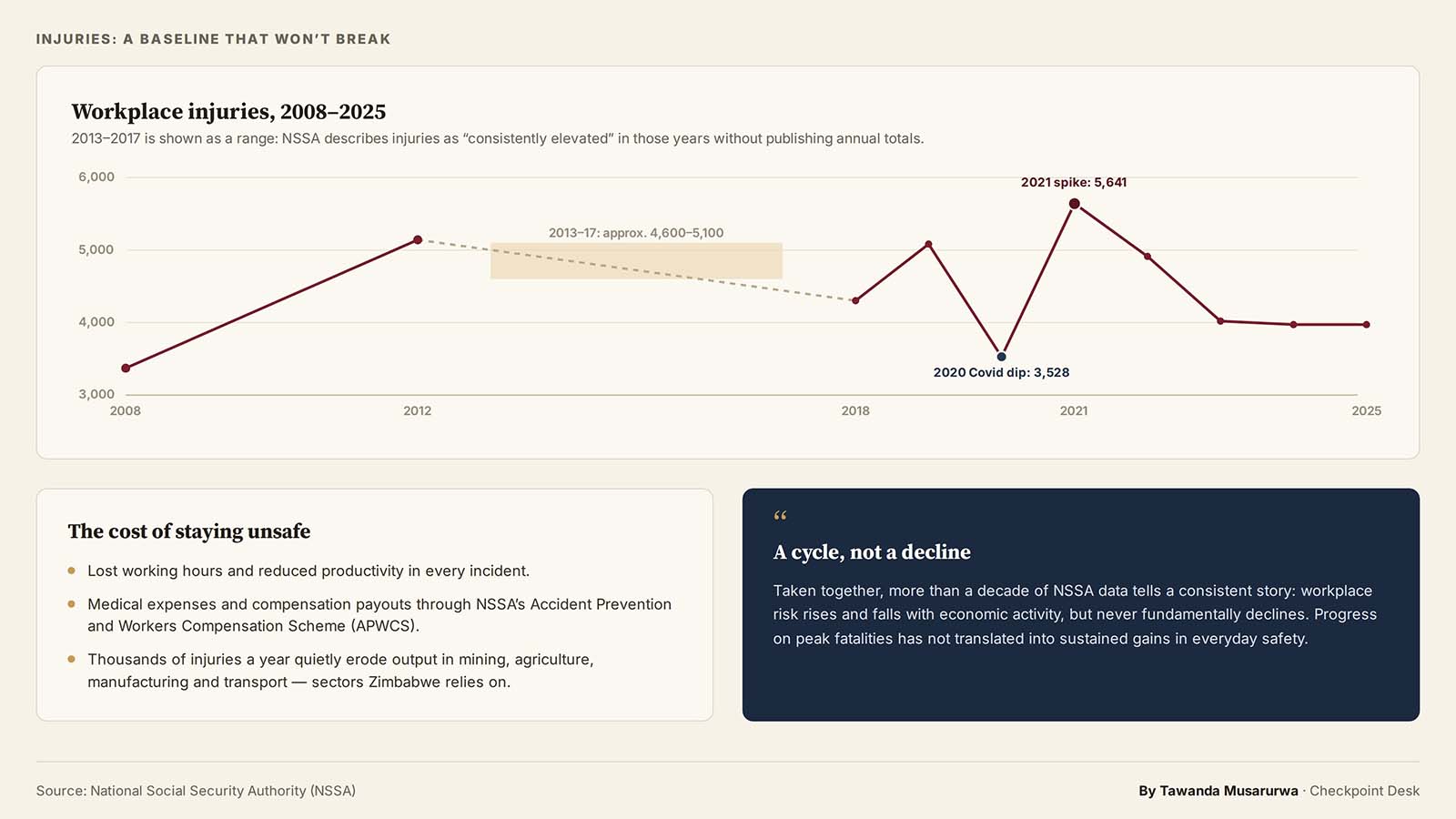
In 2008, the country recorded 3 370 occupational injuries.
Within four years, that number had climbed sharply, reaching 5 141 in 2012, one of the earliest peaks in the modern dataset.
The following years settled into a high plateau.
From 2013 to 2017, injuries remained consistently elevated, hovering between roughly 4 600 and 5 100 cases annually.
There were occasional dips.
Injury cases declined to 4 301 in 2018, before rising again to 5 082 in 2019.
The most dramatic drop came in 2020, when the cases fell to 3 528 — the lowest figure in more than a decade, which was almost certainly driven by the Covid-19 pandemic.
The pandemic slowed industrial activity and temporarily reduced exposure to hazards, but once economic activity resumed, injury cases surged.
The 2021 total of 5 641 cases not only erased the pandemic decline, but became the highest number recorded in the dataset.
Since then, the numbers have moderated, but remain high.
NSSA recorded 4 912 injury cases in 2022 and 4 020 in 2023.
More recent statistics show 3 971 injury cases in both 2024 and 2025, suggesting that while the spike has eased, the underlying pattern remains unchanged.
Taken together, the figures suggest that workplaces have not become dramatically safer over time.
Instead, injuries continue to oscillate around a baseline of 4 000 to 5 000 cases every year.
The cost of staying unsafe
Beyond the human toll, persistent injuries carry an economic cost that is rarely quantified.
Each incident represents lost working hours, reduced productivity, medical expenses and compensation payouts through NSSA’s Accident Prevention and Workers Compensation Scheme (APWCS).
At a national level, thousands of injuries each year quietly erode economic output in sectors that Zimbabwe relies on — mining, agriculture, manufacturing and transport.
Fatalities: Peak and partial decline
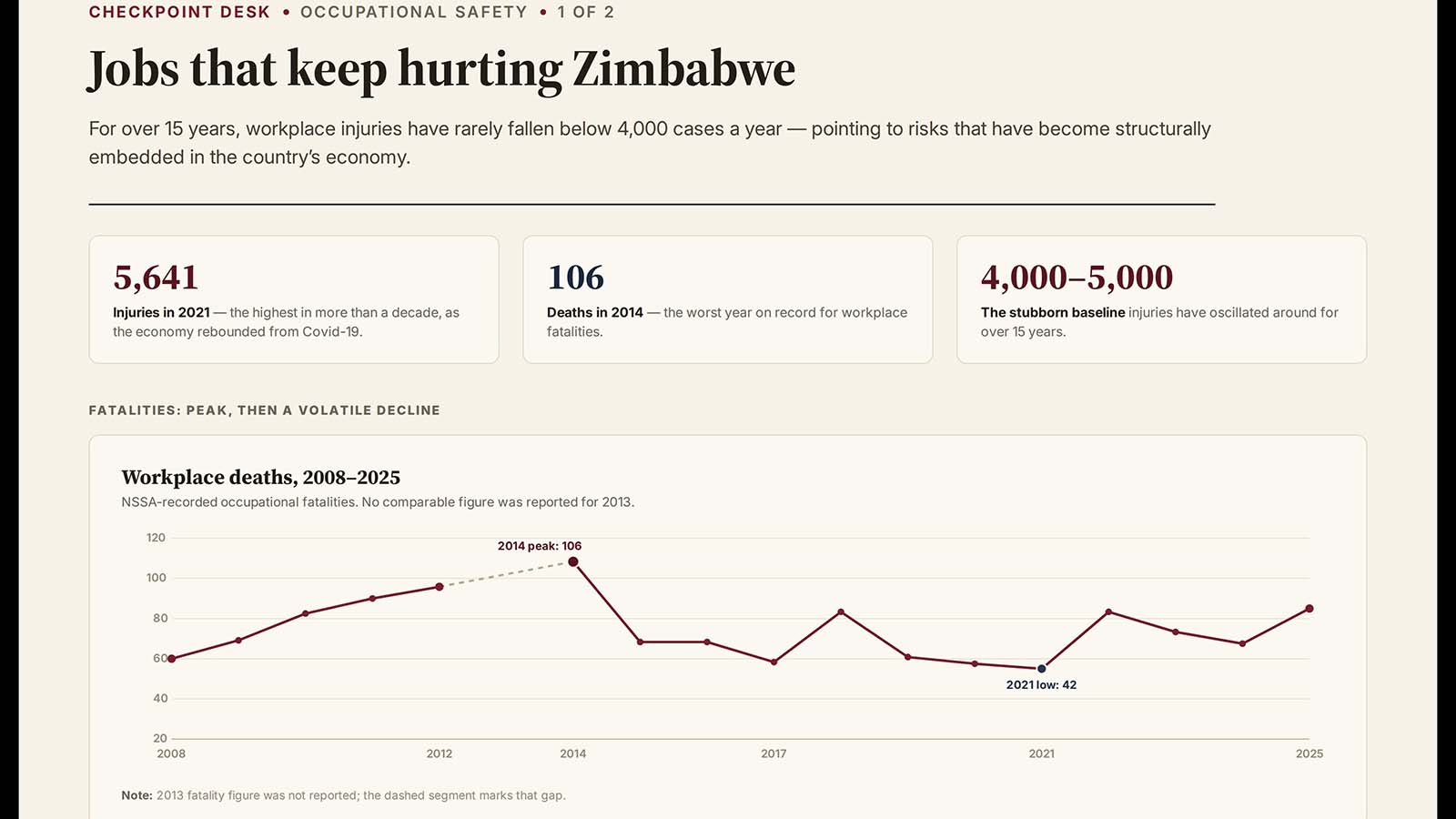
While injury numbers have remained persistently high, workplace deaths show a somewhat different pattern.
In 2008, 48 workers died in occupational accidents.
Fatalities rose steadily in the following years: 59 deaths in 2009; 75 in 2010; 84 in 2011; and 91 in 2012.
The most dangerous year on record was 2014, when 106 workers lost their lives — the highest fatality figure in the dataset.
That year appears to mark a turning point.
In the decade that followed, fatalities generally declined.
The number of deaths dropped to 58 in 2015 and remained the same in 2016, before falling further to 46 in 2017.
But the progress has been uneven.
Fatalities climbed again to 76 in 2018, before falling to 49 in 2019.
The pandemic years produced the lowest numbers in the series, with 45 deaths in 2020 and 42 in 2021.
However, the improvement did not last.
Fatalities rose sharply to 76 in 2022, before easing to 64 in 2023.
More recent data shows 57 workplace deaths in 2024 and 78 in 2025.
The overall trend suggests that while Zimbabwe may have reduced some of the most catastrophic accidents since the 2014 peak, fatal incidents remain a recurring feature of several high-risk sectors.
However, the country’s occupational safety and health (OSH) injury and fatality figures could be higher than reported.
A system that only sees part of the picture
This undercount becomes clearer when set against the structure of Zimbabwe’s labour market.
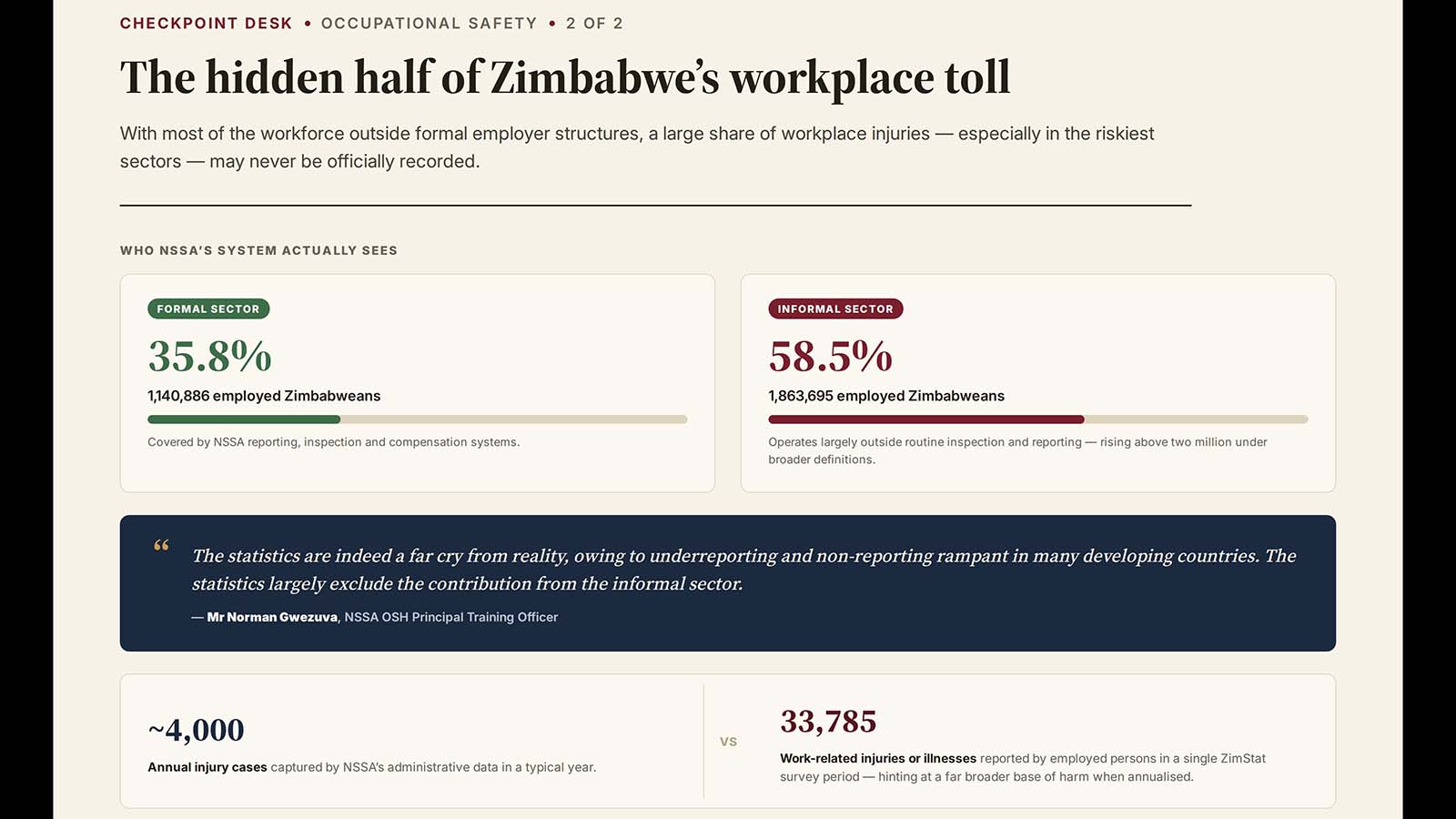
According to the Zimbabwe National Statistics Agency (ZimStat)’s 2025 Second Quarter Labour Force Survey, 3 186 598 Zimbabweans were employed.
Of these, only 1 140 886 (35,8 percent) were in the formal sector, while 1 863 695 (nearly 58,5 percent) were in informal employment.
When broader definitions are applied, including workers without contracts or social protection, the number of those informally employed rises further to over two million people.
This means the majority of Zimbabwe’s workforce operates outside formal employer structures typically covered by NSSA reporting systems.
As a result, a large share of workplace injuries — especially in sectors such as small-scale agriculture, artisanal mining, transport and informal manufacturing — may never be formally recorded.
The survey data itself hints at this gap.
The same ZimStat report recorded 33 785 employed persons reporting work-related injuries or illnesses during the survey period alone — a figure that, when annualised, suggests a far broader base of occupational harm than the roughly 4 000 cases captured annually by the NSSA administrative data.
“The statistics are indeed a far cry from reality, owing to underreporting and non-reporting rampant in many developing countries. The statistics largely exclude the contribution from the informal sector,” said NSSA OSH principal training officer Mr Norman Gwezuva.
Because NSSA systems are tied largely to formal employer structures, entire categories of workers operate outside routine inspection, reporting and compensation frameworks.
In practice, this creates two parallel realities: a documented economy where injuries are recorded and compensated, and a much larger undocumented one where accidents often go unreported.
Zim’s most dangerous workplaces
Sector-level data provides important clues about where workplace injuries are concentrated.
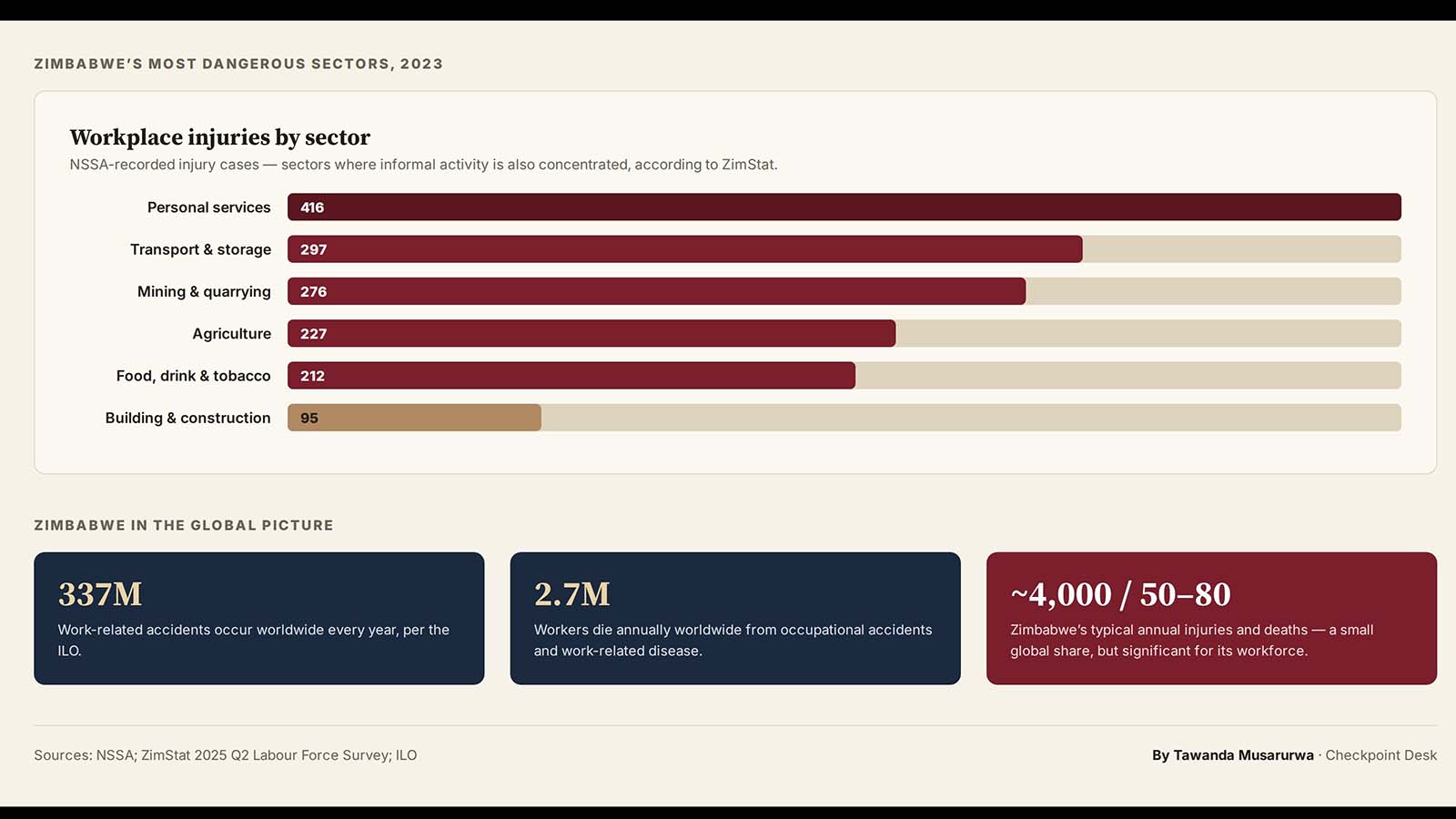
In 2023, the sector recording the largest number of injuries was personal services, with 416 cases.
The category includes a wide range of occupations, from maintenance and repair work to cleaning and other labour-intensive activities.
The transport and storage sector followed with 297 injuries, highlighting the risks faced by drivers, loaders and logistics workers.
Mining and quarrying, long associated with occupational hazards, recorded 276 injuries.
Agriculture accounted for 227 injuries, while the food, drink and tobacco processing sector registered 212 cases.
Other sectors with notable injury figures included machinery manufacturing, metal production and construction.
The building and construction sector alone recorded 95 injuries in 2023.
These industries share common characteristics: physical labour, exposure to heavy machinery and hazardous environments.
Mining workers face risks from underground collapses, explosions, toxic gases and heavy equipment.
Transport workers confront road accidents and dangerous cargo handling conditions.
Agricultural labourers deal with farm machinery, pesticides and animal-related hazards.
Manufacturing and construction workers, meanwhile, operate around mechanical equipment and structural hazards that can lead to serious accidents.
Crucially, many of these same high-risk activities are also dominant within Zimbabwe’s informal economy.
ZimStat data shows that informal employment is heavily concentrated in sectors such as agriculture, trade, manufacturing and transport-related activities.
This overlap reinforces the likelihood that a significant portion of workplace risk exists beyond the reach of formal monitoring systems.
OSH legal environment
Updating legislation is necessary to
align Zimbabwe’s OSH framework with ratified International Labour Organisation (ILO) conventions and evolving workplace
realities.
“Current OSH legislation is outdated, fragmented, limited in scope and coverage of industrial sectors is not adequate, for example, informal sector, retail, commercial operations and are not adequately covered by the current legislation,” says legal expert Ms Memory Mukapa.
Zimbabwe has ratified Conventions 155, 161, 162, 170, 174 and 176, while Convention 187 is still in the process of ratification.
Zimbabwe Institute of Occupational Safety and Health founding member Dr Benjamin Mutetwa says ratified conventions have legal force and require countries to implement them.
“Conventions are comparable to multilateral international treaties which are open for ratification by member states and once ratified create specific binding obligations, have legal status,” says Dr Mutetwa.
However, current laws — anchored in instruments such as the Factories and Works Act (1951) and the Pneumoconiosis Act (1971) — are outdated, fragmented and limited in scope, with inadequate coverage of key sectors including the informal economy, retail and parts of the public sector.
The proposed OSH Bill, which is currently before Parliament, seeks to consolidate these laws into a single, comprehensive framework covering all workplaces, strengthen enforcement through dedicated institutions, and align national standards with international obligations while improving prevention, reporting and compensation systems for workplace injuries and diseases.
Reform delayed
While the proposed OSH Bill promises a comprehensive overhaul, its impact will depend on how quickly it moves from legislation to implementation.
The country’s current framework still relies heavily on laws dating back decades, including the Factories and Works Act of 1951.
Until reforms are enacted and enforced across both formal and informal sectors, gaps in coverage are likely to persist — particularly in high-risk industries where most workers are already operating outside formal protections.
Global context
Zimbabwe’s occupational safety challenges mirror a much larger global problem.
According to ILO, workplace accidents remain one of the world’s most significant but often overlooked public health issues.
Globally, an estimated 337 million work-related accidents occur every year.
Workplace hazards and exposures also cause widespread illness, with more than 160 million people falling ill annually due to occupational risks such as chemicals, dust, noise and repetitive strain.
The ultimate toll is even more striking: Around 2,7 million workers worldwide die each year from occupational accidents and work-related diseases.
In comparison, Zimbabwe’s annual totals — typically around 4 000 injuries and between 50 and 80 deaths — represent a small share of the global burden.
But they remain significant for a country with a relatively small workforce.
How Zimbabwe compares
Globally, occupational safety is often measured not just in absolute numbers, but in rates relative to the size of the workforce.
While Zimbabwe records around 4 000 workplace injuries annually, the absence of consistent injury-rate metrics makes it difficult to directly compare its performance with other countries.
What is clear, however, is that countries with stronger enforcement systems, broader social protection and higher levels of formal employment tend to report lower and more steadily declining workplace injury rates.
Zimbabwe’s persistently high baseline, combined with a large informal sector, suggests that risk remains both widespread and unevenly managed.
Moreover, the official figures likely underestimate the real scale of workplace accidents.
Many workers in informal sectors — which, according to ZimStat, account for well over half of total employment — fall outside formal reporting systems and may not appear in official statistics.
What the data reveals
Taken together, more than a decade of NSSA data tells a consistent story: Zimbabwe’s workplaces are locked in a cycle where risk rises and falls with economic activity, but never fundamentally declines.
The numbers point to incremental progress in some areas, particularly in reducing peak fatalities.
But they also reveal a system that has yet to deliver sustained improvements in everyday safety.
More importantly, they hint at something larger; that the country may only be measuring a fraction of the problem.
Because, in an economy where most people work outside formal systems, many injuries happen beyond the reach of official statistics, inspections or compensation.