Online Reporter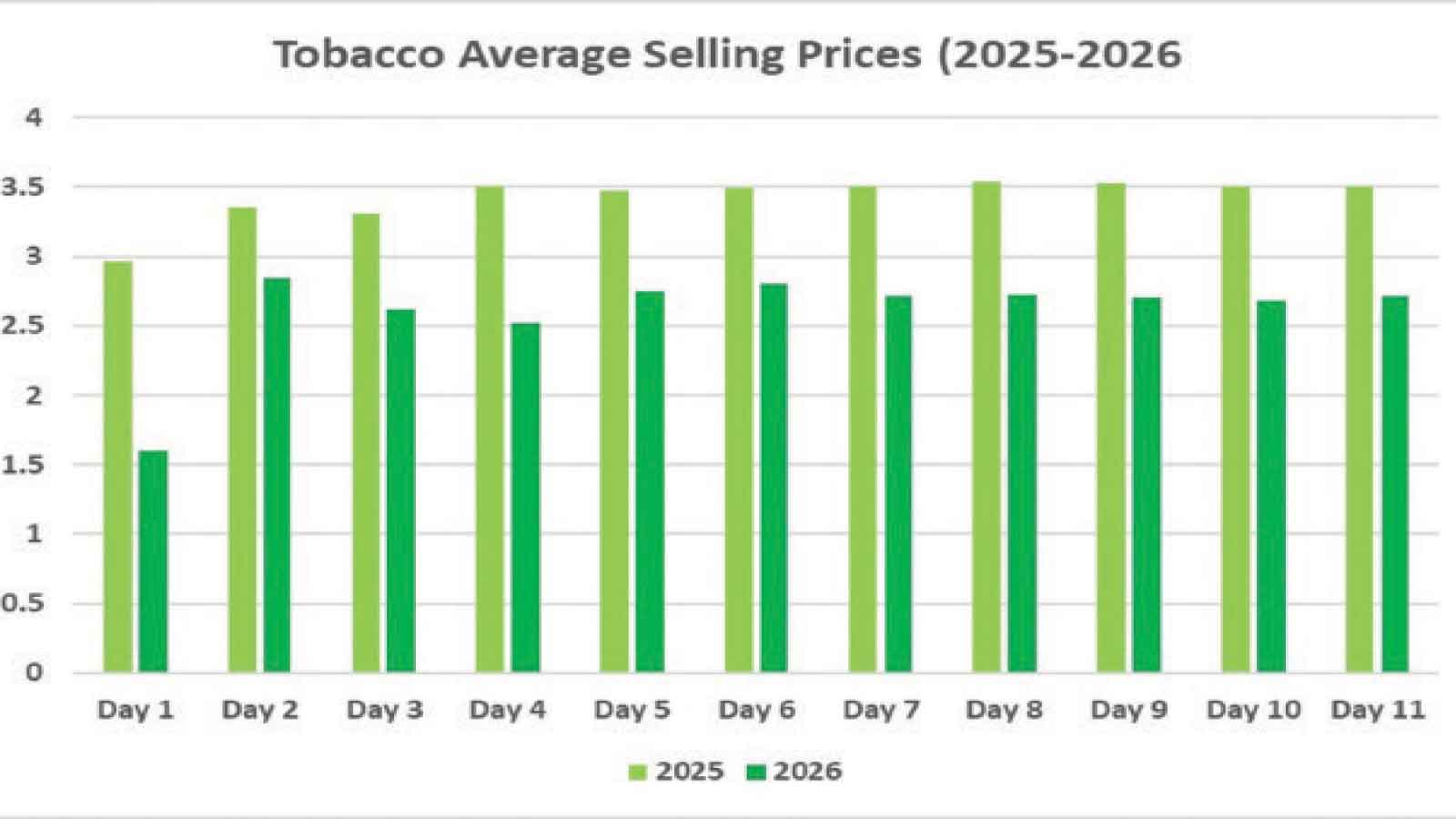
Business Reporter
ZIMBABWE’S 2026 tobacco marketing season has opened on a bearish note, as a combination of global oversupply of the leaf and muted buyer competition on the market triggered a sharp decline in early season prices.
During the opening of the season, a key performance metric — the average price — experienced a sharp decline relative to last year, creating significant uncertainty for the country’s 100 000-plus growers.
While the first bale of the season sold for a symbolic US$4,60 per kg, the reality on the floors quickly turned bleak.
As at Day 11, the average price was down by 24 percent per kg to US$2,66 from US$3,49 seen at the same point last season.
While some bales traded for as little as US10 cents, the market has since shown signs of a cautious recovery.
The Tobacco Industry and Marketing Board (TIMB) attributed the initial price shock to an unusually early start to the season.
Several major merchants — who fund 85 percent of the crop — had not yet finalised their credit facilities when the floors opened, and the lack of competition allowed prices to bottom out.
“Most merchants only started buying a week after the season opened because they had not concluded their credit facilities with banks. Participation has now improved and we are seeing prices trend upwards,” said TIMB chief executive officer Mr Emmanuel Matsvaire in an interview on Wednesday.
While increased buyer participation could have triggered a gradual improvement in pricing, industry experts warn that matching last year’s price levels remains a difficult target to achieve.
While volumes have gone up by 34 percent to 22,9 million tonnes, the value of tobacco sold is only up by 2 percent compared to the prior year.
The “elephant in the room” remains a massive supply-demand imbalance that continues to weigh heavily on the 2026 marketing season, analysts say.
Zimbabwe is coming out of a record-shattering 2025 season in which it produced 355 million kg of tobacco.
While national output is expected to hit 400 million kg this year, global demand is failing to keep pace.
Most notably, major buyers — including China, the largest consumer of the local leaf — have reportedly reduced their orders by over 10 million kg, Mr Matsvaire told the Parliamentary Portfolio Committee on Lands, Agriculture, Fisheries, Water and Rural Development last month.
The sudden shift in market dynamics traces back to the Covid-19 era.
Traditionally, global tobacco companies maintain at least 18 months of inventory to buffer against supply chain disruptions.
However, during the pandemic lockdowns, severe shipping bottlenecks forced major cigarette producers to draw down their stocks.
This inventory depletion was compounded by a surge in cigarette consumption.
According to the World Health Organisation (WHO), the stresses of the lockdown period triggered a notable increase in smoking rates as consumers turned to tobacco as a primary stress-relief mechanism.
While many health-conscious individuals attempted to quit during the pandemic, a significant portion of the global smoking population increased their intake due to both psychological and structural factors.
Lockdowns caused a surge in mental distress, including anxiety, depression and boredom, with studies in countries like Italy and the United Kingdom showing that between 25 percent and 30 percent of smokers increased their daily cigarette consumption.
The shift to remote work further catalysed this trend; without the restrictions of smoke-free office environments, many “social” or occasional smokers transitioned to more frequent, heavy smoking while at home.
Additionally, the fear of supply chain disruptions led consumers to “panic buy” more packs per visit, resulting in higher at-hand availability and, subsequently, increased daily consumption.
After the pandemic subsided, global cigarette companies moved aggressively to replenish their depleted stocks.
This intense appetite for the leaf was mirrored in the exceptionally strong prices Zimbabwe experienced during the 2024 and 2025 marketing seasons. By 2026, however, global inventories have been successfully rebuilt. As a result, buyer intake has stabilised.
The current market challenge arises from the fact that farmers, encouraged by the high prices of previous years, maintained higher production levels just as the global “restocking” phase has concluded.
“This imbalance has resulted in a significant market glut; consequently, in accordance with the law of supply and demand, the surplus has exerted downward pressure on prices,” Mr Clifford Munhanda, an independent tobacco supply chain consultant, told this publication in an interview.
Zimbabwe Farmers union secretary-general Mr Paul Zakariya has suggested that preventing future price depressions will require enhanced market intelligence to better align production with global demand.
This approach mirrors the historical production quota system once used to stabilise the industry.
In the past, the Zimbabwe Tobacco Association conducted extensive global tours ahead of the planting season to gauge international demand.
By determining exactly how much tobacco the global market could absorb, the association could effectively advise farmers on planting volumes, ensuring that supply remained controlled and prices stayed attractive.
But, while this worked for a small group of 2 000 commercial farmers, implementing it today is a logistical nightmare.
The industry now supports over 100 000 smallholder households.
“In the future, we require detailed market intelligence regarding demand levels for the upcoming season,” said Mr Zakariya.
“This will allow for a more controlled production approach, ensuring we avoid a surplus that ultimately drives down prices for the grower.”
While TIMB remains optimistic that the gradual increase in prices will be maintained, some industry players warn that this window may be short.
Once merchants satisfy their primary orders — likely within the next two months — the price floor could “shockingly crash” as they stop buying, leaving farmers with a crop that has no market. Last year, in Malawi, the government was forced to buy tobacco directly from farmers after commercial buyers stopped purchasing, having met their trade requirements.
Furthermore, some local merchants are reportedly still holding significant stocks from the previous season.
The inventory overhang is expected to dampen demand for this year’s “green leaf”, potentially exerting further downward pressure on prices.
TIMB has already begun aggressively seeking new markets to absorb Zimbabwe’s increasing production.
Among these, the Middle East, Africa and the European Union have emerged as high-growth destinations; the European Union, in particular, was a stand out performer last year, with export values sky rocketing by 64,5 percent.