


 Online Reporter
COMRADES JOHN GAZI (JG), whose Chimurenga name was Alfred Dube, and CETSHWAYO SITHOLE (CS), whose nom de guerre was Tonderai Ngoma, continue chronicling their wartime experiences. This week, they narrate to our Society Editor PRINCE MUSHAWEVATO how evolving training techniques and strategies ensured victory against the enemy. They will also explain why Zimbabwe People’s Revolutionary Army (ZIPRA) cadres downed the Rhodesian Viscount planes.
***************
Q: Our previous discussion ended with you highlighting some of the victories you, as ZIPRA fighters, registered around the country. Could you please elaborate on that?
JG: Basically, what I was saying is that we organised and advanced our strategy to match the enemy and we eventually surpassed them, courtesy of astute senior commanders and trainers like Nikita Mangena and Ambrose Mutinhiri. They created a well-oiled machine in ZIPRA. The independence we gained was not a gift; it was not handed to us. They realised we meant business and were overpowering them. The firepower coming from ZIPRA and the Zimbabwe African National Liberation Army (ZANLA) from the other side became too much for them to handle.
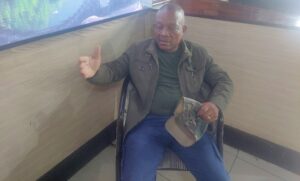
Cde Gazi
As for the Viscount planes, we targeted them because we initially thought General Peter Walls was in the first one. When we realised he had missed the flight, we targeted the next. But note that no civilians were on those planes; there were military personnel aboard.
The people who hit the Viscounts are still being sought by Britain, America, South African Boers and Israel. The incident(s) are still classified as war crimes. If you strike the West in that manner, they make it a lifetime hunt, similar to what the Jews did with Hitler’s people and the Gaddafi (Muammar) scenario.
CS: (interjects) Who was on these Viscounts? They were Rhodesian generals pretending to be civilians. A lot of generals were hit and died in those Viscounts. Those planes were used for reconnaissance; they were in the Zambezi area just to observe how ZIPRA fighters were deployed across the river (Zambezi) so they could later come and attack. General Walls was supposed to be there, but his wife went fishing, which prevented him from travelling at his scheduled time. That is how he survived the attack.
He personally shared this information at the Lancaster House meetings. He (General Walls) indicated that NATO soldiers were in the Viscounts and were hit. In fact, they never expected that ZIPRA had heat-seeking missiles (the Strela weapon). I am told that ZIPRA was the only organisation in this region that was given the heat-seeking missile by the Russians. No other liberation movement was handling that weapon. It was the complexity of the enemy we were fighting that led us to acquiring such weapons. Remember, the apartheid South Africans were too advanced.
Q: From your explanation now and in previous interviews, it is quite evident that there were significant changes in the weapons you handled and your fighting techniques. Could you perhaps touch on this briefly?
JG: As I indicated earlier, a guerrilla typically uses light weapons. For them to use heavy artillery, that requires entirely different training. Formations also change as you move; the way you approach a target and the targets themselves change as you shift from guerrilla combat. By this, I mean changing from simple attacking and running, reducing the enemy to your level — foot soldiers. Regular fighters, on the other hand, attack and defend their territory. They introduce new, heavier and better weaponry than that used by guerrillas.
CS: We must remember that the number of forces, both ZANLA and ZIPRA, was small before the release of political detainees like Joshua Nkomo on our side. Nkomo was someone who always wanted to negotiate. However, it was proven beyond reasonable doubt that the white people were not eager to grant us our independence.
This was evident when (Abel) Muzorewa was asked to be the leader while they were still in power. Muzorewa took it upon himself to build his own party and army, which collaborated with the Rhodesians. But the people felt cornered due to the prevailing injustice and oppression. They had no option but to be recruited and flock to Mozambique and Zambia to join the struggle and end colonial rule.
Q: You can carry on.
A: Eventually, our units became so huge that we could no longer employ guerrilla warfare, the hit-and-run tactic. At any given time, we had more than 10 000 recruits waiting to be trained.
This is why I was among those taken from the transit camp in Zambia to provide some recruits with basic training before they were transferred to places like Angola, where there were Cubans, Russians, et cetera. In Zambia, we had a very large group that trained there.
Some of the instructors were Zambians, so we gave them all the basic, tailor-made training so they could reach a much higher level. You cannot have 20 000 guerrilla fighters in a war situation; that simply does not work. It does not mean that those who were regular forces were not joining the war — they were.
We had platoons operating in the country and defending liberated zones, making them no-go areas for the enemy. It was our anticipation that one day we would liberate the country, and we did not want a situation where we would depend on the Rhodesians to defend it.
Q: Can you tell us about some of the instances in which the enemy began targeting your camps outside the country? What were these attacks like?
CS: There were several attacks. However, I will tell you about one incident in which NATO forces attacked to test ZIPRA’s strength. They wanted to ascertain whether we could fight them back if they attacked us outside the country.
This was a crucial part of their decision-making in admitting that we had cornered them, thus forcing them to grant us independence. They came with all sorts of advanced weaponry, but they met their match. They got what they wanted; they were hit harder than they expected.
This was an attack similar to the Battle of Mavonde, also known as the Battle of Monte Casino. In fact, it was the same mission but different places. Our biggest weapon at the time was a single-barrel missile launcher, which was more like the Katyusha. It was effective. It is the same weapon we used to hit the Elephant Hills Hotel.
It was our largest, but it did not operate alone; it was supported by smaller mortars and rocket launchers. I will leave much of the explanation and nitty-gritties for this incident to our commanders, like the current Commander of the Zimbabwe Defence Forces, General Philip Valerio Sibanda, and Brigadier-General Ambrose Mutinhiri (Retired). They led and planned the battle that time. However, what I can say is that we emerged victorious after a protracted engagement with the enemy. They left convinced it was over for them.
JG: (interjects) There is a statement that commander Mutinhiri always quotes; it is a statement that was made by General Walls towards the end of the struggle. He said: “If I had an army like ZIPRA, I could conquer Africa.”
He (General Walls) came to this conclusion through such battle engagements. ZIPRA became a formidable force through advanced training programmes, the use of advanced weaponry, quick changes in tactics and, above all, discipline among its fighters. Commander Mutinhiri, himself, specialised in training and was among the best. He was also a good motivator and we are happy that he is still among us.
Q: While operating back home, what was the situation like in the villages?
CS: We had a very good relationship with the masses. They supported us, even at times when we could see they were struggling. But have you ever wondered why the Rhodesians failed to establish “keeps” (protected villages) from Hurungwe up to Midlands, especially in Midlands north and the western provinces? This was simply because, where ZIPRA operated, it also defended the villagers. Even as guerrillas, we made sure the people were protected. We made sure we never made ordinary people the target. When we were being trained, it was emphasised that we cooperate with the masses. That was the ZIPRA principle throughout the struggle.
JG: (interjects) ZIPRA operated under difficult circumstances because after crossing the Zambezi into Zimbabwe, the population you meet there were very poor Zimbabweans. They could hardly feed five people, let alone large numbers of 10 or more. Our commanders, like Ambrose Mutinhiri, trained fighters who could go for at least seven days without looking for food from the masses, coming inland after the Zambezi. The person had to be physically fit and able to survive on natural food found in the area. The terrain was so difficult it needed a person of special skills.
Next week, Cdes John Gazi and Cetshwayo Sithole will share some of the events that took place prior to and after independence, highlighting how these shaped modern-day Zimbabwe.


 Online Reporter