


 Vusumuzi Dube
THE moon and its various perceptions among African communities constitute a collection of hilarious stories relating to, inter alia, fertility and other innumerable themes emanating from lived experiences. What goes on around human beings must, at the end of the day, be interpreted to make sense in line with what the community as learnt before. Meaning is related to previous experiences and is derived from associational learning
Traditions are an embodiment of experiences and encounters during residence on given environments. Cultural heritage serves as a litany of learnt experiences, a resource that communities make use of in order to cope with challenges that they face in life. Culture and cultural heritage constitute a comprehensive package of coping strategies. Equipped with this sort of package, a community does not have to reinvent the wheel, as some of the challenges that present themselves are not new.
Traditions are thus a collection of coping strategies that have served as successful responses to challenges encountered in the past. Traditions will relate to various aspects ranging from matters spiritual to agriculture and death. Where the challenges, presented by an environment, the responses are usually comparable. Common mental resources very often meet the common challenges. The resulting set of responses constitute a people’s store of learnt environmental resources. This is their culture, their cultural heritage and their responses and coping strategies to life as the community interacts with the environments, both terrestrial and extra-terrestrial.

It is because of these human survival strategies that traditions tend to be comparable, sharing common challenges within similar environments and applying the same cognitive resources. The environmental challenges were then met with similar packages of garnered knowledge that serve as fall-back strategies in the drive to survive and attain eternity, perpetuity, endlessness and continuity for the communities as collectives.
From West Africa to South Africa, African communities seem to share a lot. For example, in Nigeria, twins were killed. This happens to have been the case among the Zulu and Ndebele peoples. One of the twins was killed.
That behaviour was rooted in shared thought, beliefs and perceptions. Common responses to common challenges was the result. The responses were shared in common. Twins must have been perceived in the same light,
What we may surmise from this is that probably a long time ago the Nigerian communities and those of Nguni stock in southern Africa must have shared a common culture, suggesting they probably were a one people who shared common responses to common social issues. Later, the communities migrated in different directions; the Nigerians to the west while the Zulu/Ndebele did the same in a southerly direction.
However, we should not imagine that the names for the communities that we are using today were in use then. A single ethnic group, especially a migrating one, faced fission and acquisition of new names. The land then was sparsely populated and where arguments occurred some members were not obliged to stay within the group. They migrated to open spaces where they led separate, worldview and cultural practices that they shared when they were still a single unit.
Certainly, we do know the Ndebele are a recent historical phenomenon traceable to the 19th century when European groups, the English in particular, settled along the South African coasts. Mfecane was the resulting political and economic phenomenon that saw some peoples move away from the cataclysmic events taking place in Africa. King Mzilikazi led his group in a northerly direction and finally settled in the south-western part of what is present day Zimbabwe.
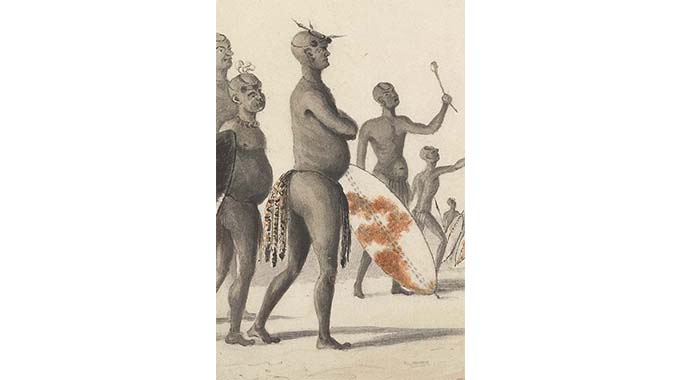
As a people who in recent times constituted a common social, political, and cultural group, the two share common cultures, thought, ideas and traditions. Their historical experiences are similar. This is possibly, what might have happened all over Africa when fission and migrations ensued to levels that today seem unimaginable, our essence as Africans is shared in common beyond colour and continental residence. We must have been one people who experienced social forces alluded to above.
African groups would have shared common ideas with regard to ideas pertaining to the cosmic bodies, the moon included. Let us demonstrate what we are dealing with in relation to organizing space for a homestead. The Nga people of Nigeria are said to have organized their settlement spaces on the bases of moon phases. This important consideration is equally found in virtually all black African communities. Largely, the arrangement of built environment was underpinned and informed by similar ideas and considerations.
It comes as no surprise that the front sections of homesteads in Africa are set aside as male domains. The front sections are dedicated to the male members of a household. Among both the Ndebele and the Zulu peoples, the cattle byres are located in the front parts of their homesteads. This happens to be the case in other African communities.
The rear sections are allocated to the women folk who are the keepers and processors of food. The granaries are located in the rear section of a homestead. This is where the harvested and processed grain is stored. The women, or wives, have their kitchen huts located in the same area. It is a practical consideration that grain storage and processing within the kitchen huts are located in close proximity.
It is in the same section that girls also spend their time, as it is their mothers who are responsible for their induction into adult roles. Similarly, the boys spend time in the male sections as they will assume roles of men when they become adults.
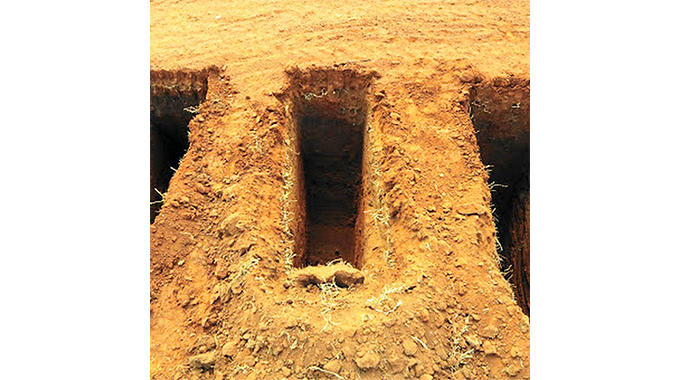
There is gender separation at play. The males and females are apart in life and apart in death. Ablution facilities are separate. The females answer to the calls of nature by visiting the rear sections of the homesteads. It turns out that at death their remains are interred in the same section of a homestead.
The males on their part are associated with the front section. It is here that they answer to the calls of nature. Upon death, their remains are interred in the same sections where their hearts in life lay. Indeed, apart in life and apart in death. Things have changed as cemeteries have been established for males and females in the homestead.
Arrangement of kitchen huts for the wives reflected their seniority. That had a direct bearing on political power and succession to the head of household, invariably a man. Age was another important consideration. Young girls and boys had their huts located near the entrance to the gate.
However, these arrangements were not cast in stone. The factors that impinged on arrangements changed over time. Among the Zulu and the Ndebele, the central cattle pattern (CCP) was abandoned in response to increased security where cattle rustling was no longer a serious challenge or problem to take into consideration wen planning and implementing the layout of the homestead as a built environment.
Belief was strong that at death, perceived as the separation of body and soul/spirit, the latter headed to some particular cosmic body. Even the pyramids of Egypt were provided with channels that pointed to the targeted star. Sometimes we fail to see the common elements between a monumental stone structure such as a pyramid and some humble and small African grave of the present.

The two-share some raised earth mound above a buried corpse. Stones are a common feature to both. It is not the scale of structures that matters. In Egypt, it was a stratified society with the wealthy and politically powerful elite that led to the creation of the colossal structures. Of course, technology played an important role. Differentiated societies with the political and social elites accounted for the monumental structures. The stones were common and so were the earth mounds.
It was the re-arrangement of big stone slabs that made me arrive at the conclusion that Stonehenge in the Salisbury Plain in England was essentially a representation and expression of a cemetery. Indeed, there were human remains that were unearthed within the iconic monument. Death, burials, graves, circularity, and stones all underpinned the essence of Stonehenge as a spiritual site. The extra-terrestrial qualities emanating from its location and the geological attributes of the site all complemented each other to buttress the idea of a spiritual site for a people who held ideas that Africa largely still holds dear and sacrosanct.



 Bongani Ndlovu
 Online Reporter