Vusumuzi Dube
AFTER journeying far into the unfathomable depths of the universe we now come back to look at those heavens from the perspective of ancient Africans.
We gleaned the various cosmic bodies and current efforts to explore the intricacies and repercussions of those distant cosmic bodies with regard to their impact on Earth.
We may be on the verge of another scramble more competitive more and intense than the Scramble for Africa in the 19th Century. Our populations on Earth may have to be offloaded onto newly-discovered and colonised d lands in outer space.
The other alternative, though sinister, is experimenting with scientific development of biological organisms that will cause pandemics (and selective ones at that) to eliminate certain targeted populations from the face of the Earth. Some pharmaceuticals in collaboration with the filthy rich of this world seem poised and determined to eliminate some populations from the face of the world.
In essence therefore, we are back to investigate why ancient Africans bothered to seek knowledge and information regarding the stars and other cosmic bodies. Knowledge and information is sought for specific reasons, sometimes the reasons have to do with beliefs that anchor on the interests of the people in terms of their survival on earth.

In comes as no wonder therefore, that we learn about Africans in the regions of Nubia, Meroe, Naphta and Egypt refining the study of subjects such as Astronomy, Alchemy, Geometry and Mathematics which improved their understanding of both their immediate cosmic or extra-territorial environments.
Before we investigate the knowledge and information relating to individual cosmic bodies such as stars and the moon, we seek to gather reasons why Africans, and indeed non-Africans, bothered themselves to acquire a body of knowledge relating to the stars. This would not have been for some intrinsic value. It was all utility inspired and driven.
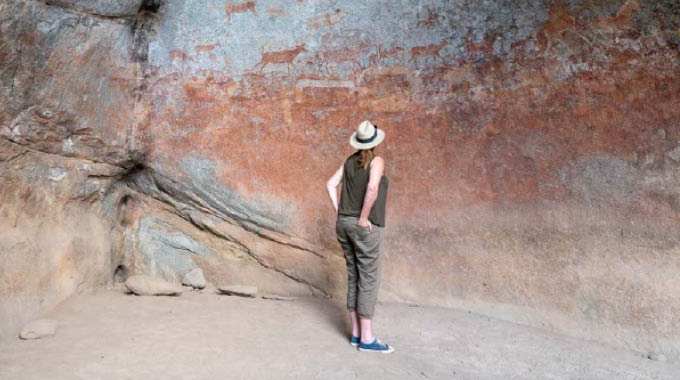
I have argued that a people such as the San would not have bothered themselves drawing artistic images on rocks when they were leading a precarious lifestyle. That may not be characteristic of a nomadic people. They were dependent on availability of game that did not wait upon them while they were drawing images for fun or some aesthetic value. Those who do so are people who would have resolved issues about availability of food resources.
Would Picasso and Michelangelo have drawn from empty stomachs? If anything, it makes sense that they painted to ensure food got to their tables. The San were no different. It is just that we tend to make use of our cultural lenses to view and seek some understanding of rock art, executed by a people whose culture is different from our own.
Africans believed that heavens divined the present and future, and the past even. Through the language of stars and other cosmic bodies, we got to know what the future had in store for us. In the last articles, we dealt with crop circles as a phenomenon that bore messages and meanings that were of interest to the community for its continued survival. For them the sites were sacred as they marked interaction between the gods and them. The latter had an interest in the welfare and wellbeing of the former.
Indeed, we behave, as we believe. Belief and thought inform and underpin our cultural behaviours.
The dark skies at night serve as information notice boards drawing from past knowledge gleaned from stars that were used to predict future events and sometimes events, as they were unfolding. Observations of relationships between celestial movements/appearances and what took place soon thereafter. Stars led the wise men from the East to Bethlehem where Jesus Christ was born. This was akin to behaviour that Africans exhibited as far as stars and their messages were concerned. Stars speak. Stars communicate.
What is important though is appreciation of the motives behind seeking messages resident in stars. It was not a pastime, but rather a way to ensure continued survival. The terms we have used in the past to express this innate desire in humans in general are continuity, perpetuity, eternity, and endlessness. It is a wish or desire at both individual and community levels. At individual level, it is not feasible, unless we consider the spiritual component of a human being within the context of “Duality of Being.”
There is something eternal within our constitution, so believed the Africans. That eternity is expressed through and represented by the spirit within our material bodies. Spirit is perceived as eternal.
However, at family or community levels the idea of eternity is feasible and only through one biological process-namely sexuality. It was against this background and realization that I coined the expression: “individuals perish, humanity is forever.”
Babies are born to replace the diminishing population of aged and ageing individuals. The process is about a dying generation and its replacement.
Stars and their messages come in here as part of an overall package to ensure humanity subsists into eternity.
Life during the Stone Age era was more precarious than the later period generally referred to as the Iron Age when agriculture was the mode of production. It was therefore critically important to rely on the movement and indeed other traits exhibited by the heavenly bodies to know when to prepare to till the land. Equally, it was important to know the expected amount of rainfall to take appropriate decisions regarding what crops to plant.

Even today, the Meteriological Services Department (MSD) advises farmers with regard to the commencement of the rainy season, whether the amount of rainfall will be normal, below normal or above normal. They tell us about cyclones that may be lurking ready to strike.
In all this, we are alerted to respond appropriately to ensure successful crop production but also survival from the life-threatening storms and cyclones well in advance.
All this is nothing new. The ancestors too were doing the same. We may be using more sophisticated scientific instruments of measure, but in both cases, we are relying on nature to tell us about future events. Nature always announces itself well in advance. With regard to long-term weather forecasting, I said winter announces itself in summer while summer announces itself in winter. Nature is not in the habit of throwing surprises at us. We are the culprits who have lost the language of nature.
What is now generally referred to as Indigenous knowledge Systems (IKS) relate to, among other things, to weather forecasting, be it short, medium or long term. It is only IKS because some people have suspicious minds with regard to African knowledge. It is not real knowledge. At best, it is described as indigenous knowledge. Origins of knowledge are traceable to some community.

Nevertheless, weather forecasting, be it immediate, medium or long relies on, inter alia, scrutiny of the cosmic bodies such as the Sun and the Moon. It is based on observations we make of nature. They tell us what to expect, Whenever I deal with IKS regarding what to expect in the following agricultural season, the essence of my presentations are based on what we glean from above-what the cosmic bdies are announcing. Then we turn to the atmosphere and identify signs that tell us about what to expect.
However, the broadest story is etched on the surface of the earth. There are observations we make that are a telltale regarding what the summer season has in store for us. The environment is fraught with signs that have a bearing on the coming seasons. Nature itself adjusts to the expected statuses of forthcoming seasons. For example, some trees may shed off some of their young fruits knowing full well, there will not be enough rain to sustain their fruit populations.
We would be a lot wiser if we learnt the lessons of survival from nature. We, however, tend to think we are super nature with dominion over the rest of nature.



 Online Reporter