Chronicle Editor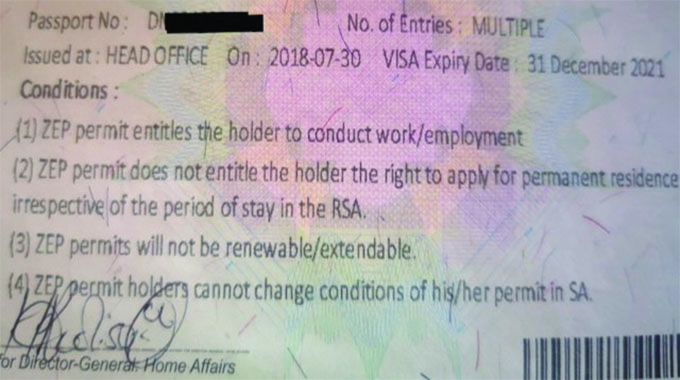
Stephen Mpofu, Perspective
YES, there was relief, better still joy and anger on international airwaves, but more importantly on the ground here at home in responses to a ruling by South Africa’s Pretoria High Court to the effect that the decision by that country’s government not to extend the lifespan of the Zimbabwe Exemption Permits (ZEP) was unconstitutional.
There are close to 180 000 Zimbabweans living and working in South Africa under the ZEP permits.
In 2021, South Africa’s Cabinet resolved not to extend further the permits saying that the affected Zimbabweans should migrate to mainstream permits and those who fail to do so should depart by June 30 this year.
However, the Home Affairs Ministry extended the grace period to December 31 this year and following the announcement, several groups including the Hellen Suzman Foundation and the Consortium for Refugees and Migrants in South Africa, and the Zimbabwe Immigration Federation took the South African government to court, arguing that the resolution by the SA Cabinet would negatively affect migrants who had been in South Africa for over a decade.
The high court decision to not have ZEP holders out of South Africa by yesterday, the end of June, has caused furore among opposition political parties in this country with their representatives in the United States of America, in South Africa and here at home, telling Mr Jonga Kandemiri of the Voice of America’s Studio 7 about their disappointment over the decision to allow the Zimbabweans to stay on in that country.
It must have become apparent to anyone listening to the grievances of the opposition representatives that they had wished the ZEP holders in South Africa to return home and implement that party’s opposition agenda item on August 23, the day of harmonised elections in this country.
However, as things stand now opposition party ZEP members who came back and registered as voters under a belief that they will have left South Africa at the end of this month might not be allowed to leave their jobs there and come back home to cast their votes — which is probably why their party representatives back home are furious.
“Me thinks” — as William Shakespeare, the great English writer might have said — that in its ruling against the ZEP holders being hustled out like that, the Pretoria High Court must have taken cognisance of the fact that the people in point were not out of space of the Southern African Development Committee (Sadc) of which their country, Zimbabwe, is an integral part and that, moreover, Zimbabweans have contributed to South Africa’s economic growth for many years while that country was still under apartheid rule. Many people from this country were before independence recruited to work in Wenela Mines while indigenous South African blacks spent their times in gigs instead.
That said, immigration representatives in South Africa told VOA’s Kandemiri, himself a Zimbabwean, that they still feared the Pretoria High Court decision might be appealed by the government or that in consultations that the court said must be made with both the migrants and South Africans, the latter might make overwhelming representations against the decision to allow the ZEP holders to migrate to mainstream permits.
While we’re still at it, is it not tragically ironic that Zimbabwe boasts so many universities such as the University of Zimbabwe (UZ), the oldest of the institutions, the National University of Science and Technology (Nust), the Midlands State University (MSU) and several others which all account for among Africa’s highest literacy ratings.
But surely, should not these institutions of higher learning not also be popular for producing entrepreneurs to create jobs for Zimbabwean graduates many of whom leave the country after completing their studies to seek employment in foreign countries where some of them are subjected to virtual slave treatment.
Or is our education system tailored to produce mere academics with not an aorta of entrepreneurship to provide jobs and in the process grow the economy?
Curiosa and curiosa.
Or should a state fund be set up to enable graduates to set up start-up companies in their respective areas of academic specialisation?



 Online Reporter