

 Chronicle Editor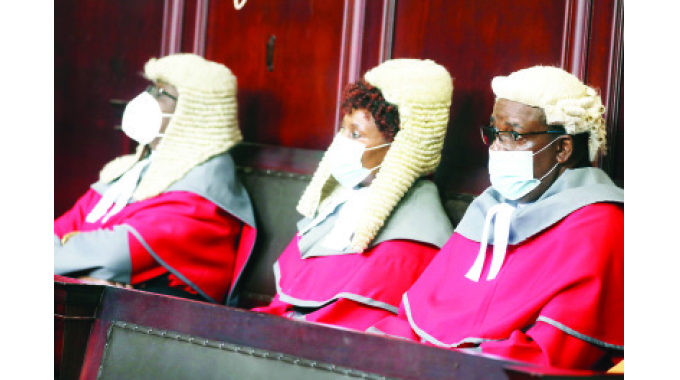
Midlands Bureau Chief
THE Judicial Service Commission (JSC) is engaging members of the public, legal experts and chiefs on whether Judges should continue wearing wigs.
Chief Justice Luke Malaba has since constituted a three-member committee, (Judicial Wigs Committee) to spearhead the discussions.
In 2019, JSC placed orders for 64 wigs made of horsehair from the exclusive and expensive Stanley Ley Legal Outfitters in England.
Each wig was bought at £1 850 (US$2 426,99), costing a total of £118 400 (US$155 286,80).
The delivery of the wigs steered debate on whether or not Zimbabwean judges should continue using the wigs, which some regard as a colonial relic.

Some believe wigs have nothing to do with professionalism while others are against the head gear citing exorbitant costs.
Others argue that the wigs have been abandoned in several Commonwealth countries like South Africa and Kenya while their role has decreased in Britain, from whom the practice was adopted.
Judges in Britain wear wigs only when hearing criminal matters as part of dress code reforms in 2008, ending a centuries-old tradition.
Zimbabwean judges wear gowns and wigs while in court.
JSC spokesperson Mr Daniel Nemukuyu confirmed the public consultations with regards to the wigs.
“The JSC contemplates on doing away with wigs but since it is a people’s judiciary, they want to hear people’s views before making a proper decision.
“As you may be aware, there is an ongoing debate on whether or not judicial wigs, both ceremonial or normal court wigs for Judges of Superior Courts be removed or retained as part of judicial attire,” he said.
According to a memorandum to regional and provincial magistrate by deputy chief magistrate Mr Ngoni Nduna, it has been resolved that consultations be done with a wide representation of stakeholders in the justice delivery system on the subject.
He said a committee was put in place to spearhead the consultation process.
“The Zimbabwean legal system was inherited from Britain. Hitherto, it still adheres to and uses a lot of traditions that characterise the British legal system, such as the wearing of wigs by judicial officers.
Historically, the trend of wearing wigs in court was started by Louis XIV of France,” said Mr Nduna.
He said around the mid-17th century, the trend quickly spread throughout the upper and middle classes in Europe including Britain and became more popular after Charles Il embraced it.
“Despite this fact, there has been a wave in the past decade of legal systems advocating for the removal of certain colonial judicial attire from being part of the official judicial ensemble, particularly the horsehair wigs.
“This debate has spread with some African jurisdictions like Kenya implementing reforms to their judicial attire, particularly judicial wigs. It is noted, for the purpose of this argument, that there are two types of judicial wigs, ceremonial wigs, worn during ceremonies such as the legal year opening and official court wigs, worn during court proceedings,” said Mr Nduna.
He said like any other African country whose legal system was influenced by colonial history, Zimbabwe has not been exempted from the debate on whether to maintain the tradition of wearing wigs or embrace change.
Consequently, he said this debate has gained traction in the region and beyond noting that from a Zimbabwean perspective, Judges had the occasion to debate on this subject matter during the end of the
First Term Judges’ Symposium held in Masvingo in April this year.
“Therein, it was resolved that this debate must recur and continue among the Judges in their respective courts. Further, it was resolved that comprehensive consultations be held with other stakeholders as may be necessary,” he said.
Mr Nduna said Chief Justice Luke Malaba constituted a three-member committee to spearhead the discussions on this important subject.
“Upon its appointment, the JWC resolved, pursuant to a baseline desk study, that it is an indispensable requirement of their mandate to solicit views from all stakeholders on the need to maintain or dispense with judicial wigs,” said Mr Nduna.

He said it is against this background that the JWC intends to solicit views of all stakeholders in the justice delivery system.
“Participants will be drawn from the relevant stakeholders who include judges, chiefs, Ministry of Justice, Legal and Parliamentary Affairs, Law Society of Zimbabwe, Zimbabwe Republic Police, Zimbabwe Prisons and Correctional Services, Parliament of Zimbabwe (Speaker, Clerk of Parliament and Parliamentary Legal Committee), Legal Aid Directorate, Attorney-General’s Office, Prosecutor General’s Office, non-governmental organisations, Civil Society and Churches and members of the public,” he said.



 Online Reporter
 Bongani Ndlovu