

 admin
admin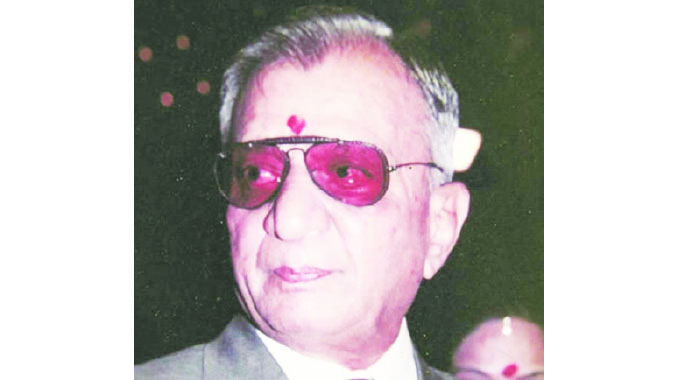
Tendai H. Manzvanzvike
Head, Zimpapers Knowledge Centre
THE struggle for independence and self-determination saw blacks, coloureds and progressive whites and Asians united under one cause — the dismantling of the racist, settler colonial system.
Politburo member, businessman, philanthropist and nationalist, Cde Kantibhai Gordhanbhai Patel was among the people who fought against the Rhodesian system.
Cde Kantibai Patel died on September 10, 2011 at Linksfield Hospital in Johannesburg, South Africa, where he was receiving specialist treatment after he sustained injuries when he fell at his Ridgeview home.
He was 83. His body was cremated at Pioneer Cemetery in Harare, according to the Hindu tradition.
Born on October 28, 1928 in Dharmaj, Gujarat State in India to a peasant family, Cde Patel did his primary and secondary education at Dharmaj and proceeded to do a Bachelor of Arts general degree at the University of Bombay.
Then the young and adventurous Kantibai, cut short his studies and decided to come to Africa, first going to Zambia in 1951 where he worked as an assistant shopkeeper for a year.
While in Zambia, the late hero rebelled against the colonial injustices that were being inflicted on shop assistants and formed a Shop Assistants’ Union to fight back.
As a result, he lost his job and stayed unemployed for two years. Cde Patel later became a teacher at Greenacre School in Kalomo, Zambia. The racist policies that segregated blacks, coloureds and Indians were a major factor that motivated Cde Patel to be involved in political activism at an early age.
Having come from a country where anti-colonial struggle for Independence was at its peak in the 1940s, Cde Patel quickly established strong links with revolutionaries that were driving the struggle in Southern Africa.
He established a close relationship with the African National Congress, and later the United National Independence Party (UNIP) of Zambia, to fight against colonial domination.
Due to his activism and leadership qualities, he became a member of the Provincial Race Relations Committee (Kalomo).
Cde Patel moved to Rhodesia (now Zimbabwe) in 1961 and joined other progressive Zimbabweans of Indian origin then working with the National Democratic Party (NDP) and Zimbabwe African People’s Union (Zapu), to fight against the Rhodesian regime.
During the same year, Cde Patel was elected to the executive of the Asian Association.
He radicalised the thinking of some of its members to support African nationalism and their struggle for independence.
In the 1960s, Cde Patel was appointed district treasurer of Zapu in Norton District. In 1969, he participated in organising the Gandhi Centenary Celebrations in the then Rhodesia to commemorate the contributions made by Mahatma Gandhi to the struggles for independence by the people of southern Africa.
Due to his stance against colonialism, his house and shop were twice ransacked by the colonial police after the banning of NDP and Zapu in the late sixties.
As more and more Africans became disenchanted with the colonial regime and became involved in political activism in the 1970s, a number of radical black students were expelled from the University of Rhodesia.
This resulted in Cde Patel and other members of the progressive Indian community starting the Sarasvati Education Trust, to raise funds for scholarships for the expelled black students, to study in universities overseas.
In 1980, Cde Patel became the interim chairman of the Zanu-PF Tongogara Ridgeview Branch where he worked with stalwarts like Cdes Nathan Shamuyarira, Maurice Nyagumbo and Herbert Ushewokunze.
When the branch was finally established, he was elected vice-chairman. In 1981, he formed the Zanu-PF District executive committee of the Harare Central branch and became its treasurer.
He was later elected to be the provincial finance secretary.
In 1985, then Prime Minister Mugabe, appointed him Senator. Cde Patel said his race was not a factor. He instead saw his role as contributing to the efforts being made at developing the country’s rural areas.
“I am a member of the party Zanu (PF), and will see that my party’s programmes are implemented. I shall try to add to the momentum in rural development, with special regards to the opening of banks and the provision of better rural services, and all those efforts add to the upliftment of the standards of living in the rural areas,” he said in an interview.
In 1986, Cde Patel called on rural communities to build small and medium-size dams on their own, rather than wait for the Government to build bigger ones for them.
Five years later, he was appointed a non-constituency Member of Parliament.
In August 1991, Cde Patel contributing in an “angry motion” in the parliament, called on Government to prosecute companies and private operators whose vehicles were involved in accidents, which resulted in deaths. He said the perpetrators should be made liable to pay compensation.
At the Zanu-PF Congress in 1994, Cde Patel was elevated to the Central Committee. In 1995, he was re-elected Member of Parliament and served on the Public Accounts and Technical portfolio.
Cde Patel was re-elected in 1999 into the Central Committee and subsequently in 2004, elevated to the Zanu-PF Politburo as Deputy Secretary for Finance. In 2005 he was appointed to the Senate.
Cde Patel sat on the national board of trustees of the Child Survival and Development Foundation and was a board member of the 21st February Movement.
He was the treasurer of the Zimbabwe-India Friendship Association through which the Jawaharlal Nehru-Robert Mugabe Scholarship fund was established.
Following the passing on of Cde Patel, President Mugabe said about the veteran nationalist: “A veteran nationalist and astute politician who belonged to a rare breed of very few courageous non-African revolutionaries in Zimbabwe … His contributions to the liberation of this country and philanthropic work are well documented and they shall remain etched in the annals of the history of Zimbabwe … We recall his heroic political activities in the National Democratic Party, the Zimbabwe African People’s Union and the Zimbabwe African National Union (Patriotic Front)”.
Cde Patel who was a widower, having lost his wife in 1973 was survived by three children (all boys), and seven grandchildren.
Sources: A Guide to the Heroes Acre: Some basic facts about Zimbabwe’s heroes and the Heroes Acre. (2019) Harare: Ministry of Information, Publicity and Broadcasting Services, and The Herald



 Online Reporter