Mahwani Kangausaru
THE increase in water levels at Lake Kariba has given a significant boost to Zimbabwe’s electrical sector. Better storage translates into higher hydropower generation and more reliability in national power supply.
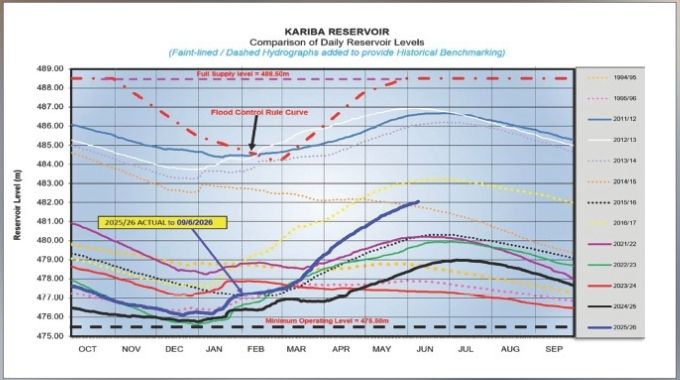
Latest statistics from the Zambezi River Authority (ZRA) show that Lake Kariba was at 482,05 metres on June 9, 2026, compared to 478,60 metres on the same day last year. More importantly, usable storage increased to 47,32 percent, more than double the 21,65 percent recorded in June 2025.
The improved hydrological situation has enabled improved generation at Kariba South Power Station. Zimbabwe Power Company records reveal that on June 16, 2026, Kariba fed 520MW into the national grid compared to 400MW on the same day last year.
The national electricity generation was 1 456MW in June 2025 and now it is 1 584MW. Hwange Thermal Power Station was the top producer with 1,006MW, while Independent Power Producers were providing 58MW.
The recovery is a big turnaround from the severe limits imposed during the past drought years when authorities had to limit energy generation from the Kariba complex with falling water levels.
Kariba is more than just a source of electricity to Zimbabwe. The reservoir is the backbone of the country’s renewable energy capabilities and is crucial in supporting economic activity, industrial production and residential power supply.
However, the good nature of the current situation should not be used as a reason for complacency.
Hydrological records show that river flows in the Zambezi Basin are now declining with the onset of the dry season.
By June 15, 2026, flows at Victoria Falls had fallen to 2 090 cubic metres per second from 2 429 cubic metres per second on the same date the year before.
Other monitoring sites reveal similar tendencies. Flows at Chavuma declined to 469 cubic metres per second and
Ngonye 1 632 cubic metres per second, both lower than levels observed in 2025.
The results underline the seasonal fact that inflows into Lake Kariba will continue to decrease in the coming months.
This water situation is further underpinned by the 2026 water allotment granted by the ZRA. This year, authorities granted a total of 30 billion cubic metres (BCM) of water for power production at Lake Kariba, split evenly between
Zimbabwe and Zambia. This offers the Zimbabwe Power Company access to 15BCM, a reflection of the enhanced hydrological conditions that have formed after a higher rainy season. It gives additional flexibility for power production and reaffirms the country’s better energy future. However, if the expected El Niño for 2026/27 materialise and rainfall underperforms, ZRA could take a more cautious stance in establishing the 2027 water allocation later this year, emphasising the need to preserve present water supplies.
In a press statement on April 20, the Meteorological Services Department (MSD) stated global climate forecasting centres also predicted a high probability, ranging from 88 percent to 94 percent, that an El Niño event will develop during the 2026/27 rainy season, as they carry a historical 65 percent chance of below–normal rainfall in Zimbabwe; thus the need for prudence. However, the MSD has warned that estimates remain uncertain at this stage and an official seasonal outlook would be released later in the year. El Niño occurrences are generally associated with an increased probability of below-normal rainfall across Zimbabwe.
In this perspective, the current recovery should be seen as a window of opportunity to build resilience, not a guarantee of extended plenty. Higher water levels offer a buffer but still need careful management of water flows to maintain enough reserves for future power generation should the rainfall forecast worsen.
The experience of past years is a relevant reminder. The peak of the drought decreased inflows into Lake Kariba, leading to significant energy shortages, increasing dependence on imports and additional pressure on thermal generating facilities.
So the water allocations at Kariba still need to be managed carefully. This must be accompanied by further investment in diversification of production via thermal power, solar projects and independent power sources. Energy portfolio diversification reduces dependence on a single hydrological system, increasing the nation’s energy security.
Consumers, too, have a role to play. Energy conservation and prudent use of electricity may reduce unnecessary demand while safeguarding essential water resources for future generation needs.
The good news is that Zimbabwe is in a far better situation going into the second half of 2026 than it was a year ago. Lake Kariba’s usable storage has more than doubled and hydropower output has risen dramatically, with national generation at over 1 500MW.
But lessons from prior droughts still apply. Zimbabwe has to ensure sustainable management of water and electrical resources to maintain energy stability and be ready for whatever climatic conditions may arise during the 2026/27 season.