

 Chronicle Editor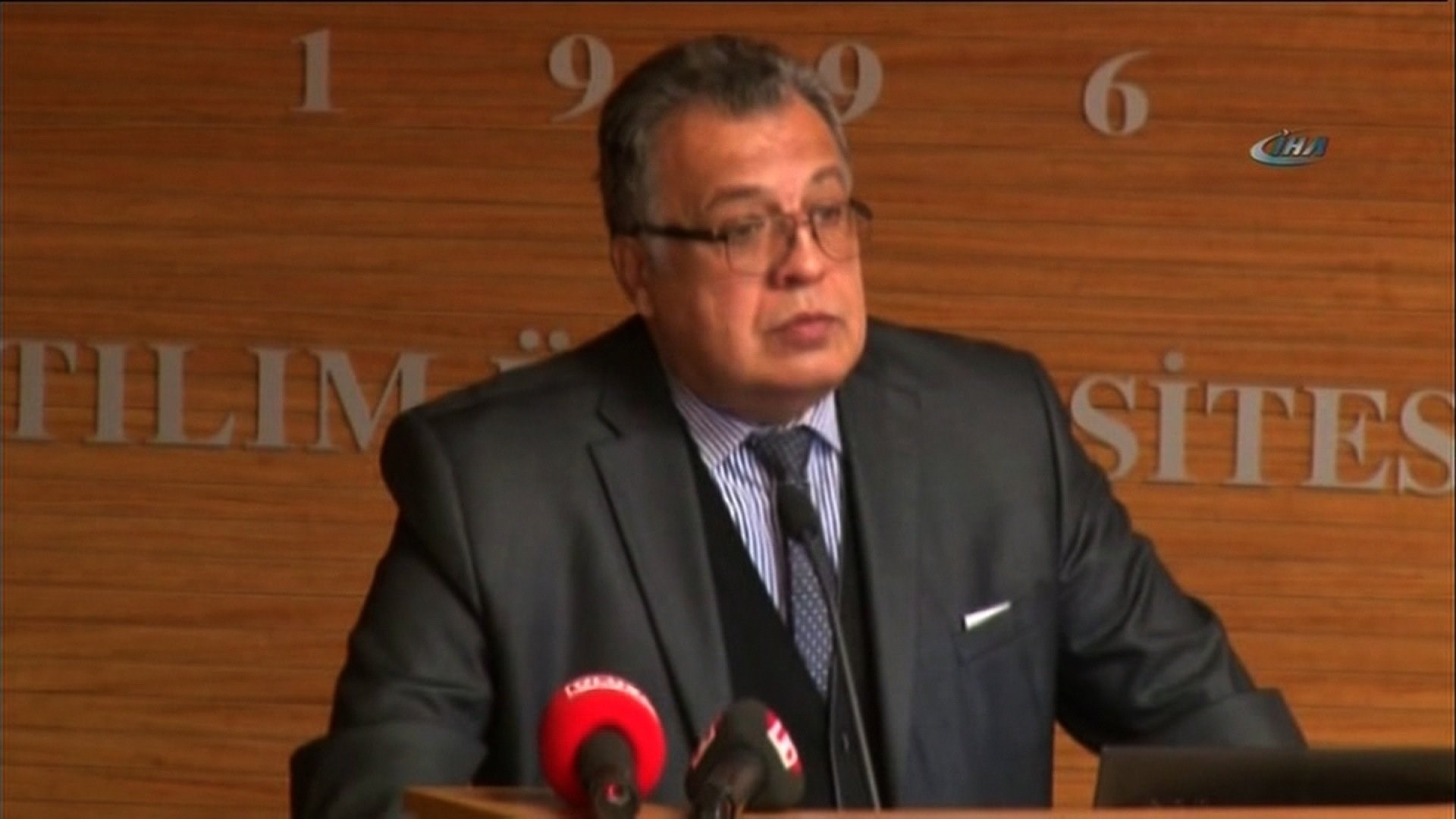
Special Correspondent
RUSSIA’S ambassador, Andrey Karlov (62) was shot in the Turkish capital while delivering a speech at the opening of the exhibition “Russia in the eyes of Turks” at an art gallery in Ankara. The gunman has been identified as 22-year-old Mevlüt Mert Alt?nta?, ex-member of the Ankara riot police. Karlov was shot in the back nine times and died of his wounds shortly afterward.
The Russian Foreign Ministry said it regarded the killing as a terrorist attack. A spokeswoman, Maria Zakharova, also said the attack would not derail the countries’ relationship. “Terrorism will not pass, we will fight it resolutely. The memory of this outstanding Russian diplomat, a man who did so much to counter terrorism in his diplomat line of work, Andrei Karlov, will remain in our hearts forever.”
“This is a shock for all of us, this is shot at every single one of us. I understand that for those who did not know him, this is a loss, this is a blow to our country. However, for those who knew him, a part of us was killed today,” Zakharova said. “This person was . . . the ambassador of the country that keeps the world at the brink of another collapse, to which you know who has led. This person worked for the sake of bilateral relations,” she added. Mrs. Zakharova also said Turkey had assured Russia there would be a thorough investigation into the shooting.
The fatal attack on Russia’s ambassador to Turkey is “a provocation” aimed at the settling of the Syrian crisis, Russian President Vladimir Putin said in a statement on Monday evening. “This murder is clearly a provocation aimed at undermining the improvement and normalisation of Russian-Turkish relations, as well as undermining the peace process in Syria promoted by Russia, Turkey, Iran and other countries interested in settling the conflict in Syria,” Putin said.
The “only response” to the attack that Moscow “should offer” is “stepping up the fight against terrorism,” the president added. “The killers will feel it,” Putin said.
Saying that ambassador Andrey Karlov “was a brilliant diplomat, widely respected in the country where he was posted,” the president added the Russian diplomat “was in good standing with both the government of Turkey and other political groups in that country.”
Russia’s Investigative Committee has already launched an investigation into the murder, Putin said in his statement, adding that he had held a phone conversation with his Turkish counterpart, President Recep Tayyip Erdogan, on the matter. Russian and Turkish officials will cooperate, Putin added.
“We have to know who organised this killing and gave orders to the assassin,” the Russian leader said.
Putin also ordered security to be strengthened at Russia’s diplomatic missions abroad, as well as Turkish missions in Russia.
Saying that he knew Karlov personally, and calling him a “kind man,” the president tasked officials with awarding the assassinated ambassador posthumously and initiating a memorial for him. “He was killed while performing his duties,” Putin said.
Meanwhile, Erdogan called the shooting of Russia’s ambassador in Ankara a provocation, aimed at destroying bilateral ties. The Turkish leader “strongly” and “vehemently” condemned the assassination of Andrey Karlov. “I believe this is an attack on Turkey, the Turkish state and the Turkish people, and also a clear provocation . . . (in terms of) Turkish-Russian relations. I am sure our Russian friends also see this fact,” Erdogan said. “Both Turkey and Russia have the will not to be deceived by this provocation.” Erdogan also added that a joint commission with Russia would be established to investigate the murder.
Andrey Gennadievich Karlov was born in 1954. After graduating from the Moscow State Institute of International Relations in 1976, Karlov served in various positions in Soviet and Russian Foreign Service at home and abroad. In 2001, he was promoted to Russia’s Ambassador Extraordinary and Plenipotentiary in the Democratic People’s Republic of Korea, the highest position a Russian ambassador can hold. Karlov was promoted again in 2007, to Deputy Director General for Consular Affairs, and again to Director General. In July 2013 he returned to the field to become Russia’s ambassador to Turkey. Karlov assumed the office as tensions between Russia and Turkey began to reach a fever pitch over the Syrian civil war. Russia officially backed the government of Syrian president Bashar al-Assad, while Turkey threw its weight behind the rebel factions trying to oust him. In November 2015, a Turkish fighter jet shot down a Russian Su-24 bomber that the Turkish government claimed had ignored warnings that it was violating Turkish airspace. They also claimed not to have known the nationality of the plane until after they shot it down. The Russians claimed that the bomber never entered Turkish airspace, nor were the pilots warned before the Turks opened fire.
Russian President Vladimir Putin called the incident, which claimed the life of one of the pilots, a “stab in the back by terrorist accomplices.” It signaled a souring of Russo-Turkish relations. However, after the failed coup attempt in June 2016, when Russia firmly supported the legitimate government of Turkey, relations drastically improved. President Erdogan publicly apologised for the incident with the Russian military aircraft and the two countries pledged to work together in Syria, though acknowledging differences. In a December 16 statement, Karlov said that Russo-Turkish relations had renormalised as the two nations collaborate to evacuate civilians from the war torn city despite backing opposite sides of the Syrian Civil War. “In the last three months, our presidents Putin and Erdogan met three times and had phone conversations 11 times. President Putin has not spoken with any other world leader as often as he has spoken with President Erdogan,” said Karlov. Karlov was married with children, and was fluent in both English and Korean. He was 62 years old.
The book of condolence will be opened at the Russian Embassy, located in 70 Fife Avenue, Harare (Consular Section Entrance), on December 20 from 2 pm to 5 pm and on December 21 and 22 from 9 am to 12 am and from 2 pm to 5 pm.
Source: Embassy of Russia, Harare.


 Online Reporter