

 admin
admin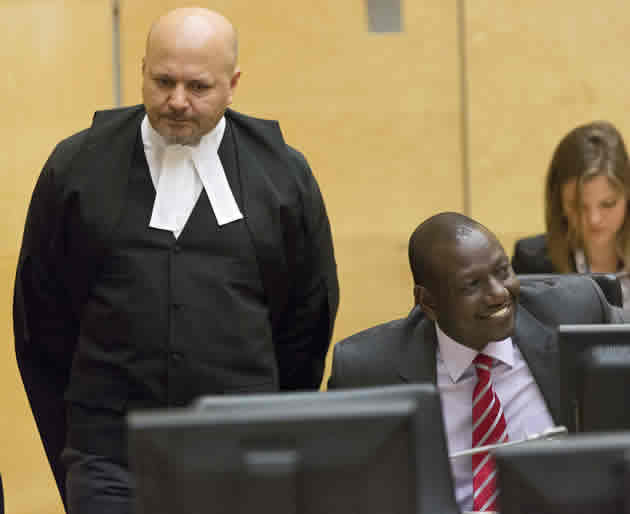

THE HAGUE – Kenya Vice President William Ruto went on trial for crimes against humanity at the International Criminal Court on Tuesday, the most senior official ever judged by the under-fire tribunal.
“Welcome to all,” said presiding Judge Chile Eboe-Osuji as he opened proceedings before Ruto, dressed in a grey suit and red and white tie, and his co-accused, radio boss Joshua arap Sang.
Ruto (46), arrived at court voluntarily the day after flying into The Hague from Nairobi to face charges of masterminding deadly post-election violence in the east African nation five years ago.
A crowd of Kenyan MPs and other supporters welcomed Ruto and Sang (38), as they arrived for the politically-charged trial.
A Ruto bodyguard pushed journalists out of the way, while Sang proclaimed his innocence.
“We are here and now God will see us through,” Sang said.
“I did not contribute to the violence in Kenya, but peace.”
Kenyan President Uhuru Kenyatta, a one-time political foe of Ruto’s turned ally, goes on trial at the ICC on November 12. He also says he is innocent.
The ICC has come under increased pressure globally, especially from the 54-nation African Union, which accused the court of targeting the continent on the basis of race and demanded the court drop the Kenyan prosecutions.
The trial also comes just days after lawmakers in Kenya became the first in the world to approve moves to withdraw recognition of the court’s jurisdiction.
Any move by Kenya to leave the ICC’s Rome Statute will have no effect on the current trials, but observers fear it may spark an exodus of court member states in Africa, where all the ICC’s current cases are based.
“We have come to say that we want to make it clear that these people are innocent,” Kenyan MP William Cheptuno told journalists at the court.
“They are innocent until proven guilty. This is the rule of law in Africa, in Europe, everywhere in the world.”
Ruto and Sang each face three counts of murder, deportation and persecution after a wave of violence swept Kenya in 2007-08, leaving at least 1,100 dead and more than 600,000 homeless. Both are expected to plead not guilty.
Violence in 2007-2008 laid bare simmering ethnic tensions. The violence was mainly directed at members of Kenya’s largest Kikuyu tribe, who were perceived as supporters of then president Mwai Kibaki’s Party of National Unity (PNU).
Pre-trial judges said evidence suggested that Ruto held a number of meetings to plan the ethnic killings as far back as December 2006.
Initial attacks quickly led to reprisals, with homes torched and more people hacked to death, bringing some parts of the country to the brink of civil war.
The ICC, the world’s only independent, permanent tribunal for war crimes, genocide and crimes against humanity, took charge of the cases after Nairobi failed to set up a tribunal of its own in line with agreements brokered by former UN secretary general Kofi Annan.
Despite vowing cooperation with the court, Kenyatta said over the weekend that he would not allow both leaders to be out of the country at the same time.
Judge Eboe-Osuji said that he also would prefer for the two cases to be staggered, possibly with each case heard for four weeks at a time.
The cases have been mired in accusations of witness intimidation, allegations dismissed by the defence.
But several witnesses already having pulled out of the trial and ICC chief prosecutor Fatou Bensouda and rights groups have frequently raised the issue.
Amnesty International said the start of the trial was “an important opportunity to end impunity for the serious crimes committed in 2007/2008.
“The government’s recent efforts to politicise the ICC trials are deplorable, and must not be allowed to affect the commencement and future proceedings of this landmark trial,” Amnesty’s Netsanet Belay said in a statement.
But there is concern in Kenya that the trials could reopen old wounds and undo reconciliation efforts by communities who once fought each other in deadly battles. – AFP.



 Online Reporter