

 admin
admin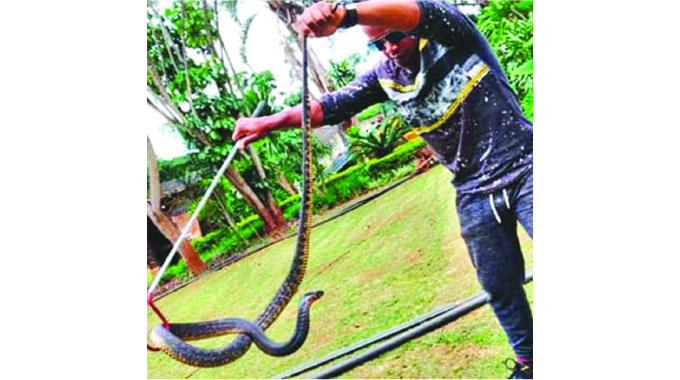
Sifelani Tsiko
Innovations Editor
As the country is already into the snake season which usually lasts from September to March – it is quite important for the public and medical experts to familiarise themselves with the list of potentially fatal snake species found in the country.
Popular snake handler Chawatama Marimo with vast experience in snake identification and handling spanning more than two decades was recently invited by the Zimbabwe Medical Association (ZiMA) to share some useful insights about the problem of snake bites in the country.
Zimbabwe often registers more cases of snake bites during the rainfall season and less when snakes hibernate between April and August.
At the seminar, Chawatama noted that it was very important for medical doctors to familiarise themselves with the list of both deadly snakes and non-venomous ones – knowing how to identify them and understand their danger level so as to quickly offer appropriate treatment to victims.
He also said it was important for medical doctors to be prepared for snakebite emergencies and that education, cooperation and research in partnership with snake handlers and charmers is important in improving their knowledge and skills in the identification, handling and snakebite treatment of victims.
Medical experts hailed Chawatama for his presentation on snake identification, handling and snakebite treatment saying it gave them a good measure of understanding snakes to improve their knowledge and skills.
“The presentation was very relevant and worthwhile and the use of practical life examples make it more relatable to the audience. Chawatama even invited a bite victim of a Mozambique spitting cobra who was accompanied by his father to this seminar,” said University of Zimbabwe pharmacist-toxicologist Prof Dexter Tagwireyi.
“This seminar was quite enriching for us. He also shared life experiences of bites from venomous snakes including his very own experience.”
Marimo stressed the importance of doctors and other attending healthcare professionals to be able to identify or at least have an idea of venomous snakes in the country which are of medical importance.
The popular Zimbabwean snake handler also said that it was equally important for healthcare professionals to know that there are non-venomous snakes like the Brown House Snake which may cause panic in bite victims with symptoms of shock like sweating, dizziness which may in fact be the result of panicking and not of snake venom (since this snake is harmless to people).
“Chawatama also mentioned the importance of supportive therapy aimed at supporting breathing and the heart which could be lifesaving in cases of bites from neurotoxic snakes like the black mamba or snouted cobra – even in the absence of antivenom,” said Prof Tagwireyi.
“He informed us that although the snouted cobra is widespread in Harare (especially in residences that keep chickens), bites from these snakes are very rare.
“In addition, Chawatama also told us that bites from the python, although not venomous, are still dangerous as the razor sharp teeth could rip open the skin at the bite site.”
Marimo has vast snake handling experience and has encountered most of the dangerous snakes found in the country, namely snouted or Egyptian cobra, boomslang, Mozambique spitting cobra, night adder, puff adder, stilleto and black mamba.
Zimbabwe is home to roughly more than 80 snake species and some snake experts suggest that more continue to be discovered especially in unstudied areas or remote habitats.
According to the African Snakebite Institute, Zimbabwe has 81 snake species, 48 of which are highly poisonous.
About 14 people have lost their lives due to snake bites in Zimbabwe since the beginning of the year, according to a Ministry of Health and Child Care update released last month.
In a disease surveillance report for the week ending September 15, the Ministry indicated that there have been a total of 2 917 reported snake bite cases this year, with no deaths recorded in the most recent week.
This marks a significant increase compared to last year, which recorded 707 snake bite cases and three fatalities.
Zimbabwe, just like many other developing countries is grappling with the snake bites menace and an acute shortage of anti-venoms.
At present, Zimbabwe spends a sizeable amount foreign currency importing anti-venom from other countries, which some highly placed hospital sources say it’s not effective in the treatment of snake bites and has caused complications in a number local patients.
One vial or dose costs between US$80 and US$150 or more depending on the quality and manufacturer. The majority cannot afford to pay for the doses.
Official figures show that by March 25, 2018, there were 114 cases of snake bites and one death. The cumulative figure for snake bites were 1 937 and 13 deaths by this period.
In the first quarter of 2017, snake bites claimed 38 lives, while the total number of those bitten were 5 605. There is a paucity of information on snake bites as many go unreported in most parts of the country. Figures are only based on estimates.
Researchers say the biggest killer are puff adders which are responsible for up to 90 percent of cases of deaths.
Snake bites kill approximately 32 000 people in Africa and leave an estimated 435 000 to 580 000 victims annually that need treatment.
According to the World Health Organisation, more than 5,4 million people worldwide are bitten by snakes each year with 1,8 to 2,7 million cases of envenomings – potentially life-threatening conditions that occur when a person is bitten or sprayed with venom from a venomous snake.
Between 81 410 to 137 880 people die each year because of snake bites and around three times as many amputations and other permanent disabilities are caused by snake bites annually.
Health experts say bites by venomous snakes can cause paralysis that may prevent breathing, bleeding disorders that can lead to a fatal haemorrhage, irreversible kidney failure and tissue damage that can cause permanent disability and limb amputation.
Agricultural workers and children are the most affected. Children often suffer more severe effects than adults, due to their smaller body mass, according to the WHO.



 Online Reporter