Online Reporter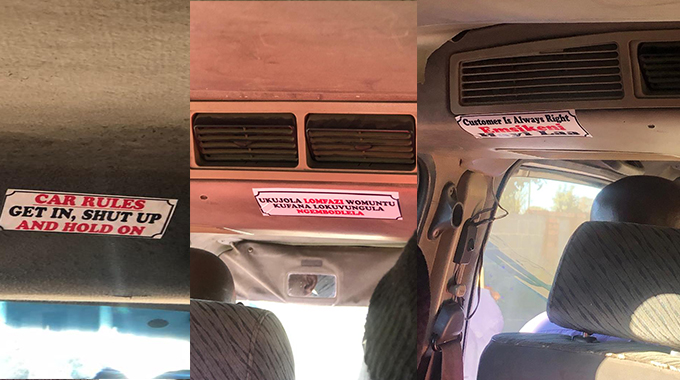
Trish Mukwazo, [email protected]
THE devil is in the detail — an idiom that warns us that while something may appear harmless on the surface, hidden problems often lie beneath. It reminds us that attention to detail is crucial, as overlooking small elements can lead to unintended consequences.
This sentiment rings true when one considers the many messages plastered as stickers inside our Emergency Taxis (ETs) or commuter omnibuses. At best, they make for fascinating reading; at worst, they are downright irritating.
Drivers and touts in our public transport system are notorious for their uncouth behaviour, often expressed through crude language and abrasive demeanour. Insults have become a way of life — delivered with a mischievous energy, a clever defiance, and a self-assured boldness.
In a development that has further broadened their notoriety, kombi crews have embraced the use of stickers to convey their often mundane, sometimes provocative messages.
But what lies beneath these messages? One often has to scratch their head to grasp the intended meaning.
A sticker that immediately catches the eye upon boarding an ET reads: “Car rules: get in, shut up and hold on.”
Does this reflect the attitude of kombi crews — that passengers should not question anything, no matter how inappropriate? Do our rights end at the kombi door?
This sentiment is echoed in other stickers such as: “Customer is always right emsikeni hayi laa” (A customer is right at the market, not here), and “Obejahile uhambe izolo” (The one in a hurry left yesterday).
Do these suggest that once aboard, you are no longer a paying customer but merely a passenger, subject to the whims of the crew?
One sticker boldly declares: “i-Customer ngeye mbanje, lina lingama passenger” (A customer is someone who buys marijuana; you are just passengers).
Yet, in another, the term “passenger” is used again: “If you are a passenger, don’t greet people nge window, uyaqeda i-fuel” (Don’t greet people through the window, you’re wasting fuel).
Two stickers that are likely to offend feminists read: “Umfazi yinkinga edingakalayo empilweni” (A woman is a necessary problem in life), and “Ukujola lomfazi womuntu kufana lokuvungula ngembodlela” (Dating another man’s wife is like picking youth teeth with a broken bottle).
These messages are not only problematic but reflect deeply entrenched gender biases.
Other stickers, while less offensive, still raise eyebrows: “Yonke into egadwayo iyaguga” (Everything that is ridden over eventually wears out), possibly acknowledging the vehicle’s poor condition; and “Ungazi ngombono emoteni” (Don’t share your opinions in this vehicle), which may imply that passengers should not question anything.
Some stickers are simply bizarre or humorous: “Uthi angilabantu wena uyinyamanzana yini?” (You say I have no people — are you an animal?). “If hard work pays, show me a rich donkey,”

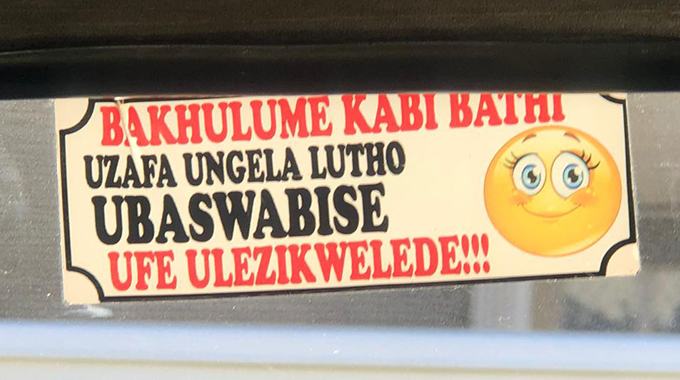
“Badala sihlale kuhle abanye bengahlali emoyeni njengama demoni” (Let all sit properly, others are sitting like floating demons), and “Bakhulume kubi bathi uzafa ungela lutho, ubaswabise ufe ulezikweledi” (They speak ill of you, saying you’ll die with nothing — at least die with debts).
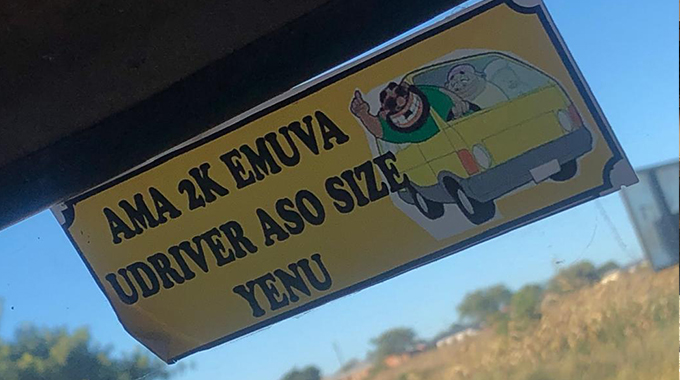
One sticker pokes fun at the younger generation: “Ama2k emuva, u-driver aso size yenu” (You born in the 2000s, the driver is not your age mate).
But perhaps the most self-aware sticker is the one that reads: “Akuyena yodwa iColgate elondoloza amazinyo, lokukhuluma ukhetha amagama kuyalondoloza njalo” (It’s not only toothpaste that preserves teeth — choosing your words also helps preserve them).