Online Reporter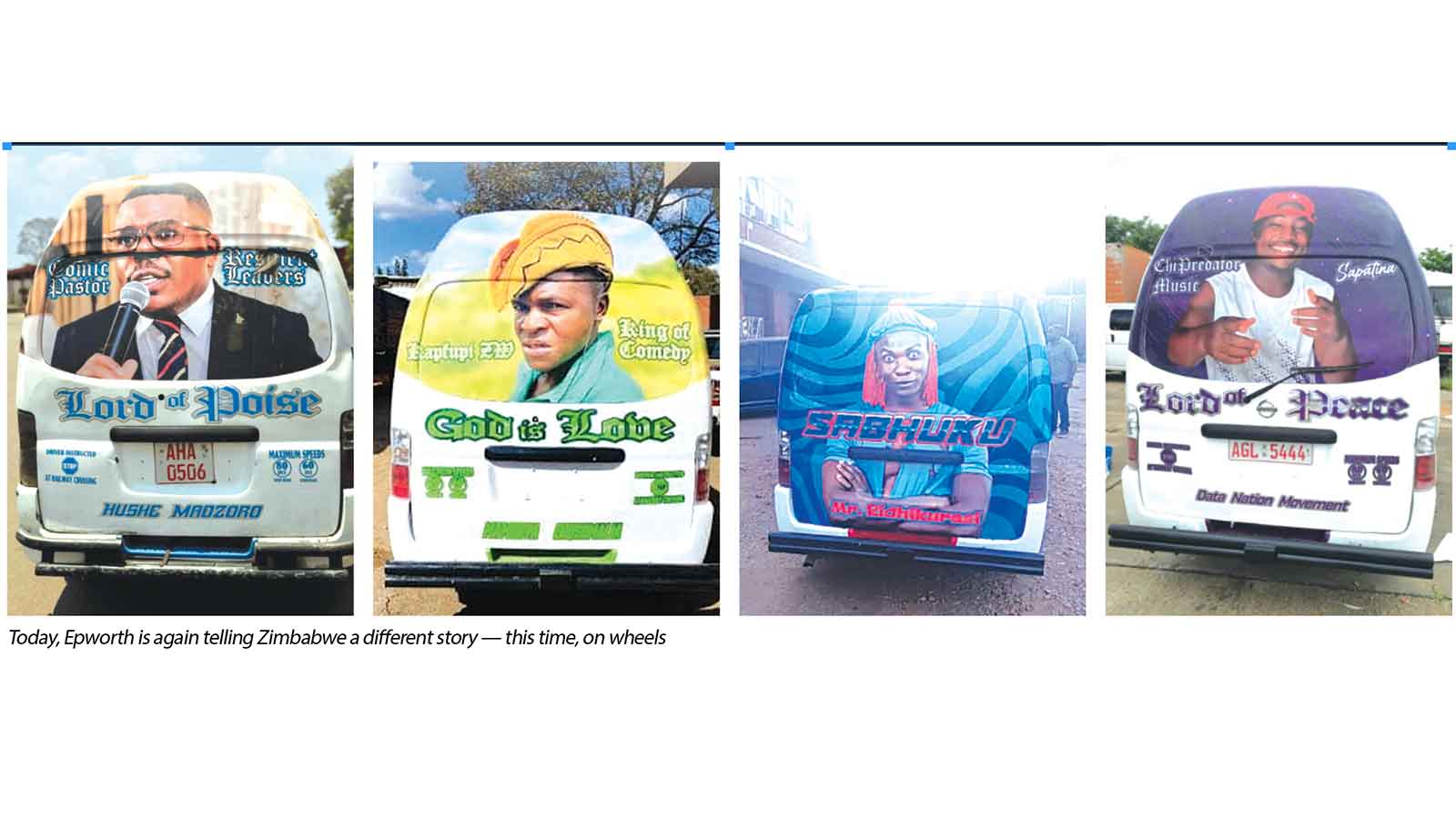
Theseus Shambare
WHENEVER a kombi is mentioned in the media, there is the usual talk — something bad must have happened, a red robot shot past, a tragedy unfolded.
The same judgment has long followed Epworth, Harare’s eastern dormitory town.
Like the biblical Lodiba, very few believed something good could ever come from it.
Yet history has been quietly correcting that assumption.
From WBO Africa Lightweight boxing champion Peter “Sniper” Pambeni, to the late karateka Mugove Muhambi, to football star Ronald Chitiyo, Epworth has produced national figures.
Comedy, too, found fertile ground here — through Prosper Ngomashi, popularly known as The Comic Pastor, and Kapfupi, born Freddy Manjalima.
Today, Epworth is again telling Zimbabwe a different story — this time, on wheels.
Chiremba road, the town’s main well-manicured road, commuter omnibuses roll past wrapped in colour, faces and familiar smiles.
Where once Lionel Messi or Cristiano Ronaldo stared back at passengers, Zimbabwean entertainers now take centre stage.
Laughter replaces distant fandom.
“This is intentional,” said Tafadzwa Carlos Tapomwa — Boss Carlo — founder of Adonai Transport.
“These are our own. Why should we wait to celebrate them?”
Short sentence. Big question.
Boss Carlo’s journey into transport is deeply personal.
“My father helped people Funerals. Churches. The community. That spirit stayed with me,” he said.
When his father passed away in 2009, Carlo did not just inherit a business idea — he inherited a responsibility.
Adonai Transport was born to create jobs.
“Team paghetto rakaomerwa ka (ghetto youths are struggling to earn a living),” he said.
“To move people safely and to move culture forward, Our kombis must mean something. They must speak,” he said.
And they do.
Across Adonai’s fleet are faces Zimbabweans recognise instantly.
Comedians who live on phone screens now live on the streets.
Kapfupi, whose humour once dominated television and music charts, smiles from the side panels.
His journey — from Epworth to national stages — mirrors the very road these kombis travel.
Then there is Atidaishe Chesoro “Mr Ridhikurasi”. Sharp wit. Millions of online views.
Beyond the familiar faces already celebrated, Adonai’s kombis also carry a wider roll call of Epworth’s creative voices — a deliberate effort to show the depth, not just the headlines, of township talent.
A digital following built on everyday observations that resonate across class and geography. “When you see yourself on a kombi,” he once joked online, “you know you’ve arrived.”
Arrival matters.
This is not limited to Epworth. Also featured on the kombi inscriptions is Leroy Tadiwanashe Zaware, “Comic Elder”, a product of social media’s fast lanes.
Although not from Epworth, his works have influenced many. His skits are short, punchy and unmistakably local.
From Facebook timelines to kombi routes, his reach has multiplied beyond screens.
The kombis also celebrate a broader constellation of Zimbabwe’s creative talent from Epworth and beyond, turning transport into a mobile honour roll.
Among those featured is Uncle Epatan (Ozeman Marera), a Zimdancehall artiste who has carved out a loyal following with hits like “Bata” and regularly returns to perform for his hometown crowds, insisting Epworth holds a “very special place in my heart”.
Dancehall voices such as ChiPredator bring another dimension to the mix, with tracks and challenges spreading across social platforms as he connects with fans through his music and online presence.
Even Chigudo Gudo — the Zimdancehall artiste still serving time in prison — has a devoted fanbase that continues to celebrate his work, with footage of him performing for inmates and admirers keeping his name alive in Zimbabwe’s dancehall circles.
These faces, together with the likes of Comic Pastor, Kapfupi and Mr Ridhikurasi, turn a simple kombi ride into a moving gallery of local culture — reminding passengers that Epworth and other townships are not just producers of talent, but curators of national pride.
For these creatives, the road is no longer just metaphorical.
When The Comic Pastor returned from overseas recently and saw himself emblazoned on an Adonai kombi, his reaction captured the moment perfectly.
“The man in that kombi,” he laughed in a video posted online, “is driving this car. If you have not yet boarded an Adonai kombi, you have not yet enjoyed travelling.”
It was humour. It was pride. It was recognition — alive and immediate.
For commuters, the feeling is equally powerful.
Josiah Tambudzayi, a resident of Epworth, said boarding one of the branded kombis feels different.
“You sit there and you see people you watch on your phone every day,” he said, “It makes you feel proud. It tells you that even from here, we can be seen.”
That validation, passengers say, travels with them long after they disembark.
This is where transport meets the creative economy.
A kombi travelling between Epworth and the city centre reaches thousands daily — office workers, vendors, students, artists themselves.
Each stop becomes exposure. Each glance, affirmation.
Offline validation. Online amplification.
Photos are snapped. Shared on WhatsApp. Posted on Facebook. TikTok clips follow. The kombi becomes content. The content becomes currency.
Cultural practitioners note that such visibility often translates directly into opportunity.
A familiar face on a kombi can lead to increased bookings, higher show attendance, brand collaborations and corporate MC gigs.
In a competitive creative market, recognition becomes leverage.
For young creatives, especially those without access to formal marketing structures, this kind of exposure is critical.
It opens doors to income, sustains livelihoods and encourages others to pursue art not just as passion, but as profession.
“This is grassroots branding at its most authentic,” observes a Harare-based cultural analyst.
“It lowers entry barriers into the creative economy and redistributes visibility to those who are genuinely connected to communities.”
The phenomenon is not limited to comedy.
Last year, a kombi driver branded his vehicle with the words “Ndini Mukudzeyi” — the title of Jah Prayzah’s recent album and world tour.
It was not a paid campaign; it was pure fandom — a rolling tribute from a supporter who chose to honour an artist through his daily work.
Jah Prayzah noticed.
Moved by the gesture, the musician took to social media, inviting the driver and his wife to his office.
There, he handed them free tickets to the album launch at Old Hararians — a simple act that reverberated far beyond the couple.
A kombi. A caption. A connection.
In that moment, the streets spoke back to the star — and the star listened.
The exchange revealed something profound: a two-way relationship between creators and communities.
The kombi was not merely advertising the artiste.
The artiste was affirming the kombi, the driver and the everyday Zimbabwean who believed enough to brand his livelihood with a name.
Across Harare, Bulawayo, Mutare and Gweru, similar scenes are emerging.
Kombis increasingly showcase Zimbabwean musicians, comedians and influencers instead of foreign football idols.
It marks a quiet but profound mindset shift.
For decades, recognition often arrived late — after death, or after international approval. Today, communities are saying: not anymore.
“We clap while you are alive,” Boss Carlo said. “Because tomorrow is not promised.”
The streets are listening. There is discipline behind the colour.
Adonai Transport prides itself on safety, boasting a zero-accident record since its launch. In an industry often criticised for recklessness, professionalism becomes part of the message.
“Respect the people,” Carlo said. “Respect the road. Respect the culture.”
Family businesses like his are evolving into social institutions — generating employment, modelling responsibility and shaping identity.
They prove that economic participation and cultural contribution can coexist, even in sectors often overlooked.
And Epworth is no longer just an entry point. It is a symbol. A reminder that greatness does not only rise from polished suburbs or corporate boardrooms.
Sometimes, it rises from dusty roads — painted bright, laughing loudly, moving forward.
As kombis criss-cross the nation carrying Zimbabwean faces, one truth becomes clear: Zimbabwe’s streets are no longer just moving people. They are moving beliefs.
Feedback: X @TheseusShambareW