

 admin
admin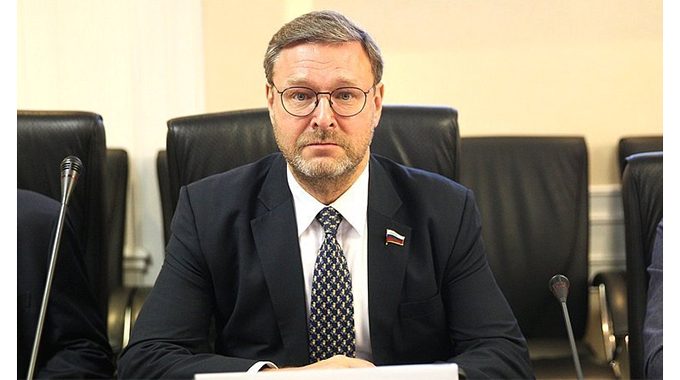
Konstantin Kosachev (Deputy Chairman of the Federation Council of the Russian Federation).
The most important conclusion from the events after February 24, 2022 is that the “end of history” solemnly announced at the end of the Cold War did not take place. What is happening in Ukraine, around it and as a result of the development of the situation there is, in fact, a revolt of history against those who tried to put an end to it. And this did not happen at all because, as Western leaders are trying to convince their citizens, some “revisionist powers” challenged the supposedly so comfortable “rules-based order” for everyone.
The idea of the “end of history” suffered from a generic defect that doomed it to failure, because it implied not the triumph of universal ideas, but the fixation of the global dictate of one pole, based on another “only true” doctrine, a dominant position in the world economy and an unprecedented military force. This model was considered final or final, not because it suited everyone, but because it is more expensive for most subjects of international relations to oppose it, as they say.
All the intimidation operations against Yugoslavia and in the Middle East, “further everywhere”, as well as economic sanctions against dissenters, as well as artificially generated voting results at the UN General Assembly under the threat of excommunication of small countries from Western aid — all this served a single purpose: to prove that the main task for any state in the world should be not to quarrel with The West, and for the chosen ones — to become a part of it.
The main task of the world community is to convince the West that democracy does not threaten it.
And now all this is suddenly called into question. That is why the West, with such blind and suicidal frenzy, is making the stakes in Ukraine ever higher, in fact existential: the special operation is shaking the world throne.
At the same time, surprisingly, in justification of the model of a unipolar world governed from one centre, the West resorts to the argument that it fundamentally rejects at the national level: they say, without a single owner, the world will plunge into chaos, and everyone will feel bad. What is a matter of pride in one’s own systems and belongs to the category of values is considered completely inapplicable in the international system. The West is categorically afraid of democracy, equality of subjects of international relations, equal access to governance, resources, and the development of common rules.
By imposing unprecedented sanctions against Russia, the West has, in fact, opened up all its pressure resources, its arsenals of economic weapons. Yes, this confirms its power, but at the same time very clearly convinces the whole world of the injustice of the current system, built strictly under one centre. Although in the conditions of a total crisis, in fact a global proxy war, the West itself risks being thrown on a desert island with an iPhone and a credit card. When there is a war, simple things begin to be valued — food, water, heat. Financial and technological blackmail of rich countries can lead to a backlash, as a result of which a revision of the current — still neocolonial in nature – system of redistribution of world wealth will begin.
Of course, cancelling the “end of history” means, among other things, that uncertainty will appear. But it should be considered primarily as a multivariance. That is, the availability of choice, which, by the way, is an important element of democracy.
Now any civilisation (Chinese, Russian, Islamic, Indian, Western) can offer its own scenarios of world development. And this is by no means a clash of democracy and authoritarianism, but a conceptual confrontation between the end of history and history without end.
Someone may be confused by the lack of predestination of the ways of human development. I want simple, “the only true” vectors, as was the case with the “world victory of communism” and with the “end of history”. But this is, firstly, fear of the democratic foundations of the world order and, secondly, civilisational snobbery, which simply does not allow the idea that someone can get equal rights along with the “chosen ones”. There are the same complexes, as well as, by historical standards, the recent bans on the participation of blacks in public and political life in the United States. Or the quite modern experience of the Baltic “democracies” of turning an entire category of residents of the country into “non-citizens” without the right to vote on a national basis. The favourite self-designation of the West and its supporters is “the whole civilized world” – and means that all others from this purely racist point of view are uncivilized peoples who have no place on Olympus and whose interests can be ignored. And it is better to “cancel” them altogether.
The key problem, however, is not to “re-educate” the West, or even to surpass it economically or militarily. For example, demographically or by the number of votes in the UN, the non-Western world far surpasses the “golden billion”. However, this quantity does not automatically translate into quality. The fact is that the current system was formed under the domination of the West, which pursued an important goal — to institutionalize the unipolar model of the world. Thus, for those who want to give the world an alternative, the task should be formulated in exactly the opposite way, as the institutionalization of multipolarity. That is, through the formation of new and strengthening of existing truly universal institutions.
Of course, what is happening today is a significant bid by Russia to participate in the formation of such institutions. Attempts to squeeze our country out of structures that are actually controlled by the West, such as the Council of Europe or the OSCE, in practice discredit these organizations themselves, turning into useless instances where resolutions that do not affect anything are stamped, unlike the real control centres of the Western system like NATO and the European Commission. The nervous reaction of the West to the strengthening of alternative structures, such as the SCO and BRICS, shows that the world is on the right track, building new decision-making mechanisms on a fundamentally different basis, without dividing into “teachers” and “students”.
However, the strategies of our participation in this process of forming a multipolar management system should exclude two key risks: acting alone, purely in their own interests, as well as “bipolar disorder”, that is, attempts to form new poles of the “cold War 2.0”. It should be clearly seen that the West’s attempts to isolate Russia fail not because most developing countries want to take up arms against the West, but because they do not want to be drawn into a new global conflict on anyone’s side. A multipolar world will become a reality if this idea, as the classics said, “takes hold of the masses,” that is, it will receive the support of the non-Western majority of the world’s population.
And this, in turn, will be possible if an inclusive democratic world system becomes an alternative to the unipolar world, and not a new split along the lines of “West-East” or “North-South”.
That is why Russia should offer such concepts of the future that would meet the interests of the vast majority of countries in the world. At the same time, so that they give a chance for equal inclusion in this model to “come to their senses” Western countries, that is, not obsessed with the ideas of national and bloc superiority.
The problem of the West itself – and, accordingly, its inclusion in global schemes as an equal among equals, and not an authoritarian world centre – is that it automatically perceives any strengthening of other powers and the development of ties between them, as well as alternative currencies, alliances, integration projects, as a challenge and a threat to itself. Thus falling into the “Thucydides trap”, which in politics is understood as an increase in the aggression of one power out of fear of the strengthening of another. And the West reacts to the strengthening of non-Western powers in the same way: to weaken, isolate, impose sanctions, interfere in internal affairs and bring loyal forces to power, at least to destabilize. Therefore, oddly enough, the main task of the world community is to convince the West that democracy does not threaten it. The unwillingness of the world to continue living under a single authoritarian leadership does not mean an existential challenge to the West itself. This is not a global “coup d’etat” with repressions against the former dictator, but an offer to him to join the new democratic model on a common basis, without claims and — no less important — without the possibility of usurpation of power.
The key task for the formation of such a system is to ensure the real inability of one State or group of States (and any State and any group) to impose its will on others, small and large. This should be fixed both doctrinally and legislatively (in many respects it is already in the UN Charter and other universal acts), but also institutionally. This is why truly independent and universal institutions are needed in all spheres, from security to culture and healthcare, so that legal, technical, and actual opportunities to exert pressure on small subjects of international relations are excluded. The very desire of individual countries or groups of countries to declare politically motivated sanctions should rest on the availability of alternatives that devalue the effect of such blackmail.
For example, one of the points of the sixth package of EU anti-Russian sanctions was a ban on insurance of cargo ships with Russian oil. Insurance in the EU and in the UK covers 90% of the world’s tanker fleet. Therefore, this situation, like all others where the West rules almost monopolistically, is actively used against political opponents on the world stage (against this background, accusations against Russia of allegedly using energy weapons against the EU sound frankly cynical).
This means that alternatives should be created that would make unilateral measures (and they are the basis of the unipolar world) simply ineffective. Which, of course, would not exclude truly collective sanctions mechanisms against countries that, for example, violate their security obligations. The success or failure of the world community in forming the institutional and legal foundations of a truly multipolar world will determine the vector of world development for the coming years. And the point of no return here is by no means passed, there is no need to delude yourself. Therefore, the tasks facing our foreign policy mechanism in the near future are very ambitious, requiring deep analytical study, as well as the inclusion of all formats of foreign policy interaction – parliamentary, public and other forms of diplomacy. Like the USSR in 1945, Russia should be at the origins of the new world order as one of the world leaders. But this world this time should not end with another “Fulton speech”.



 Online Reporter