Online Reporter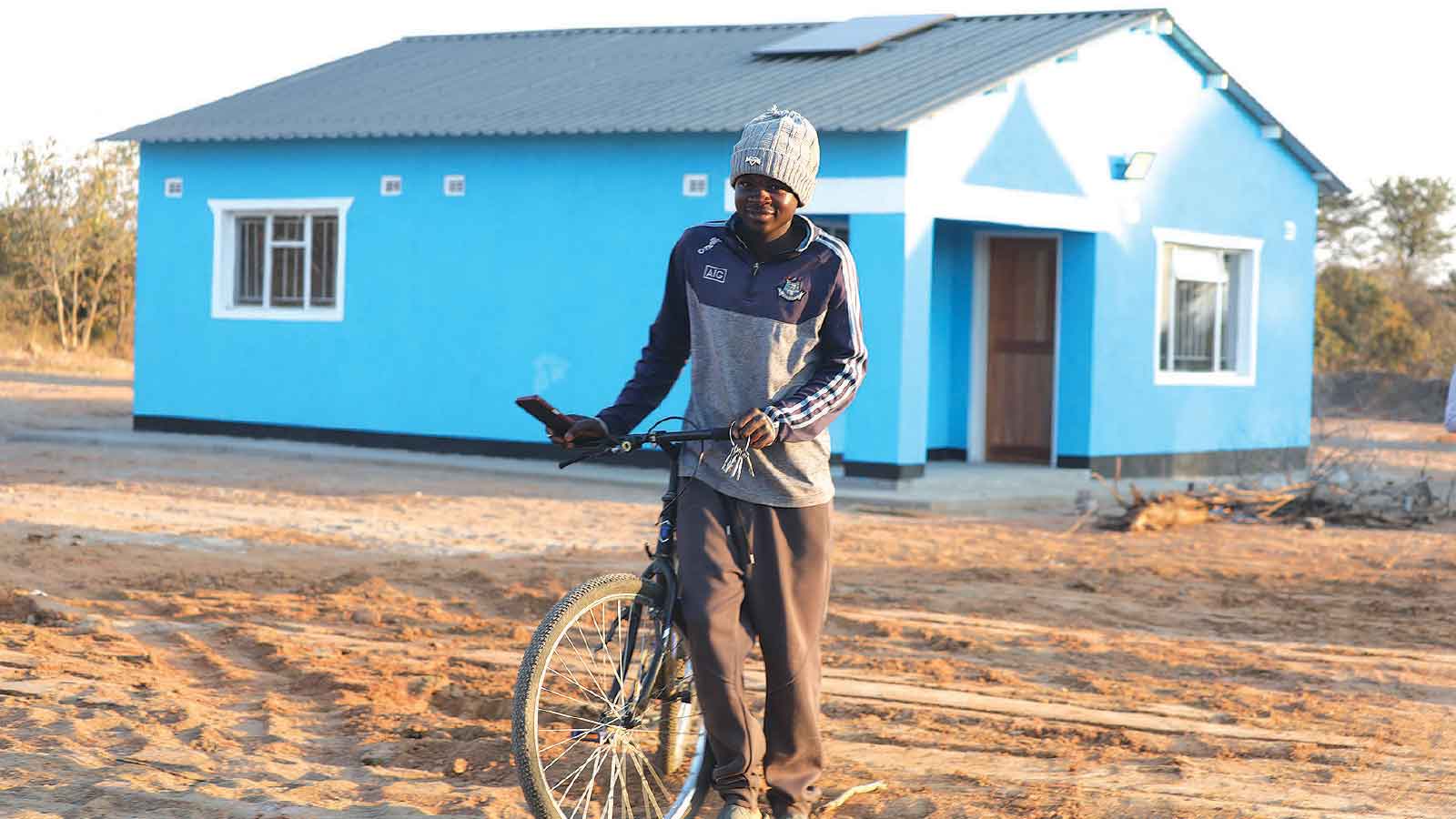
Theseus Shambare
Features Writer
AT dawn on Nyaguwe River, a thin mist rises above what used to be a quiet valley in Goromonzi district, Mashonaland East province.
The major perennial tributary of Mazowe River in north-eastern Zimbabwe no longer moves freely.
It is being shaped, measured and contained, turned into something far larger than itself.
Steel, rock and concrete are slowly rewriting the landscape at Kunzvi Dam, where the sound of machinery now competes with birdsong.
For nearby villagers, the transformation is not abstract.
It is personal, physical and irreversible.
Some remember the first days of relocation in 2021, when more than 400 families were asked to move to make way for the dam wall.
Others now walk through new homesteads, three-bedroom houses, kitchen huts and storage spaces for grain and tools, built under a Government resettlement programme that has begun to redefine what displacement means in the language of development.
“We are grateful for what has been done for us,” Mr Mark Kaliza, one of the resettled residents, said, standing outside his new home.
The dam is still rising in the background, but already it has reshaped his life.
A few kilometres away, engineers move between intake structures and concrete works.
Resident engineer Johane Mwase pauses briefly, gesturing towards the massive structure taking shape across the river valley.
“We are now above 70 percent completion,” he says during a recent media tour of the project.
“The dam wall is 52 metres high, and the water depth will reach about 45 metres. Five intake points will channel water for distribution.”
Kunzvi Dam is a water supply project that will feed Harare, Chitungwiza and Goromonzi.
But on the ground, something more complex is being designed.
Zimbabwe is beginning to treat dams not as endpoints of engineering, but as starting points of entire economies.
This is what the Government now calls, in planning terms, the “dam economy”, a concept that reimagines water infrastructure as a multi-layered system of production.
Water is no longer just stored. It is activated.
In an interview, the Permanent Secretary in the Ministry of Agriculture, Mechanisation and Water Resources Development Professor Obert Jiri said the “blue economy” is the future.
For him, the old model, where dams simply held water for later use, is no longer enough.
“We want every dam to do more than store water,” he said. “It must support irrigation, fisheries, domestic supply systems and where possible, energy generation.”
That simple idea carries wide implications. It means every dam is now expected to produce multiple outcomes at once: food from irrigation schemes, income from fish farming, stability from household water supply and in select cases, electricity from hydropower systems. In this new framework, design begins differently.
Engineers are no longer just calculating height and capacity. They are asking harder questions: How many hectares (ha) will this dam irrigate? How many households will it serve? What kind of livelihoods will form around it?
Further west, at Lake Gwayi-Shangani in Matabeleland North, the same philosophy is taking physical shape on an even larger scale.
The dam, now about 74 percent complete, is being built not only to solve Bulawayo’s longstanding water challenges, but to transform an entire corridor of land along a 252-kilometre pipeline route. When complete, it will carry water to the City of Kings, irrigate roughly 10 000ha and support a 10MW mini-hydropower station, turning a single infrastructure project into a multi-sector development system.
The project itself is a reminder of how long Zimbabwe’s water ambitions have been delayed. First conceived more than a century ago in 1912, it remained on paper through decades of funding constraints until it was revived under the Second Republic as part of Vision 2030. Back in Mashonaland East, Kunzvi is moving along a similar trajectory.
For provincial leaders, the dam is already tied to economic performance.
Mashonaland East Minister of State for Provincial Affairs and Devolution Advocate Itai Ndudzo noted that the province’s economy has grown from US$2,9 billion to US$3,5 billion over recent years, driven in part by infrastructure investments of this kind.
But the bigger change is not only in figures. It is in how water itself is now being understood.
Along the dam corridors, irrigation schemes are being planned before construction is complete. Fisheries are being introduced as standard components of water bodies.
Domestic supply systems are embedded into engineering designs from the outset.
Around them, small economies begin to form, from farming clusters to emerging agro-processing activity.
Even the meaning of a dam is changing. It is no longer a boundary between land and water.
It is becoming a point where multiple systems converge: agriculture, energy, housing, industry and community life.
Yet, beneath the ambition, lies complexity.
Large-scale relocations, long construction cycles and the coordination of multiple sectors test the speed at which this vision can be realised.
The dam economy is not a finished system. It is still being assembled, piece by piece, across landscapes.
Still, what is emerging is difficult to ignore.
At Kunzvi, water is rising behind a wall of earth and steel.
But around it, something else is rising too. It is a new idea that treats infrastructure not as an endpoint, but as the beginning of production itself.
In that shift, Zimbabwe’s dams are no longer just holding water. They are beginning to hold economies.