Online Reporter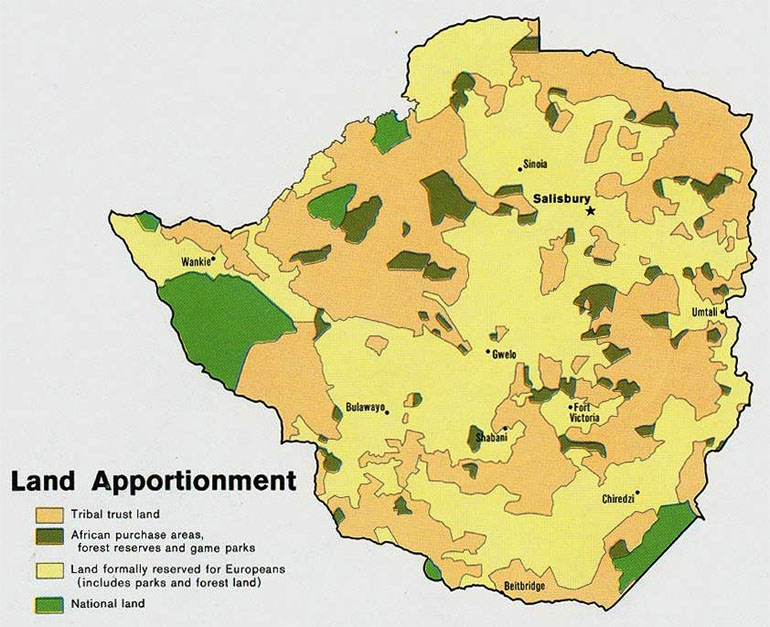
Lloyd Makonya
Correspondent
THE 1930 Land Apportionment Act did more than divide Zimbabwe’s land along racial lines, it sowed the seeds of resistance, shaped the liberation struggle and continues to influence the country’s journey towards Vision 2030.
For every nation, there is a defining issue that shapes its history and determines the course of its future.
For Zimbabwe, that issue has always been land. Land is more than soil beneath one’s feet. It is identity, livelihood, heritage, sovereignty and economic power. It is where families build homes, grow food, bury their ancestors and secure a future for generations to come.
Beneath its surface lie the minerals that fuel industry, generate national wealth and underpin economic transformation. It is therefore unsurprising that land became the single most contentious issue in Zimbabwe’s colonial history and ultimately the principal catalyst for the liberation struggle.
Former President Robert Mugabe succinctly captured this reality when he remarked: “Hatina kurwira ivhu rekutsika bedzi asi rekuvaka misha yedu nemhuri dzedu.” (We did not fight merely for land to walk on, but for land upon which to build our homes and raise our families.)
As Zimbabwe approaches Heroes Day, this statement provides an opportunity to reflect on one of colonialism’s most enduring injustices, the Land Apportionment Act of 1930 and how it transformed land from an economic resource into the defining symbol of resistance and national liberation.
The Land Apportionment Act of 1930 remains one of the most discriminatory pieces of legislation ever enacted in colonial Southern Rhodesia, a law designed to divide.
Presented by the colonial administration as a measure to organise settlement patterns, its real objective was racial segregation and economic domination. For the first time, land ownership was legally divided according to race, creating two completely different Zimbabwes.
European settlers, who constituted less than five percent of the population, were allocated approximately 51 percent of the country’s land. More importantly, they received virtually all the fertile high-rainfall regions, areas with rich soils, established infrastructure, railway networks and access to commercial markets.
The African majority, comprising over 90 percent of the population, was confined to roughly 22 percent of the land. Much of this consisted of marginal regions characterised by poor soils, erratic rainfall, rocky terrain and susceptibility to drought and livestock diseases. These became known as Native Reserves (Kumaruzevha).
The imbalance was not accidental but was carefully engineered to secure European agricultural prosperity while undermining African economic independence. Perhaps the greatest injustice of the Act was not merely the unequal distribution of land but its deliberate destruction of African self-sufficiency ultimately turning owners into labourers.
Communities that had sustained themselves through farming and livestock production for generations suddenly found themselves overcrowded on shrinking reserves. As populations increased, the land could no longer support them. Overgrazing became inevitable, soil erosion intensified, agricultural productivity declined, poverty deepened and the colonial economy depended on this outcome.
Unable to survive on increasingly unproductive land, many African families had little option but to seek employment on white-owned farms, mines and industries for meagre wages. Land dispossession thus became an instrument of labour control, ensuring a constant supply of cheap African labour that sustained the colonial economy.
The discriminatory reach of the Land Apportionment Act extended beyond agriculture. Urban centres were effectively reserved for Europeans. Africans were prohibited from owning or leasing land in most towns except in limited designated locations. Cities were viewed as white spaces, while Africans were regarded merely as temporary labourers whose permanent homes belonged in the reserves.
This exclusion entrenched racial segregation across every sphere of life from housing, education, employment and commerce. Land had become both an economic asset and a political weapon. For many liberation movements across Africa, political representation was the central demand. In Zimbabwe, the issue ran much deeper, the demand was for land.
As nationalist consciousness grew throughout the 1950s and 1960s, land dispossession increasingly became the rallying point around which resistance was organised. Successive colonial laws including the Land Husbandry Act of 1951 and later the Land Tenure Act of 1969 did little to reverse the injustice. Instead, they reinforced racial inequalities and further alienated African communities.
Young men and women who crossed into neighbouring countries to join the armed struggle did so carrying more than political aspirations. They carried memories of ancestral lands lost. They carried stories of families squeezed into overcrowded reserves. They carried the hope that independence would restore dignity through equitable access to land.
Thus, when the liberation war intensified during the late 1960s and 1970s, the struggle was not merely about changing a flag or replacing one government with another. It was fundamentally about reclaiming ownership of Zimbabwe itself.
More than four decades after independence, the importance of land remains undiminished. To the ordinary Zimbabwean, land continues to represent security, opportunity and wealth creation. It provides space to build homes and establish businesses, it feeds families through agriculture, it creates employment across farming, agro-processing and tourism, it hosts schools, hospitals, industries and transport infrastructure. Beneath it lie deposits of gold, platinum, lithium, diamonds and numerous other minerals that continue to drive national economic development. In short, every sector of Zimbabwe’s economy ultimately begins with land.
Zimbabwe’s aspiration to attain Upper Middle-Income Economy status by 2030 recognises this fundamental reality. Productive land utilisation remains central to national development. The National Development Strategy 2 (NDS2) identifies agriculture, mining, infrastructure development, tourism, housing and industrialisation as major pillars of economic transformation. Each of these depends directly upon sustainable and productive use of land.
Agriculture remains a significant employer and contributor to national food security. Mining depends on access to mineral-rich land. Tourism thrives because of Zimbabwe’s landscapes, wildlife estates, mountains, forests and heritage sites. Urban development requires serviced land for housing and industry. Renewable energy projects depend on land availability. In this sense, land remains both the foundation of economic production and the platform upon which Vision 2030 is being built.
Heroes Day is often remembered through stories of battles fought in the mountains and forests of Zimbabwe. Yet beneath every account of courage lies a deeper truth. The liberation struggle was fundamentally about restoring ownership, dignity and economic freedom to the people of Zimbabwe. The 1930 Land Apportionment Act did far more than redraw maps. It uprooted communities and institutionalised inequality. It transformed fertile fields into symbols of injustice. And in doing so, it planted the seeds of one of Africa’s most determined liberation struggles.
As Zimbabwe honours its heroes not only in the month of August but even beyond, remembering the Land Apportionment Act reminds us that independence was never simply about political sovereignty. It was about reclaiming the means to determine our own destiny. The land that once divided Zimbabwe now carries the hopes of building an inclusive, prosperous and modern nation. The challenge before this generation is not to fight for it as their forebears did, but to steward it wisely, productively and sustainably so that it continues to provide homes, livelihoods and opportunity for generations yet unborn.
For, as history has repeatedly demonstrated, land is not merely where a nation stands. It is where its future begins.