admin
admin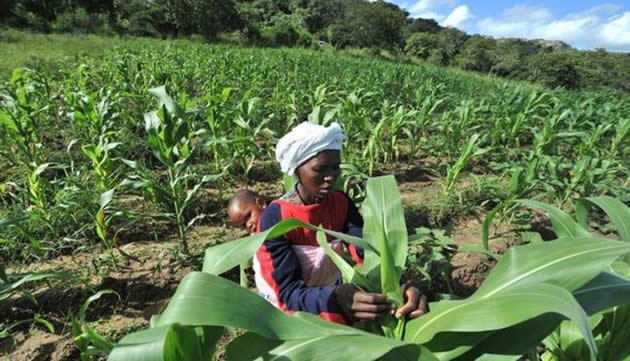
Benny Tsododo
Besides saddening reports of floods in the Tokwe-Mukosi basin, shocking levels of corruption in the public sector and frightening outbursts of violence in the opposition MDC-T party, the country appears set to record positive developments in the agricultural sector.
Of late, the sector has come under unrelenting criticism from spiteful neo-colonial quarters whose feathers have been ruffled by the historic land reform programme in Zimbabwe.
With an estimated 2,2 million people reportedly facing starvation in the country, Western critics and their local subalterns have unsparingly castigated the country’s “chaotic” land reform programme for being the sole cause of food shortages.
This is despite a medley of plausible factors that were directly militated against better agricultural yields.
Prominent among these factors were the lack of financial support to the agricultural sector and recurrent droughts.
Financial institutions have been reluctant to extend lines of credit to the new farmers, saying that they don’t have collateral to back up their requests for loans.
Worse still, during the inclusive Government, the then Finance Minister Tendai Biti scrapped Government’s support to agriculture in order to satisfy his bookish economic policies guided by the pro-rich Bretton Woods institutions.
Coupled with the unpredictable climate shifts and the undeniable lack of funding, the scrapping of Government support to farmers blunted agricultural operations leading to poor harvests.
Nevertheless, events took a twist for the better when the new ZANU-PF Government got a resounding electoral tenure in 2013.
Guided by the pro-poor Zim-Asset plan, it reintroduced the Presidential agricultural input scheme to support communal farmers.
Under Zim-Asset’s Food Security and Nutrition cluster, Government proposed to initiate interventions aimed at reviving the agricultural sector.
It noted that: “While the plan will ensure that the Presidential Input Support Scheme focuses on supporting vulnerable groups at household and community level, it will also ensure that other farmers timeously access affordable inputs.” The visionary blueprint also envisages increasing the country’s maize yields from last season’s estimated 800 000 metric tonnes of maize to around 1,9 million metric tonnes a year by 2018.
President Robert Mugabe commissioned the agricultural input scheme valued at US$161 million.
This saw the distribution of 51 218 tonnes of compound D fertiliser, 30 020 tonnes of Ammonium Nitrate fertiliser, 16 668 tonnes of maize seed and small grains and 9 967 tonnes of lime.
This time around, Government ensured that the agricultural inputs reached the farmers before the first rains. Fortunately, the skies opened up and the country received above average rainfall that nurtured a better crop.
As a result of well-planned and well-timed interventions by Government to support agriculture accompanied by better rainfall patterns and the undeniable farming prowess of both resettled and communal farmers, predictions already point to an improved yield this year.
The Zimbabwe Commercial Farmers’ Union last week said the country was expected to harvest at least 1,2 million metric tonnes of maize this year, a significant improvement from last year’s yield. Other permutations presented to Parliament by the Permanent Secretary in the Ministry of Agriculture, Mechanisation and Irrigation Development, Ringson Chitsiko, indicated that the country could produce between 1,6 and 1,8 million metric tonnes of maize this year.
These predictions clearly show that the country is now on track to achieve its Zim-Asset target of harvesting 1,9 million metric tonnes of maize a year by 2018. The country is equally set to close the gap between current productions and the expected national requirement of 2,1 million metric tonnes of maize needed each year to feed the nation while maintaining adequate grain reserves.
Production is also expected to improve in other crops. The Tobacco Industry and Marketing Board said they were expecting total sales of around 170 million kilogrammes of tobacco compared to 140 million kilogrammes last year. At this level, it is noteworthy that tobacco production is on a rebound and is moving closer to the 1990s annual production records of around 200 million kilogrammes.
These are good records for the land reform programme. The records vouch for the indigenous people’s farming capabilities, which for long had been disbelieved by some bigoted quarters who think that only former white commercial farmers have the mettle to meet the country’s agricultural needs.
The records put to shame unsubstantiated claims that the land reform programme had stymied agricultural production in Zimbabwe. It is clear that the agricultural sector was not negatively affected by the land reform programme but rather was hit by poor rains and lack of support from Government and financial institutions. Now that Government has extended support to farmers and the skies have smiled upon the country, Zimbabweans are expecting a bumper harvest.
Much better yields are expected when financial institutions join in and inject much-needed capital into the farming sector. In the meantime, Government should solidify the gains so far recorded in the sector by ensuring that there are adequate storage facilities for the maize yields.
Reports that the Grain Marketing Board does not have suitable grain storage space are unsettling. Already there are indications that the country is losing around 100 000 metric tonnes of maize each year due to the deplorable state of storage facilities at the GMB.
Instead of allegedly paying hefty salaries and perks to its senior management, including building plush homes for them in the upmarket Charlotte Brook suburb, the GMB should concentrate on its core business of ensuring that the country has adequate and secure grain reserves.
It should use its allocation from Treasury together with its own earnings from its food-processing operations to ensure that the silos are regularly maintained and are free from any biological or chemical agents that could contaminate the country’s grain reserves.
Government should intervene to ensure that the issue of grain storage is urgently addressed before the crops are harvested since failure to do so would obviate the expected gains in food security.



 Online Reporter