Chronicle Editor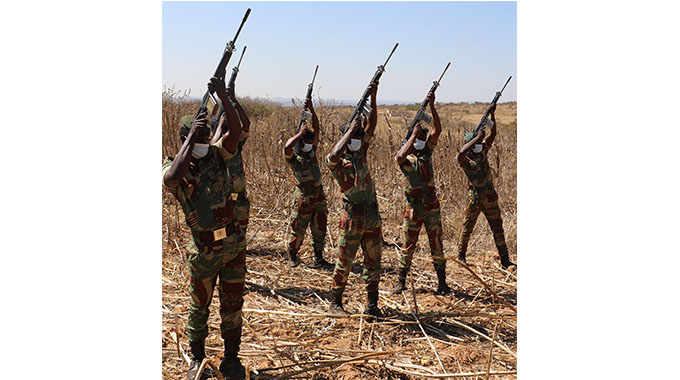
Mashudu Netsianda, Senior Reporter
VETERAN nationalist, Cde Elliot Ngwabi, who succumbed to Covid-19 last Saturday, was yesterday laid to rest at his home in Esiphezini (Mabindisa village) in Umzingwane District, Matabeleland South province.
Cde Ngwabi (85) died at the United Bulawayo Hospitals (UBH) where he was admitted. President Mnangagwa conferred liberation war hero status on Cde Ngwabi following a request from the Zanu-PF leadership in Matabeleland South province,
He was among the four heroic freedom fighters who dramatically escaped from the tightly guarded Grey Street Prison — now Bulawayo Prison — in 1965.
Cde Ngwabi was buried under strict Covid-19 regulations with a limited number of mourners, mostly relatives, neighbours and war veterans attending the burial.
The funeral procession passed through his homestead where scores of people stood by the roadside to pay their last respects to the veteran nationalist.
As the coffin was being lowered to the grave, a quarter guard from the Zimbabwe National Army (ZNA) One Infantry Brigade honoured Cde Ngwabi with the last post and a gun salute.
In a speech read on his behalf by Umzingwane District Development Coordinator Mrs Tafadzwa Makausi, Matabeleland South Provincial Affairs and Devolution Minister Abednico Ncube described Cde Ngwabi as a true patriot who served his nation diligently before and after independence.
He said President Mnangagwa had accorded liberation war hero status to Cde Ngwabi as an honour of his selfless contribution to the liberation of Zimbabwe and the work he did after independence.
“We convey our profound gratitude to His Excellency President ED Mnangagwa and the ruling party Zanu-PF for conferring Cde Elliot Ngwabi with a liberation war hero status. It is indeed humbling and an honour to us as a province given Cde Ngwabi’s well documented history,” said Minister Ncube.
“Cde Ngwabi was incarcerated in various prisons during the liberation struggle and on one such occasion he met fellow comrades at Khami who included President Mnangagwa.”
Minister Ncube said Cde Ngwabi was a loyal and committed patriot who dedicated his life to seeing a better and prosperous Zimbabwe.
War veterans’ representative, Cde Joshua Moyo spoke glowingly about Cde Ngwabi, describing him as a brave and fearless cadre who tenaciously fought the enemy during the liberation struggle.
Cde Ngwabi whose war name was Cde Okello, was part of the six combatants who launched an attack at Zidube Ranch in Kezi, Matobo District in Matabeleland South in September 1964 during the liberation struggle.
The attack, carried out on September 12, 1964, was the first attack by Zimbabwe People’s Revolutionary Army ZPRA) cadres and signalled the start of the Second Umvukela/ Chimurenga.
Cde Ngwabi dramatically escaped from prison in January 1965 in the company of three other combatants, Cdes Moffat Hadebe, Key Nkala and Clark Ngiyo Mpofu. Cdes Nkala and Mpofu are both late.

The quartet had been detained at Gwanda Prison before being transferred to Grey Street Prison.
They were detained for fighting injustice and oppression against blacks by the Rhodesian government.
Zidube Ranch belonged to Bulawayo senior magistrate, Mr Francis Fairwell Roberts who was part of the judiciary that oppressed black people by issuing out detention orders to the nationalists without any justification.
The attack, which they executed together with Cdes Israel Maduma, Roger Matshimini Ncube and Rhodes Malaba, was their first target in the country upon their deployment to Rhodesia.
Cde Mpofu’s offence was in connection with an explosive attack on Wilkie’s Circus, Tredgold Building and the Post Office. The attacks were carried out between August and September in 1964.
Cde Ngwabi was one of the early veterans of the country’s struggle for independence. He was influenced to join the liberation struggle by other young men that he used to meet and play with in Makokoba.
During those days, youths were doing a lot of sabotage by throwing stones at the colonial government buildings and white people’s cars.
During one of his interviews with our sister paper, Sunday News, Cde Ngwabi said he got involved in politics when he joined the Southern Rhodesia African National Congress (SRANC) in Makokoba when he was only 18 years old.
In 1963 when he was part of the team that was at the airport to welcome Dr Joshua Nkomo, police tried to manhandle him because he had brought some weapons into the country from Algeria.
He was arrested and spent the whole night at the main police station in Bulawayo. The other comrades visited him the following day with the party’s lawyer.
Upon his release soon after that incident, he went for military training in Zambia.
From Zambia, he went to Algeria for further training together with Cde Hadebe and others.
After training, they came back from Algeria via Lusaka and they were welcomed by the likes of Cdes Jason Ziyaphapha Moyo and Lookout Masuku.
Upon their return, they had weapons from Algeria hidden in a suitcase, which they managed to smuggle to Zambia.
The same guns sparked the Second Umvukela/Chimurenga.
When they arrived in the country, they were lucky not to be searched because security was lax.
Born on October 10, 1935 in Esiphezini in Umzingwane District, Matabeleland South, Cde Ngwabi attended Esiphezini Primary School and Mzilikazi Primary School where he completed his primary education.
He was detained at Grey Street Prison and Khami Prison where he met some fellow comrades from the Zimbabwe African National Liberation Army (ZANLA) who included President Mnangagwa.
After independence, Cde Ngwabi became the deputy chairman of Zanu-PF at Esiphezini for 10 years and that was after the Unity Accord of 1987.
He was also instrumental in setting up Sekusile Co-operative in Nkulumane whose objective was to economically empower war veterans.-@mashhets


 Online Reporter