Online Reporter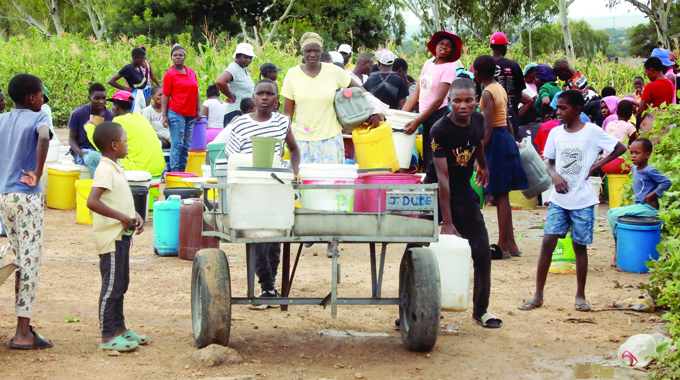
Peter Matika, [email protected]
WATER challenges in Bulawayo have led to the emergence of water barons who have taken control of water sources in most western residential areas.
Additionally, water and laundry maids have also capitalised on the situation by offering laundry services at these sources for a fixed rate.
The city is facing an acute water shortage that has seen city suburbs going for weeks without running water.

Residents are now forced to buy bottled water for consumption while relying on borehole water for laundry and ablution.
The lack of functional bowsers has also left residents in dire situations, with many forced to rely on unsafe water sources or expensive private suppliers.
A survey yesterday by Chronicle established that water barons have emerged and charge a minimum of US$2 for 100 litres of water.
“I never thought I would have to pay for water. We have had no running water for weeks, and it’s heartbreaking to see my children going without.
“We are forced to pay for free water at our water sources. It’s a serious predicament; we are now buying bottled water for drinking every day and using borehole water for laundry and bathing,” said a resident in a water queue in Lobengula Extension suburb.
Another resident in New Magwegwe suburb said given the scarcity of water, a new group of individuals has found a way to thrive.
“These individuals have stepped in, offering laundry services at water sources for a fixed fee, capitalising on the growing need for reliable access to water,” said Mr David Dube.

A young woman who offers laundry services at one of the boreholes in the neighbourhood said:
“I charge a flat rate for laundry. People need clean clothes, and with the water situation, I am just trying to help while making a living”.
While the emergence of water barons and service providers like water and laundry maids speaks to the ingenuity of the community, it also highlights the desperation many are facing.
The city’s enduring water crisis has sparked conversations about the need for sustainable solutions, infrastructure improvements, and accountability from local authorities.
“It is high time Government takes action and walk the talk. This is a dire situation. There are long-term plans that are being implemented, but we need short-term plans to address the situation immediately. The issue of long queues at boreholes will surely give us headaches. There are vulnerable girl children. Drugs are soon to flow without effort, and this all needs to be considered,” said Gogo Nyathi.
BCC recently announced that residents are set to endure severe water shortages for the next two to three weeks as the local authority awaits procurement of crucial spare parts for damaged pumps that are being sourced outside the country.

With the main pumping stations operating at only 50 percent capacity, daily water supply has dropped from 90 million litres to 45 million litres, severely impacting reservoirs and high-lying suburbs.
The Criterion reservoir, which is the primary source that supplies Magwegwe, 6J, and Hillside reservoir, is receiving half its usual volume due to pump failures.
Bulawayo Town Clerk, Mr Christopher Dube, said as a result of the operational challenges, areas such as Emganwini, Nkulumane, and Pumula are particularly affected as they rely on off-takes from the struggling Magwegwe reservoir.
He said when Magwegwe’s levels dropped below 50-70 percent, households in elevated areas faced prolonged dry taps.
Mr Dube said restoring water supply under the circumstances is extremely difficult due to several factors including filling main reservoirs.
He said the reduced flow from Criterion will take much longer to fill up the main reservoirs — Magwegwe, 6J, and Hillside.

Recharging pipelines is also another factor as the pipelines are empty for extended periods, they need to be completely refilled before water can reach residential properties. This process takes time.
The situation is compounded by low water levels in the city’s supply dams, with Bulawayo mayor, Councillor David Coltart, having advised that the water-shedding programme will stay, as the city’s dams did not get substantial amounts of water from the rainfall season.