

 admin
admin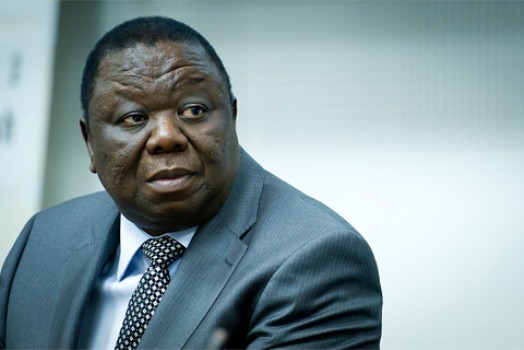
Harare Bureau
LAWYERS representing MDC-T leader Mr Morgan Tsvangirai yesterday disassociated themselves from the politician’s statements impugning the integrity of the court. This came as the court nullified Mr Tsvangirai’s purported withdrawal of the poll challenge. Chief Justice Godfrey Chidyausiku, sitting with eight judges of the Constitutional Court, yesterday ruled that the withdrawal was not supported by any law and proceeded to hear arguments on the main petition.
The court, however, reserved judgment on the petition to today.
The withdrawal was nullified because it did not comply with the law.
It was the court’s finding that whenever a presidential election petition is filed, the matter has to be heard and determined before the swearing in of the winning candidate.
The withdrawal, according to the court, was not provided for in the laws of this country and therefore should be heard and determined.
“This court is satisfied that there has to be a determination and there has to be a hearing.
“In an ordinary application, a withdrawal means the end of the matter, but in a presidential election petition, arguments have to be heard and a determination is made,” said Justice Chidyausiku.
Asked to comment on the averments made in Mr Tsvangirai’s affidavit and other papers filed in which he allegedly impugned the integrity of the court, Advocate Deepak Mehta disassociated himself from the statements.
The instructing lawyer Mr Chris Mhike of Artherstone and Cook also confirmed through Adv Mehta that he was not part of the “attack on the judiciary”.
In disassociating himself from the case, Adv Mehta struggled to state his position until the Chief Justice came to his rescue.
“In other words you are saying these are beliefs of your client and you disassociate yourself and your colleagues from the statements made in the affidavit?”
The lawyers confirmed the position to the court, leaving Mr Tsvangirai exposed.
In the petition, PM Tsvangirai incorporated and attached the so-called “dossier” which was prepared by the MDC-T.
The dossier accused the judiciary of failure to comply with the Sadc guidelines and being biased towards Zanu-PF.
Part of the dossier reads:
“(The) Judiciary is not independent from the executive, and politically, from Zanu-PF.
“Since 2010, the President has appointed or elevated 23 judges to the High Court, Supreme Court and the Constitutional Court without consulting Prime Minister Morgan Tsvangirai, contrary to the requirements of the GPA and the Constitution.
“Consequently, the opposition does not view the judiciary as independent of Zanu-PF.”
The document also accuses the courts of contributing to the delay in the announcement of the election date.
“Although Sadc recommended an extension of time for the election date, this was strongly resisted by Zanu-PF with the concurrence of the courts.”
The dossier alleged widespread rigging implicating various individuals, organisations, traditional leadership and the army as the culprits.
Mr Tsvangirai also challenged the involvement of an Israeli firm Nikuv in the alleged manipulation of votes and produced some statistics showing that the company had received payments amounting to $10 578 335 for the elections-related services offered.
The dossier was attached to the petition by Mr Tsvangirai as Annexure A and forms part of his affidavit.
During yesterday’s proceedings, lead counsel for President Mugabe Mr Terence Hussein argued that Mr Tsvangirai did not have faith in his own petition hence he should be slapped with an order for costs of the suit on a higher scale.
Mr Hussein, who was representing President Mugabe with the assistance of Advocate Fred Gijima, argued that the winning presidential candidate could only be sworn in after the court rules on the petition.


 Online Reporter
 derick.khumalo