Online Reporter
Veronica Gwaze
SLIGHTLY over a week after the gruesome murder of Martin Muduva — allegedly at the hands of his wife, Lyliosa Chirara, who subsequently committed suicide — social media remains abuzz as netizens speculate about the horrific incident.
Polygamy, its pros and cons, and secret marriages have captured a significant share of attention during these discussions.
Chirara, a nurse, reportedly struck her husband thrice with an axe before taking her own life by consuming rat poison due to “emotional distress”.
Muduva, who was a commissioner with the Zimbabwe Human Rights Commission and a lecturer at Midlands State University, was slain after allegedly marrying a second wife in secret under customary law
The alleged secret union came to light when Chirara saw status updates of the customary ceremony on her husband’s phone, triggering the tragic sequence of events.
This incident came just two months after a Bindura woman identified as Pamela caused a scene when she gate-crashed a secret roora ceremony of her husband, Temptation, in Sunningdale.
Temptation was caught in the act, attempting to pay lobola to formalise his union with his girlfriend.
Pamela, a mother of three, shocked guests by revealing that Temptation had shared the same bed with her in their matrimonial home the previous night, confronting both the groom’s and the new bride’s families.
The disgruntled wife revealed that she never received even the slightest hint from her husband regarding his intentions to marry a second wife.
Months prior, what was supposed to be a special day for a Harare woman also ended in shame after her secret white wedding was stopped by the groom’s first wife.
The groom, Everisto Mukura, intended to secretly tie the knot with Anne Ntini Dube before his first wife walked in and halted the proceedings.
Pervasive phenomenon
This is just a microcosm of the cases occurring across the country where secret marriages and weddings have seemingly become prevalent.
Most of these unions are conducted under the pretext of “polygamy”.
Yet what is clear is that the true context of polygamy has been lost along the way.
Many stark differences can now be drawn between modern occurrences and the traditional practice of polygamy.
Custom
Historian Taderera Magumise notes that polygamy is the practice or custom of having more than one spouse or multiple wives at the same time.
While the phenomenon is not new in Zimbabwe and Africa at large, Magumise explained that specific procedures must be followed when one wishes to formally take more than a single wife.
“The first step should be family consultation where traditionally, a man intending to take an additional wife is expected to inform his existing wife or family elders beforehand,” he said.
However, consultations did not guarantee approval from the first wife to proceed with marrying a second wife.
If she disapproved, the man needed to engage family elders to negotiate with her.
In most cases, he noted, the first wife would eventually give in, after which the man would be asked to pay a token of compensation (kuripa) to her.
Engagement negotiations would then follow, with the prospective husband or his family representatives approaching the family of the new bride-to-be to negotiate and pay lobola.
“Once the bride price was accepted and paid (or agreed upon), the union would then be traditionally recognised as a valid customary marriage that is potentially polygamous,” Magumise explained.
Elder’s view
Gogo Esnath Maturure, whose late husband had five wives, also shared her views.
“The current trend is unfortunate,” she said.
“Polygamy is not a new thing in our culture. Back in the day, we allowed our husbands to marry more wives because it made life easy for everyone.
“It resulted in a bigger family; thus, we would be able to achieve a lot, especially in the fields and domestic chores.”
Gogo Maturure, now in her late 80s, said married couples should not keep secrets from each other as this could have serious consequences.
“Yes, we had instances, even back in the day, where there would be conflict and jealousy within a particular polygamous setup but because everything was done in the open, close relatives, particularly elders, would intervene and peace would prevail. As wives, we have always treated each other like sisters.”
While this used to be the historical standard, couples under Zimbabwean law can now solemnise or register their union independently.
The law
Under Zimbabwean law, including the Marriages Act, customary unions can remain unregistered as Unregistered Customary Law Unions (UCLUs) or be solemnised and registered by a designated authority, such as a chief or magistrate.
Legal practitioner Cathrine Sinambale of Moyo and Sinambale Attorneys reckons that traditionally polygamy functioned as a structured economic and social security framework tied to agriculture, communal land and village labour.
However, today the practice collides with rapid modernisation, economic hardship and legislative overhauls.
She noted that the major emerging challenges regarding polygamy centre around informalisation, legal conflicts, financial strains and shifting social dynamics.
“Formal polygamy is declining lately and is being replaced by the ‘small house’ phenomenon,” she said.
“This is largely because formalised polygamy is heavily stigmatised in modern, urban and some Christian settings, which is why most men are opting to take second or third ‘wives’ in secret.
“Unlike traditional polygamy, where co-wives lived in the same village and built a shared compound, the ‘small house’ dynamic thrives on secrecy and isolation.”
This, she explained, often results in emotional distress, family abandonment and a lack of social safety nets for the second family.
In some cases, when the first wife finds out, it can escalate to violence, divorce or even death by murder or suicide.
“The landmark Marriages Act (Chapter 5:15) radically transformed the legal landscape by recognising Unregistered Customary Law Unions and civil partnerships,” she added.
“However, this has created immense friction. When a man in a registered monogamous marriage secretly enters a customary polygamous union, the relationships overlap legally.”
Under the Marriages Act, a person cannot be married under both general law (a monogamous civil marriage) and customary law simultaneously.
When a person attempts to contract a civil marriage — which accepts only one spouse — while a customary marriage already exists with another person, or vice versa, several legal outcomes occur.
Historically and under current legal practice, if a person in a customary union contracts a monogamous civil marriage with a different person, the law treats the subsequent civil marriage as valid and regards the prior conflicting arrangement as legally superseded or void in terms of general law capacity.
Conversely, contracting a civil marriage while already bound by a valid registered customary marriage with another partner violates the monogamous nature of the general law union, constituting the criminal offence of bigamy.
No person may contract a general law marriage during the subsistence of another exclusive or contradictory union status, making the simultaneous dual status legally impermissible.
However, parties to a valid, monogamous registered customary law marriage can legally upgrade or convert that exact existing customary marriage into a civil marriage, provided there is no other existing spouse.
Managing polygamy
Zimbabwean entrepreneur, agronomist and author Gabriel Mapfunde recently gained widespread media attention for being in a polygamous marriage.
His four wives and 14 children, four of whom are adopted, live under the same roof.
Mapfunde explained that he learnt about polygamy from the Bible.
“Being raised with a Christian background, I did research regarding biblical marriages and found all the answers that I apply in my life and marriage today,” he said.
“I look at the church as a polygamous setup where the church is likened to the man while the congregants are the wives . . . so, biblically, polygamy is not a crime.
“However, in real life, as a polygamous family, there are principles that we have to stick to if we are to function as one and remain united.
“Personally, I avoid favouritism, promote equality instead of equity and I have learnt that maintaining honesty and integrity has become a solid foundation for our family.”
Mapfunde understands that in Shona and other Zimbabwean cultures, a man’s desire to take an additional wife was not treated as a private decision.
Instead, it involved family, elders and, most importantly, the existing wife or wives.
In traditional African practice, after consulting family elders, a man was expected to explain why he wanted an additional wife.
Elders would then consider whether he was capable of supporting an additional household and whether the move would protect or destabilise the family.
“This is particularly important; historical accounts of Shona custom indicate that a man was expected to seek the consent of his existing wife or wives before taking another one,” Mapfunde said.
“Seeking consent and consulting the first wife also gave her significance and a voice in both the process and the polygamous setup.
“Further, the first wife was given recognition and compensation before the new wife came.”
Shona practice records that a first wife who consented to an additional wife would receive a cow as part of compensation.
This, Mapfunde notes, was not a mere payment for permission, but a gesture that symbolised her senior position and acknowledged that the arrival of another wife affected her household.
“When talks had been done, the elders then helped prepare the family mentally to prevent the new marriage from becoming a source of jealousy, competition and family conflict,” Mapfunde said.
“Traditional Shona marriage was understood as a relationship between extended families, so the marriage negotiations involved representatives from both families, including respected women such as the paternal aunt.”
Bribe
However, Methodist Church in Zimbabwe pastor Ringisai Zvoushe argues that the compensation was a form of “bribery” to silence the first wife.
He contends that marriage is intended for two people only.
“In Genesis, God created one man (Adam) and one woman (Eve) to show His plan for marriage,” he said.
“Genesis 2:24 states that a man leaves his parents and joins his wife and the two become one.”
Pundits opine that the rise in “small house” cases and subsequent secret marriages could be the major reason behind increased divorce and domestic violence cases.
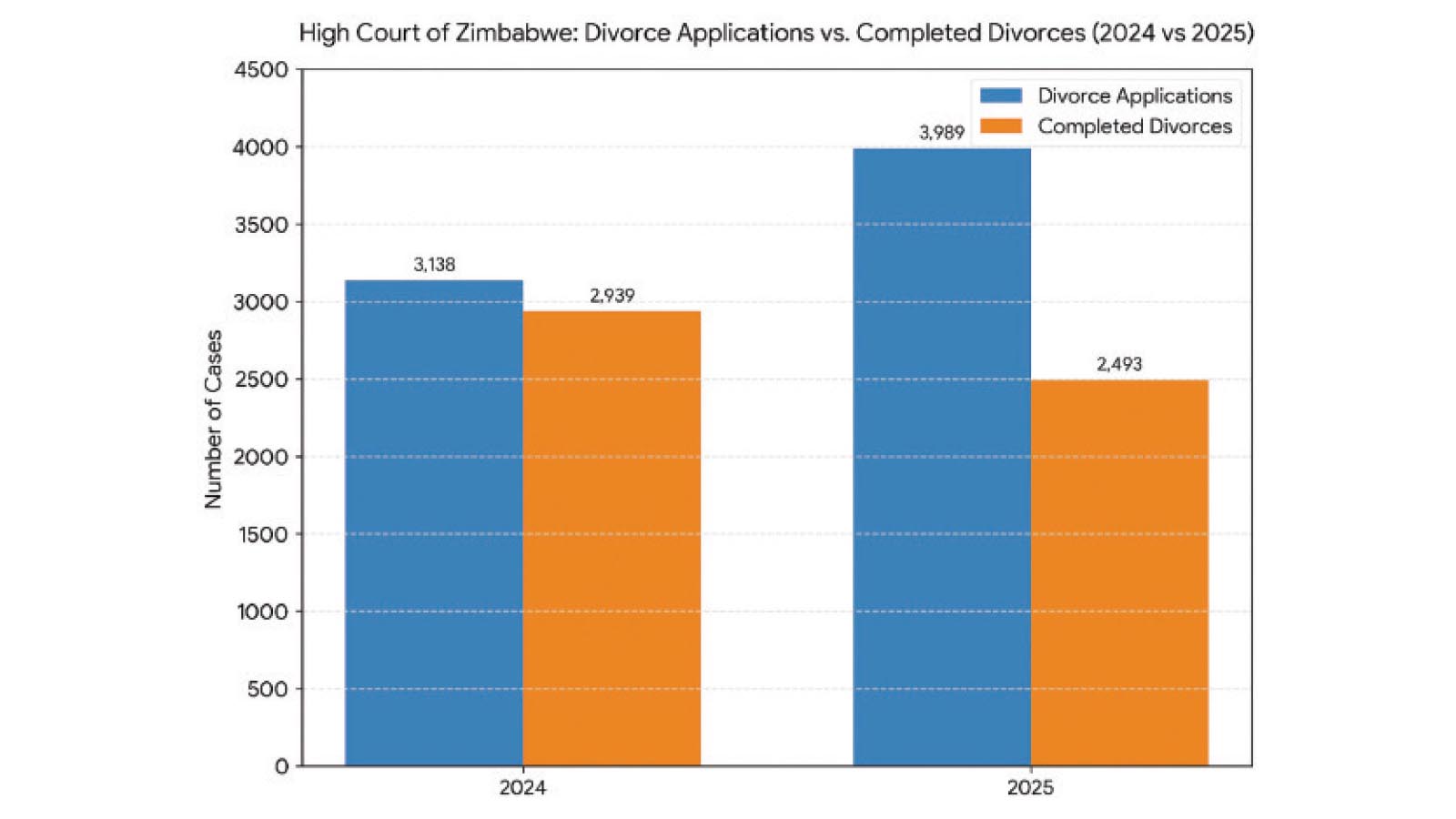
The High Court of Zimbabwe received at least 3 989 divorce applications between January and December last year, marking a 27 percent increase from the 3 138 cases recorded in the previous year.
However, statistics obtained from the Judicial Service Commission (JSC) show that despite the surge in filings, there was a 15 percent decline in completed divorces, falling from 2 939 in 2024 to 2 493 in 2025.
Operating from five main stations in Harare, Bulawayo, Masvingo, Mutare and Chinhoyi, the High Court handles divorce matters under the Matrimonial Causes Act.
The Act allows the dissolution of marriage on grounds such as irretrievable breakdown, adultery, abuse and prolonged separation.
Harare continued to account for the largest share of cases, with registrations rising sharply from 1 939 in 2024 to 2 386 in 2025.