Chronicle Editor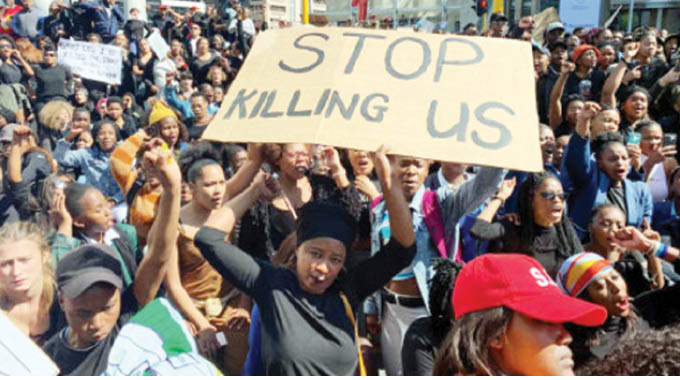
Andile Tshuma
The month of March is a reminder that women play a critical role in sustainable development. When they are educated and healthy, their families, communities and countries benefit. Yet, various forms of violations undermine opportunities for women and denies them the ability to fully utilise their basic human rights.
In Zimbabwe, about one in three women aged 15 to 49 have experienced physical violence and about one in four women have experienced sexual violence since the age of 15.
Awareness alone cannot create change; it is actions that create change and it is the duty of every member of society to bring about this change.
Just a few months ago, two Zvishavane villagers brutally murdered a 51-year-old woman who had her nine-month-old grandchild strapped on her back before taking turns to have sex with the corpse. The assailants were sentenced to death by hanging.
The villagers, a court heard, threw the body down a disused mine shaft together with the child crying and still strapped to the body’s back.
Givemore Mutumba (25) and Tatenda Ngwenya (22) both of Chief Mazvihwa’s area, were convicted of murder with constructive intent by Bulawyo High Court judge Justice Maxwell Takuva on Circuit in Gweru.
Passing sentence, Justice Takuva said the duo’s level of cruelty was shocking.
This week, this publication had shocking statistics on violence perpetuated by machete gangs in the country.
The article revealed that at least 35 people were killed while 15 women were raped in the last 13 months by the infamous machete wielding gangs.
The machete-wielding gangs have become a problem across the country, unleashing terror, attacking and robbing members of the public, having assaulted 382 people, with 225 robberies having been recorded during the same period.
A rape of one woman is too much. Having 15 women having gone through such is really unthinkable.
The degree of cruelty in the murders and rapes is shocking and such people should be removed from society and not allowed back as the courts have a duty to protect the sanctity of life.
Our southern neighbour, South Africa, is also in trouble. South Africans were last year horrified by the murder of University of Cape Town student Uyinene Mrwetyana. More murders of women followed in a space of weeks, including that of a 25-year-old boxer Leighandre Jesse.
The South African Police Service (SAPS) regularly releases a breakdown of murder victims by age group and sex. Their latest data shows that 20 336 people were murdered in 2017/18. The majority of the murder victims were adult men, accounting for 16 421 deaths. This is equal to one murder every 30 minutes.
In the 2017/18 period, 2 930 adult women were murdered. It is said that a woman is murdered every three hours in South Africa, according to 2018 statistics from the SAPS.
Conversations at corporate events, social circles and other spheres of life have been bordering on these killings and ending gender-based violence and equal treatment for all.
The advocacy and support for the elimination of gender-based violence should be a 365-day task and not just the month of March.
Creating safe spaces for all and fighting in unity to end these violations should be on everyone’s diary every day. It should not be an event but a culture.
In an effort to champion gender equality and advocate for the elimination of femicide in our communities, Government must prioritise and implement the various recommendations made to reduce and eliminate femicide in all of its forms.
There should be a clear commitment to fostering better working relationships between Government, private and civil society actors towards maximising collective impact in eradicating the root causes of gender-based violence.
All Zimbabweans must reflect on their own complicity in maintaining the culture of violence and abuse, make the necessary behavioural and attitudinal shifts and commit to standing together to safeguard communities against these vicious cycles of abuse.
Advancing gender equality and dismantling patriarchy in Zimbabwe must therefore go beyond awareness to include radically transforming those systems and institutions that produce and reproduce unequal power relations.
The law must continue to protect women and men from abuse and must uphold equal treatment of victims of gender-based violence.
It is also important to ensure that no custom, tradition or religious tenet is used to justify gender-based violence. Full and sustained funding must be availed to ensure adequate implementation of policies and progammes to fight gender-based violence so that indeed there is peace in the homes and communities.
In most countries including Zimbabwe, navigating the justice system is complex and tedious hence many victims of gender-based violence end up withdrawing their cases before they reach court. A few cases result in conviction. In most cases, women withdraw cases due to lack of knowledge of their rights and in some cases the perpetrators are the family breadwinners. Women must have support systems within the justice system that help them garner the courage to report all forms of violence and seek justice.
As we celebrate women’s month, it is important to ensure that we have this talk on femicide, and that society goes beyond awareness. Awareness, on its own, is not enough.


 Online Reporter