Zvamaida Murwira-Senior Reporter
COMESA member states must prioritise trading among themselves by leveraging their vast mineral endowments and natural resources to create sustainable value for their citizens, regional leaders have said.
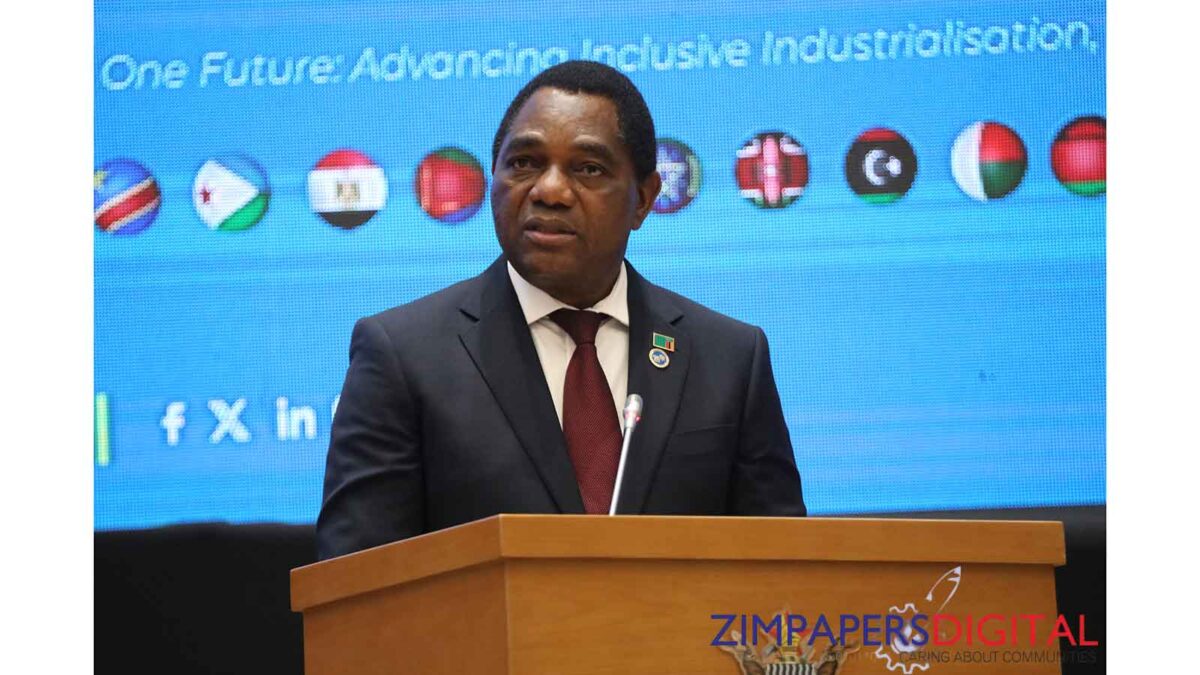
Delivering his maiden speech at the Common Market for Eastern and Southern Africa (COMESA) summit at the New Parliament Building in Mount Hampden on Thursday, Deputy Chairperson and Zambian President Hakainde Hichilema criticised the persistence of trade barriers across the continent.
His remarks came as President Mnangagwa officially assumed the chairmanship of the 21-member economic bloc, with Zambia becoming the incoming chair.
President Hichilema called on neighbouring countries like Zimbabwe and Zambia to deepen bilateral trade by eliminating border bottlenecks, which he characterised as artificial constraints.
He emphasised that local integration serves as the bedrock for broader continental objectives, referencing the presence of African Continental Free Trade Area (AfCFTA) Secretary-General Wamkele Mene.
“We have raw materials and we should add value. We should buy from ourselves then we will increase the intra-Comesa transactions. For Brother Wamkele (Mene), we as Comesa, are the building block to the African Continental Free Trade Area. It doesn’t sit in the air, it sits in the transaction between Zim-Zam, Zimbabwe and Zambia,” President Hichilema said.
“Then within SADC, within Comesa, these are the building blocks. Unless we consciously remember to do these things and plan for them and implement them, it will take us longer to increase the intra-Comesa transactions, creating value for our people, including jobs and supporting the skills that are required.”
Highlighting agriculture as a key sector for immediate collaboration, the Zambian leader urged the COMESA secretariat to deliberately facilitate transactions, investments, and cross-border trade.
“Between Zimbabwe and Zambia, we can move the fertiliser by our people, including on transport modes such as the wheelbarrow, because it’s such a short distance. It’s one step to the other side, you are in Zimbabwe, the other one, you are in Zambia. So that allows even our small traders to participate in growing our intra-Comesa transactions, Practical, isn’t it?” President Hichilema stated.
He maintained that domestic economic growth strategies within countries like Zambia, Zimbabwe, and the Democratic Republic of Congo are inherently linked to the broader regional agenda.
He further challenged member states to dismantle the stereotype that investment capital must exclusively originate from Western or Asian markets.
“Let’s invest together. Let’s produce together. When we think of investment, why do we always stereotype that, that investment must come from Europe, and from America, and from Asia? When we have good projects in Comesa I think we can get the capital.
“What we should do first is to get the capital from ourselves, and then supplement that. I think that’s the approach that will make Comesa much, much better to fulfil the needs of our population, young population, skills, jobs, business opportunities,” he said.
To achieve this, President Hichilema urged countries to adopt modern border-management technologies to eliminate redundant checkpoints and cargo delays.
“With technology, single window capacity, we can watch what is being packed in a factory in Harare, and is going to DRC coming through Zambia. Why should we stop that truck at Chirundu? It must pass. Because we are viewing it technologically. And why should we stop it with more roadblocks in Zambia? Then we will create jobs across our artificial borders. Because when the borders were done for us, we were not there. We were not even consulted. So these are our populations,” President Hichilema added.
Presenting the COMESA annual report for 2025, outgoing Chairperson and Kenyan President William Ruto echoed these sentiments, noting that regional trade remains critically underutilised.
“We are neighbours who prefer to trade with strangers. That is the gap that this plan exists to close. It commits us to growing the value of intra-Comesa trade every single year and to raise its share of our total trade to 15 percent by 2030,” President Ruto said.
President Ruto concluded by stressing the economic necessity of local resource processing to halt capital and job flight from the continent.
“We must process our own minerals and add value to our own produce. Trade them among ourselves and take our full share of its gains. For too long, we have exported raw materials, imported finished products and surrendered the jobs, industries and wealth that should have remained in Africa.
“This plan that we launched today reverses that and an effective secretariat underpins it all. It will be data-driven in its decision, agile in its response and rigorous in its tracking of results, able to coordinate implementation and support every member state.”