Chronicle Editor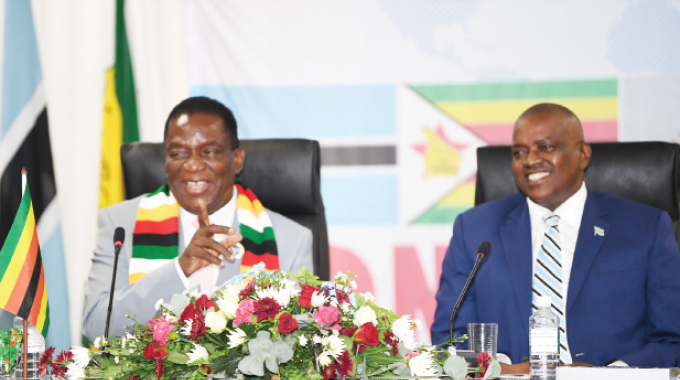
Analysis by Prosper Ndlovu recently in Maun, Botswana
THE recent Second Session of the Zimbabwe-Botswana Bi-National Commission (BNC) is an expression of the cordial and strong bilateral relations between the two countries, which are founded on long standing historical, political, economic, social and cultural ties.
Botswana hosted the high-level conference in the resort town of Maun between 25 to 28 February, whose climax was the signing of seven Memoranda of Understanding (MoUs) and agreements. Zimbabwe hosted the inaugural session in Harare at the same time last year when six agreements covering a range of socio-economic and political issues were sealed
The two Heads of State — President Emmerson Mnangagwa and Dr Mokgweetsi Masisi — led high powered delegations comprising nine Cabinet ministers from both countries, as well as senior Government officials to last week’s indaba. Both parties re-affirmed the significance of the BNC as a bilateral instrument to give strategic direction to the growing relations between the two neighbouring countries, in order to improve the well-being of their peoples. It was in this regard that the seven bilateral instruments were inked at the end of the summit last Thursday.
The agreements covered: mutual legal assistance in criminal matters; a memorandum of understanding on health matters; sport development; cooperation in the field of media information and publicity; provision of sustainable, affordable and functional low-cost housing; cooperation in technical, vocational education and training; and employment and labour.
Information, Publicity and Broadcasting Services Minister, Senator Monica Mutsvangwa, signed the MoU on media and publicity while Dr Obadiah Moyo signed the agreement on health. Foreign Affairs and International Trade Minister, Dr Sibusiso Moyo, signed the remaining agreements on behalf of the Zimbabwean government.
A closer look at the agreements would show that, indeed Botswana and Zimbabwe are bound by common challenges and destiny, which require strong collaboration in the context of regional integration in order to yield desired transformation.
For instance, the two countries need to work together in combating crime, which has become a global issue of concern, especially cross-border crime and terrorism.
Mutual legal assistance on these matters would go a long way in enhancing peace and stability. Health is also a critical matter in both countries and the agreement on this aspect will ensure harmonised operations.
This is critical for human security hence President Mnangagwa and Dr Masisi expressed serious concern over the outbreak of COVID-19 (Coronavirus) and the health risk it poses to the global community. Creating a formidable social infrastructure and efficient service delivery is at the heart of sustainable development and buttresses tenets of good governance and improving community livelihoods.
The MoUs on provision of sustainable low-cost housing, sport development, employment and labour as well as cooperation on technical education and training, concretise this thrust. Zimbabwe has already made strides on the education front in particular, which would benefit Botswana, while at the same time seeking to tap into existing competencies in the neighbouring country.
The full realisation of these ideals, which are embedded in the national interest of both states, would not only deepen the scope of cooperation but also create wider opportunities for investment, jobs and trade.
The role of the media is also very critical in mobilising societies in both countries and bringing to the fore those issues that motivate citizens to participate in national development hence the desire by the two countries to cooperate in the field of media, information and publicity. As an industry, the media sector also presents wider employment opportunities in a modern world and offers a platform for cultural expression and identity consciousness. The biggest challenge now lies on implementation, which will determine realisation of desired outcomes.
“I am pleased to note that this session has witnessed the signing of MoUs and agreements, which set the foundation for our broader cooperation in the identified areas.
“We must apply greater determination towards the full implementation of these agreements for the benefit of our two countries and peoples,” said President Mnangagwa, with Dr Masisi concurring.
“There is no doubt that in working together and consistently, we can achieve much more. Let us introspect and ask ourselves whether we have exerted enough energy and shown adequate commitment to realise progress in our cooperation.”
Based on the outcomes of the inaugural and the recent 2nd session of the BNC, it is unquestionable that Botswana and Zimbabwe are clear as to where their cooperation must go.
The onus is now on officials at the technical level in respective governments to equally demonstrate zeal, focus and sense of urgency through speedy implementation of agreed positions.
The private sector in both states must also play ball and take advantage of these developments to expand their prospects. Positive steps are already being taken as shown by the sideline business forum, which was held on Thursday and attended by about 60 companies drawn from both countries.
“It is, of course, the private sector and not government, which has to identify and seize these opportunities for cooperation. Our role is primarily to facilitate,” said Industry and Commerce Minister, Dr Sekai Nzenza.
The Botswana Investment and Trade Centre (BITC) and ZimTrade, jointly organised the business forum. The Zimbabwean business delegation represented various sectors – including the engineering, clothing and textiles, food, leather and the services sector. Potential investors from Botswana and the Zimbabwe Diaspora community also stand to benefit immensely from the existing opportunities in all sectors – including manufacturing, mining, agriculture, and services including tourism, telecommunications, information technology, energy, transport and distribution to finance and insurance. The opportunities extend to beneficiation and value addition of abundant natural resources and agro-processing in both countries. F
or Zimbabwe, creating good relations with other countries dovetails the new dispensation’s re-engagement drive, which buttresses the desire to transform the economy into an upper middle-income status by 2030.
The commitment to deeper relations between the two countries demonstrates the feasibility of the attainment of the regional integration agenda at both the SADC level in particular, and the African continent at large.
Zimbabwe and Botswana have a long-standing trade relationship, dating back to the 1950s. The two states are also party to the SADC Free Trade Area, the Tripartite FTA and the African Continental Free Trade Area, under which trading is due to commence on 1 July, 2020.
However, despite these preferential agreements, bilateral trade figures remain subdued and investment cooperation remains insignificant. It on this basis that continued business to business engagements and at government level as was the case last week, are expected to help inject new energy to boost trade and economic relations between Zimbabwe and Botswana.



 Online Reporter