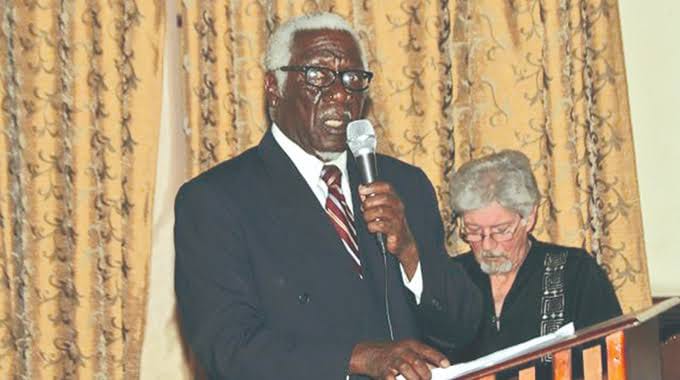
Vusumuzi Dube
Vincent Gono , News Editor
KENYAN veteran novelist Ngugi wa Thiong’o has not been shy in expressing his derision for a thinking that glorifies everything Western as superior and everything African as inferior in his book Decolonising the Mind.
He says there is an urgent need for Africans to start interrogating the ideology, philosophy and culture that they are adopting and blindly grafting on to their own.
Although Ngugi was more concerned with language as a medium through which the human race transmits ideas that shape their lives, his view aptly summarises the need for Africa to decolonise its systems including politics from the Western thinking.
Admittedly, culture is porous it gives and takes aspects but the question and the problem arise when one culture continuously takes from another without a semblance of reciprocity as has been the case with Africa where its citizens have been gullible to desire everything from religion, colour of skin, hair, nails, language, culinary (food), fashion, music, sport, money, political ideologies and everything else.
Ngugi is not alone in this dislike of the Western tendencies and the desire for Africans to open their eyes and realise that when a lion plays with a zebra’s cub it is not looking for friendship, Frantz Fanon died a bitter man, having himself experienced the suffering, the gnawing doubts, and the alienation of the oppressed.
He delved deep into the social inferno Europe had created for millions, found his destiny inextricably bound to theirs, and sought to build, on the very ashes of that inferno, a world of reciprocal freedom and recognition.
His views are explicitly expressed in Frantz Fanon and the Psychology of Oppression while Paulo Freire has been unapologetic in language and thought when he penned the Pedagogy of the Oppressed. He believed an emancipatory pedagogy was necessary and required. He said it was important for the oppressed to assert their identity first, and then unshackle themselves from the dehumanization caused by oppression.
There is a commonality in the writings of the above critical thinking authors. They all speak to the need for people in the global south and in this context Africans to be specific, to define themselves – their identity and nativity and their connection to their history then knowing their friends and what their interests are in their political and economic scheme of things.
It is from that epistemological standpoint that one will question the continued interests of the West in Africa’s political affairs where they have shown an appetite of being both referee and player, something that Africa has not being doing to Europe, America and or anywhere else in the world.
That the West still thinks Africa is an extension of their territory is given through the meddlesome behaviour that they have been showing and their disdain of the language of decoloniality in its totality that Africa has been preaching.
Their neo-colonial approach have been finding route and grip in Africa through opposition political parties that are ideological fed from the West and remote controlled into power through hook and crook at the expensive expense of the liberation parties that are rooted in the struggle and history of oppression the understanding of what it means to be liberated.
Elections in most liberated African countries have not surprisingly therefore, been a tug-of-war between the liberation movements and the West camouflaged in ‘democratic’ opposition political movements.
Such opposition parties are not only funded but sponsored with ideology that seeks to further the interests of the West in Africa.
The just ended harmonised elections in Zimbabwe points to the fact that the West has not loosened its efforts to vanquish liberation movements and replace them with puppetry ideological lost and culturally suspended opposition parties.
Political analysts believe Africa has for a long time now provided a turf for political and economic contest between the Western Europe and America on one side against the Eastern bloc that comprise Eastern Europe and Asian giants who have been genuine historical friends to most of Africa through liberation struggle.
They say the expression of willingness by Zimbabwe to work with BRICS therefore flies in the face of Western Europe and America and attempts to stop that should be read in the context of the recent elections.
Harare has made formal overtures to join the New Development Bank of the BRICS which is envisaged to bring in a refreshing alternative and counterpoise to the Bretton Woods Institutions, which were set up to preserve Europe’s post-colonial stranglehold on African nations.
The US hegemony ensured that Africa was marginalised from the global economy and ostracised from the international finance system. America has been extending its grip and influence in Africa through establishing military bases in willing countries which bases serve the purpose of keeping neighbours in check and the AU should interrogate such within its member states.
Political analyst Dr Gift Gwindingwe said what has happened in the recently held harmonised elections in Zimbabwe reflects what Zimbabweans were content with, it’s a reflection of their ideological taste, an expression of what they are made of, it speaks to their DNA.
He said to try to influence them to see and think neo-liberally or otherwise is akin to skinning them off their nativity, it is akin to cultural and ideological surgery.
“What the liberation struggle taught us is difficult to de-teach. Every election period is a walk down the memory lane, it is renaissance period marked by a looming rebirth of how and why Zimbabwe shed off the Rhodes(ia) to re-orient her sons and daughters in the frame desired of Africans and their wealth.
“Let the victorious party in the just ended elections carry its term and the mandate to develop the nation. The imported Westist (it’s not even Western) funded by isolated fragments of the West has dire consequences to the nation and eventually the continent. Uprooting a tree is not synonymous with cutting its branches for reasons of rejuvenation. We can’t be symbolically annihilated under the guise of (neo) liberalism. There is no liberty in a caged mind,” said Dr Gwindingwe.
He added that the electoral triumph of Cde Mnangagwa and the progressive citizens of Zimbabwe on August 23, 2023 was a victory over the United States and its western friends. “With Africa as their main focus, the United States and its western allies have had a long and exceptional historical chance to impose their political and economic principles on the rest of the world.
“They are using what I can only refer to as Western democracy and democratization as a prerequisite for African nations seeking foreign assistance and loans, particularly from the International Monetary Fund (IMF) and the World Bank, to address their severe political and economic difficulties. Since the start of the millennium, when Zimbabwe completely rejected this, there has been war.”
Dr Gwindingwe said Zimbabweans exercise a unique form of democracy although America and its friends in the West have consistently worked to destroy that democratic system. He added that the answer to the question of what the West wants for Zimbabwe is quite important. “What kind of democracy do they want, and who would gain from it?”
Another political analyst Dr Last Alfandika weighed in saying the West was aware that Cde Mnangagwa was a staunch supporter of Zimbabwe’s right to self-rule and of its claims to sovereignty over its natural resources.
“The west seeks to undermine advancement and erect a puppet administration with close links to Washington and its allies by sponsoring these opposition parties and other pressure groups. To ensure that Zimbabwe advances the objectives of the United States and its allies, their puppets will take whatever actions they think necessary and President Mnangagwa is correct to see American interests as calling for the suppression of any populist movement that smacked of the “nyika inovakwa nevene vayo” notion. No wonder why they support the opposition politics with funding and other non-financial resources,” he said.
Dr Alfandika said opposition political formations and other civil society organisations continued to require material, financial and moral support from non-African donors endowed with these resources.
“The question of opposition politics’ independence from Western influence is central in the process of analysing the ideas they are pushing for. It is therefore no secret that the opposition political parties’ organic links to the western imperialists is designed in a manner which make it a de facto affiliate member of the western coalition that forms it creating animosity with the Zimbabwe national sovereignty stewards like President ED Mnangagwa,” he posited.



 Online Reporter