Online Reporter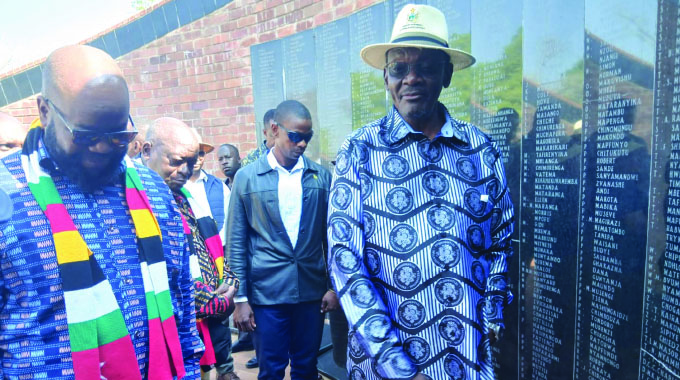
Ray Bande in CHIMOIO, Mozambique
GOVERNMENT, through the Ministry of Home Affairs and Cultural Heritage, will soon roll out a comprehensive makeover of all liberation war heritage sites in neighbouring countries where thousands of sons and daughters of Zimbabwe are lying in mass graves, some of them still unmarked.
This was revealed by Vice President Kembo Mohadi during his tour of liberation war sites in Tanzania, Zambia, Angola and Mozambique this week where he was assessing liberation war shrines in order to take corrective action where necessary, for the departed freedom fighters to rest in peace.
During the 16-year struggle for liberation, the Rhodesian regime launched air and ground strikes against the country’s liberation forces resulting in guerilla training and refugee camps being ruthlessly bombed and many of those killed in these attacks were buried in those countries.
Mozambique alone has about 17 shrines of deceased cadres of the war of liberation.
However, at Chimoio, Nyadzonia, Tembwe, Nyangao (Beira), and Tongogara Memorial Site and Changara, mass graves have been constructed, while at shrines that include Madulu, Mapai, Barrage, Chibavava, Navonde, Espungabeira and Save, remains of those who were either killed or died of illnesses during the war are still lying in unmarked graves.
Most of these shrines are lying in a state of neglect without basics such as ablution facilities, sources of water, poor road network leading to the sites, rolls of honour as well as falling security fence or barbed wire.
It is against this background that, in an interview on the sidelines of the tour here at Chimoio Shrine, VP Mohadi said: ““There are a lot of less important things that we can sacrifice resources in order for this initiative to be undertaken.
“For example, the responsible Ministry, the Ministry of Home Affairs and Cultural Heritage can make use of the money collected from gambling to ensure that boreholes, ablution facilities and other amenities are in place in these shrines.
“The question from some of us who lived through this war is that are we doing enough? The answer in many circumstances is that we are not. We surely need to do more.
“To that end we will be soon ensuring that all the basic amenities are put in place in these shrines so that they can be turned into tourism products. For example, Mutare will be hosting the annual Zanu-PF conference and a lot of people will be flocking this place (Chimoio Shrine) because it is near and perhaps the biggest of them all.
“However, many people would be ready to visit all the other shrines only if proper facilities were in place and the shrines are adequately marketed to young Zimbabweans to appreciate their history.”
The heartless massacre of predominantly young Zimbabweans that took place in training and refugee camps in neighbouring countries during the war of liberation left several shrines, where the remains of the deceased were largely interred en mass.
In a touchy moment of political awareness imparted to young officials from his office — who are part of this excursion — the Vice President emphasised the need to consistently preach against the inhuman manslaughter committed by the colonial regime, in order to inculcate a deep sense of patriotism and responsibility in the younger generation..
“When you look at these mass graves, it is difficult to imagine that people were killed in numbers like this. It is painful. It all goes to show how brutal the colonial regime was.
“You, young people, especially all those below the age of 50, you really need to learn about this and take it seriously. Lack of that understanding and knowledge has left some of you calling on the return to colonial era so that you can start the liberation war again. It is sad, to say the least.
“The story of the liberation war must be told now and again to all Zimbabweans. It must be talked about in all social spaces regularly so that our young ones can understand what we mean when we say this country’s liberation war was nourished by human blood. This is what we mean.
“If this had happened in Europe it would be an everyday song. Look at how the Holocaust, the German attack on Jews. Up to this day they are still talking about it like it happened yesterday. This is how we should make our own war for independence a crucial story. Let us not be brainwashed into thinking that this is not important,” said Vice President Mohadi.
Cde Mohadi, who also addressed a gathering of locals at Doroei Shrine in Gondola district of Manica province, said Zimbabwe will forever remain grateful not only for the assistance it got from Mozambique during the war of liberation but also for taking good care of nation’s war shrines in the neighbouring country.
“I felt I should thank you, Mozambicans for the good job you are doing in preserving our history, our liberation war shrines. You supported us during the war and here you are supporting us in preserving the legacy of the liberation war.
“As a country, Zimbabwe will forever be grateful to have a neighbour like Mozambique. Mozambique has been a true definition of a good neighbour.”
Vice President Mohadi said as part of the planned infrastructure development on liberation was sites, Government will also consider establishing amenities that also help local communities where the shrines are located.
In his tour of shrines in Chimoio, Vice President Mohadi was accompanied by Zimbabwe’s Ambassador to Mozambique Victor Matemadanda, Deputy Minister of Information, Publicity and Broadcasting Services Dr Omphile Marupi and Deputy Minister of Home Affairs and Cultural Heritage Honourable Chido Sanyatwe, Minister of State for Manicaland Province Advocate Misheck Mugadza, Deputy Chief Secretary to the President and Cabinet, Social Services Reverend Paul Damasane, and Zimbabwe’s Consul General to Beira Mr Malvern Bere.