admin
admin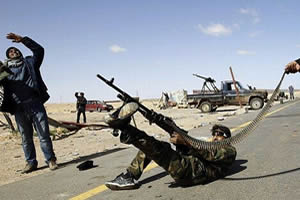
too decided to remove their own. Contrastingly, if the Tunisian one was a Jasmine Revolution, certainly it is not the case with the Libyan uprising. Both the Egyptian and Tunisian revolutions were purely home-grown.
Libya’s dusty revolution might also have been home-grown but was hijacked by what now clearly appears to be a foreign driven agenda than the national aspirations of the people of Libya. The Libyan “war” must and should be placed in the appropriate records of history alongside the Afghan campaign in 2001 and the invasion of Iraq in 2003.
The only difference separating them is a technical thin line in a sense that while the Iraqi invasion was not endorsed by the UN Security Council, the Libyan “invasion” was endorsed by Resolution 1973, but implemented under the false pretext of Responsibility to Protect. In fact it was the “responsibility to remove” or in plain language, to effect regime change.
To call the Libyan war a “fig leaf revolution” is to attempt to highlight the cover upof the naked lust for resources by the Western powers. Why this assumption? Several factors supported by evidence point to this direction.
Panic Over Domino Effect
The uprising in Tunisia sent a wave of panic in Western capitals. The panic was however not about humanitarian concern, but more to do with the loss of influence and control in Tunisia and the domino effect that would havein the other countries in the region and the world at large.
The assumption by Professor Hans Morgenthau that “the actions of states are determined not by moral principles and legal commitments but by considerations of interest and power” has been clearly demonstrated in Libya. Dismissal of this assumption amounts to deceitaimed at misrepresenting intentions and consequences.
It was perhaps the flippant assumption in the Western capitals that the uprising in Tunisia would end in the toppling of the Ben Ali government in neighbouring Algeria. The then French Foreign Minister played a perfect cast of being an ostrich with its head buried in the sand of denial.
While vacationing in Tunisia at the time of the uprising, Michele Alliot-Marie suggested sending French riot police to help crush the popular revolution. She went on further to offer the French teargas canisters to Tunisia to help disperse protesters. The French Foreign Minister underestimated the resolve of the Tunisian domino dice in pushing other countries down.
When the unexpected became a reality in Tunisia and that reality was followed by the events in Tahrir Square in Cairo, Egypt, the tone of the language changed.Zine El Abidine Ben Ali and Hosni Mubarak were now officially called “dictators” by the Western governments – something that they had avoided in the past.
Like a ship in the ocean making a u turn to avoid hitting an iceberg, the Western governments realized that their influence in the region was quickly slipping away. The alternative was unthinkable – a government controlled by the Muslim Brotherhood in Egypt was like handing Iran a veto in the Middle Eastern affairs.
Therefore the domino dices should fall in a direction favourable to Western interests. Otherwise yielding the Middle East to Iranian influence will send a dangerous message to the Arabs populations.
The starting point should be none other than the man former US president Ronald Reagan once called “a mad dog of the Middle East”, Col Muammar Gaddafi.
This was to pre-empt the Revolution in both Tunisia and Egypt and to avoid a situation where Hezbollah-type of revolutionaries would gain power at the expense of western influence in the region. The western leaders had interests to protect; they could not contemplate an unguided revolution taking over and jeopardize their interests – oil reserves 42 billion barrels or could even be as high as 60 billion, the largest oil reserves in Africa.
Consequently in Libya the option was neither the riot police nor teargas canisters, but aerial bombardments to remove what France and its NATO allies termed as “a brutal dictator”. While one revolution was apparently, to be suppressed with riot police and teargas canisters, the other was propelled with bombs and Tomahawk cruise missiles.
Like predators lured to an injured animals by the smell of blood, NATO allies descended on Libya hiding behind an internal revolt while providing it air cover. What should have been an operation to protect civilians turned out to be an operation to protect Western interests. Under the cover of a “fig leaf revolution,” NATO allies started “operation regime change,” hiding behind the UN Security Council Resolution 1973.
Technically, NATO was an air force for the Libyan rebels just as it was during the Kosovo air campaign in 1999. The only difference was that in Kosovo NATO had no mandate from the UN Security Council and in Libya there was a mandate from the UN Security Council, which was misused.
In Kosovo NATO had five point objectives to force Serbia to comply, which were: a) a verifiable stop to all military action, violence and repression; b) the withdrawal from Kosovo of military personnel, police and paramilitary forces; c) the stationing in Kosovo of an international military presence; d) the unconditional and safe return of all refugees and displaced persons and unhindered access to them by humanitarian aid organizations; and e) the establishment of a political agreement for Kosovo in conformity with international law and the Charter of the United Nations.
In Libya, the only objective, which wasundeclared, was regime change under false pretext of responsibility to protect civilian population. If all along the Westthought that Gaddafi was a brutal dictator, what had prevented them from removing him well before the Jasmine Revolution in Tunisia? Literally, the Tunisian and Egyptian uprisings provided a much needed window of opportunity to execute the imperialist plan to get hold of oil fields in Libya as in Iraq; and to revenge on past several missed opportunities to “get” Gaddafi or to settle old scores.
The British are still upset by the release of Abdelbaset Ali Mohmed al Megrahi. It was as much the settling of old scores as the pre-emptive or counter-revolutionary move. Settling of old scores in the sense that Gaddafi was an irritant to them like a scorpion in the pocket which has to be removed before it stings.
Pre-emptive in a sense that the trajectory of the revolution had to be guided under the “fig leaf” cover to avoid the much needed Libyan oil and other resources falling into unpredictable and potentially hostile hands.
Regime Change Under False Pretexts
There is a misguided tendency of viewing the argument of NATO actions in Libya through the lenses of pro- and anti-Gaddafi. This is not our point here. The point of argument is not and should not be shrouded under the veil of indifference to the people of Libya and their aspirations.
It should rather be viewed through the prism of immoral methods of inducing regime change under false pretexts. That is the bottom line of the argument here. As a person who was subjected to, and experienced apartheid, I was offended by the British Defence Secretary Liam Fox reminding the South Africans that “they wanted the world at one point to stand with them against apartheid; they now need to stand with the Libyan people”. Undoubtedly, Liam Fox seems to suffer from memory lapse.
The Conservative Party, of which he is a member, had stood against the segregated black majorities in Southern Africa (Namibia, South Africa and Zimbabwe) in the just cause of freedom and independence and he now wants to give a moral lecture! The Conservative Party stood with the apartheidregime until the last grain of sand had covered its grave.
The names of all those who stood with the apartheid, (a system which segregated human beings on the basis of skin colour) are engraved on its tombstone in the graveyard of shame. Perhaps Liam Fox may be advised to check who else’s name is enshrined on the apartheid’s tombstone.
The point he tried to use as a basis of argument is unconvincing. The underlying factor should not be confused by those who want to divert the argument from its logic. Both proponents and opponents of the Libyan invasion should focus their attention to the following question and try finding satisfactory answers: was it appropriate to go the United Nations Security Council to seek authorisation for a no-fly zone under false pretext, but knowinglythat the real motive was regime change? If the British and their allies knew that they had the right intentions; why were they afraid to tell the UN Security Council the whole truth, nothing but the truth?
This is what William Cohen, former US Defence Secretary under Clinton, said on CNN, 22 August, 2011: “Well, there was always something of a mismatch between what NATO had declared its mission to be and the public statements by the leadership of both France and Britain, and also president Obama. Namely, that Gaddafi had to go. So I think that that was more of a fig leaf to cover the naked truth that this had to be a mission to remove Gaddafi under the rubric of a mission to protect the rebels from being assaulted by Gaddafi himself. So I think NATO had this in mind. It was not able to express it because it would have contravened the UN Security Council resolution; it might have undermined the Arab League’s resolution to support a no-fly zone”.
l Jeroboam Shaanika is a Namibian civil servant; however, the views expressed here are entirely his own and do not reflect those of the Namibian government.



 Online Reporter