Online Reporter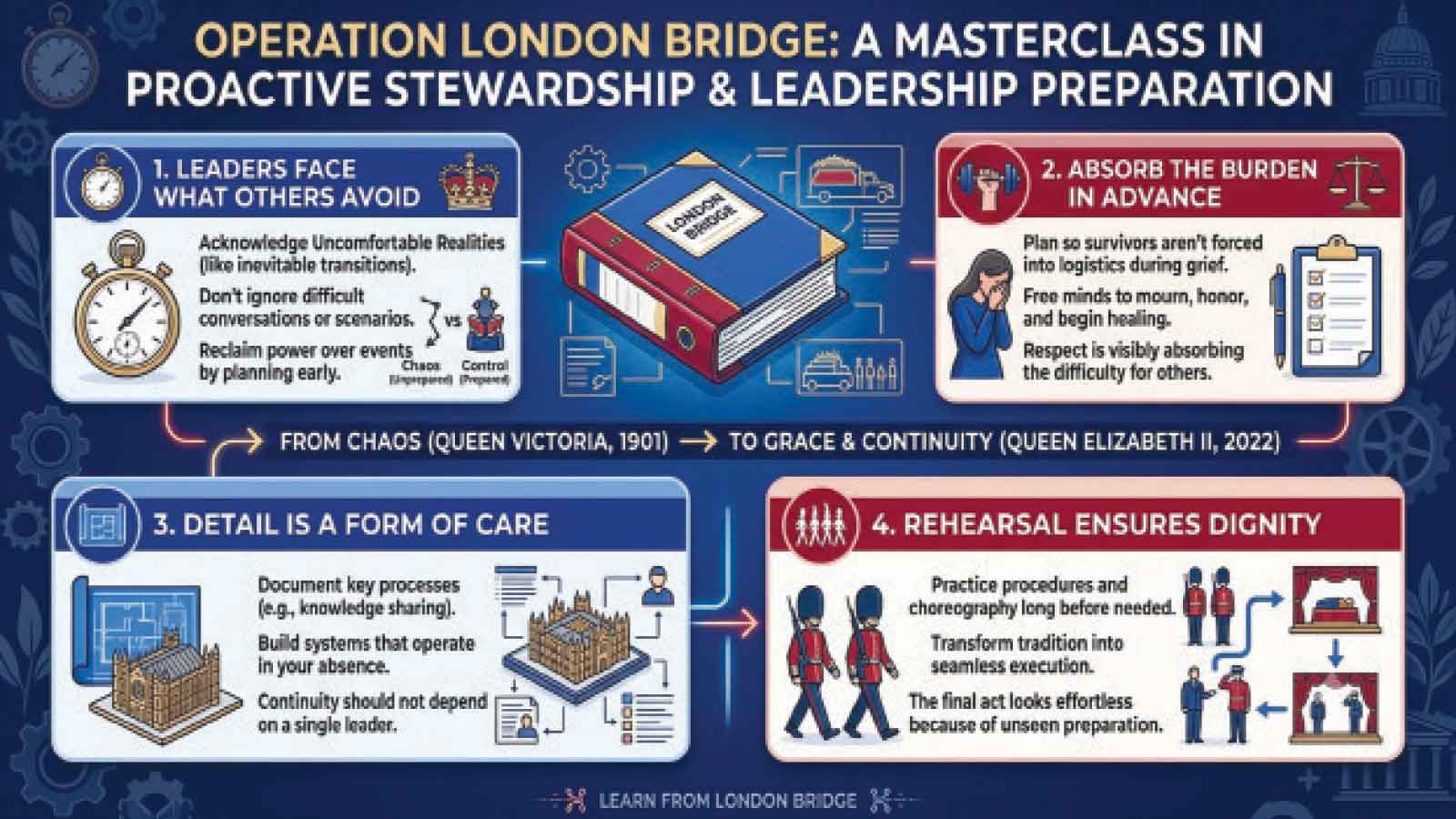
Arthur Marara-Point Blank
In September 2022, the world watched as Britain mourned Queen Elizabeth II.
For 10 days, a meticulously choreographed sequence unfolded: the coffin’s journey, the lying in state, the funeral at Westminster Abbey. To the public, it felt like an ancient tradition, carried out with solemn grace.
What few realised was that almost every detail had been decided, rehearsed, and refined more than two decades earlier.
The plan—codenamed London Bridge—was over two and a half inches thick. It was built and updated annually by a team of around three hundred people, and it accounted for scenarios ranging from the Queen’s death at Balmoral in Scotland (Operation Unicorn) to the precise angle at which flags would be lowered. The coffin itself, made of English oak, had been crafted decades before it was needed.
For most people, planning one’s own funeral decades in advance seems morbid or excessive. But for those who lead—whether a nation, a company, or a family—there is a profound lesson hidden in those thick binders: the highest form of responsibility is preparing for the moment when you are no longer there.
This is not about death. It is about stewardship, continuity, and the quiet courage of looking ahead.
1. Leaders Face What Others Avoid
The tradition of planning royal funerals decades in advance began not with foresight, but with failure. When Queen Victoria died in January 1901, she had reigned for nearly sixty‑four years. She was the most powerful woman in the world, and yet her death triggered something no one had prepared for: chaos.
There was no plan. No one knew which route the funeral procession should take, who should walk where, or even which ceremonial duties needed to be performed. The result was frantic, last‑minute decision‑making at a moment when the nation was grieving and the family was in shock. Officials scrambled. Protocols were invented on the fly. The disorder left a lasting impression on her son, the new King Edward VII.
Edward understood what his mother’s death had revealed: when a leader avoids preparing for an inevitable transition, the cost is paid not by them, but by everyone who depends on them. He vowed it would never happen again, and he insisted that his own funeral be planned in meticulous detail long before it was needed. Every monarch since has followed that principle.
What seems like a morbid royal quirk is actually a masterclass in leadership. Great leaders do not pretend that uncomfortable realities will somehow take care of themselves. They understand that an inevitable event—a departure, a crisis, a transition—does not become less inevitable by being ignored. It only becomes more destructive when it finally arrives.
In business, we see the opposite play out again and again. Founders who refuse to discuss succession, telling themselves they are “irreplaceable” while secretly fearing what life after them would look like. CEOs who have no contingency plan because drafting one would mean acknowledging that the organisation could, in fact, survive without them. Leadership teams that avoid the “what if” conversations—what if the CFO leaves suddenly, what if a key market collapses, what if the founder falls ill—until a sudden departure or crisis throws the entire organisation into reactive, panicked mode.
The cost is always borne by those left behind. Employees lose direction. Stakeholders lose confidence. Families are left to piece together what was never written down. The avoidance may have felt like a kindness—perhaps the leader didn’t want to alarm anyone—but the result is rarely kind. It is the abdication of responsibility dressed up as optimism.
Royal tradition offers a counter‑example that is both humbling and practical: acknowledging what you cannot control is the first act of control you actually have. By facing the thing others avoid—whether it is your own departure, a difficult conversation, or a scenario you hope will never happen—you reclaim power over it. You stop being a passenger to events and start being their architect.
The lesson is not about funerals. It is about the courage to look squarely at the transition points in any organisation or family and ask: What will happen to these people when I am no longer here to steady things? The answer becomes your blueprint. And the act of asking—years before the answer is needed—is what separates leaders who merely occupy a role from leaders who truly steward it.
2. Detail Is a Form of Respect
The plan codenamed London Bridge was not merely a document; it was a world built in miniature. In a discreet aircraft hangar, planners constructed a full‑scale replica of Westminster Hall—every arch, every step, every sightline reproduced with painstaking accuracy. Over days and nights, guardsmen marched the exact routes they would walk when the moment came. Officials rehearsed the placement of the coffin, the timing of the processions, and the choreography of dignitaries. Nothing was left to guesswork.
Why go to such lengths? Because the planners understood a simple, profound truth: when the moment arrives, the people left behind should not have to make decisions. Grief steals clarity. Shock slows thought. The mind that should be free to mourn, to honour, to begin healing is instead forced into logistics—what goes where, who stands where, what happens next. By absorbing that burden years in advance, the planners ensured that when the day came, the family and the nation could simply feel.
That is the essence of respect. It is not in the grand gesture, but in the invisible work that makes the grand gesture possible without burdening those who are already carrying enough.
Leadership is often judged by how an organisation performs in a crisis. But the true work of leadership—the work that separates stewardship from mere management—happens long before the crisis arrives. A leader who documents key processes, not because anyone is leaving tomorrow, but because knowledge should never exist only in one person’s head. A leader who mentors successors, not because they are planning to retire, but because continuity should not depend on a single heartbeat. A leader who builds systems that can operate in their absence, not because they expect to be absent, but because those who rely on those systems deserve stability.
In business, we have all seen the alternative. The founder who kept everything in their head, leaving behind a vacuum when they departed. The executive who considered process documentation “bureaucracy,” leaving their team to reverse‑engineer years of tacit knowledge under pressure. The organisation that never rehearsed the hard moments, then stumbled publicly when a sudden departure or crisis demanded flawless execution.
Detail, in these moments, is not micromanagement. It is the highest form of care. It says: I will do the hard work now so that you do not have to do it under duress later. It is the opposite of ego—a quiet acknowledgment that the leader’s role is to absorb complexity so others can focus on what matters.
The replica of Westminster Hall stood in that hangar for years before it was needed. When the real day came, the guardsmen did not have to think. They had already walked the path. The officials did not have to invent procedures. They had already rehearsed them. And the family, the nation, the world witnessed a funeral that seemed to unfold with ancient, effortless dignity.
What looked like tradition was actually love—love rendered as a thousand unseen details, prepared long in advance by people who understood that respect is not a feeling. It is a plan.
Arthur Marara is a corporate law attorney, keynote speaker, peak performance and corporate strategy speaker. With his delightful humour, raw energy, and wealth of life experiences, he captivates audiences and inspires them to unlock their full potential. He is also a leadership expert with extensive experience in leadership development and coaching. Through his engaging talks and workshops, he imparts invaluable insights and practical strategies that empower individuals to lead with confidence and make a lasting impact. Arthur is the author of “Toys for Adults” a thought-provoking book on entrepreneurship, and “No One is Coming” a book that seeks to equip leaders to take charge. Send your feedback to bookings@arthurmararaattorneys.
com visit his website www.arthurmarara.
com or contact him at +263772467255.