Online Reporter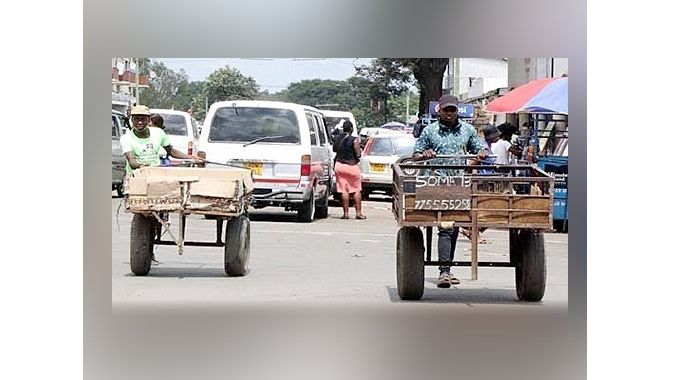
Bruce Ndlovu Sunday Life Reporter
WHEN the City of Bulawayo announced its intention to place a ban on pushcarts within the Central Business District (CBD) in 2022, Thembalenkosi Khanye thought this was just an idle threat from the city fathers.
Khanye, who had been operating a pushcart for three years before this new threat emerged, thought he had seen and heard it all.
For years, he had navigated the city streets, weaving dangerously through traffic in a high-stakes game of cat-and-mouse with the municipal police.
Fleet of foot, the boys in blue could never catch him as he eked out a living delivering cargo around Bulawayo.
Even Covid-19, which he admits temporarily forced him out of business, failed to permanently crush his enterprise.
Things had been bleak briefly, he concedes, but he ultimately bounced back. Once the worst of lockdowns lifted, he found himself back where he needed to be.
When council announced that it planned to repeal the Bulawayo (Clamping and Tow-away) by-laws of 2006, published in Statutory Instrument 231 of 2006, the city’s Clamping and Tow-away By-laws of 2015, published in Statutory Instrument 63 of 2015 and the Bulawayo (Roads and Traffic) By-laws of 1978, Khanye thought that this was nothing but newspaper talk.
In his streets, in Bulawayo, a man who was fleet of foot and could quickly spot a law enforcement officer was king.
Laws made on paper rarely made any difference to the day-to-day task of making a living.
However, this year something seemed to have changed.
Authorities seemed to move with the kind of zeal that Khanye had not noticed before.
Authorities seemed eager to pounce on anything on wheels that did not resemble a motor vehicle.
Never mind the fact that Khanye’s pushcart was adorned with eye-catching Gauteng Province (South Africa) number plates on the front.
Word on the street was that the long-promised Statutory Instrument 220 of 2023 had finally arrived.
The law prohibits the use of pushcarts within the CBD area bounded by Naison Kutshwekhaya Ndlovu Avenue, Lobengula Street, Joseph Msika Avenue and Robert Mugabe Way.
A livelihood on wheels
According to Khanye, leaving the streets of Bulawayo is not an option.
A father of two, Khanye told Sunday Life that his family was entirely dependent on the income he made from his business.
On a good day, he said, he could make between US$25 and US$40 from his pushcart.
“Things are a bit difficult now because the city council has really come hard at us over the last few months, but there’s nothing I can really do. This is my source of livelihood and if I get off the streets, my children will not eat and my children will not go to school. That is the reality, so anyone expecting me to leave what I’m doing is not okay upstairs.
This is what puts food on the table and sends my children to school, so I will not stop anytime soon.”
Innovation under pressure
With authorities clamping down drastically over the last few months, pushcart operators have had to find ways to circumvent the new rules.
Instead of the traditional scania, long a staple on the streets of Bulawayo, many have had to improvise to survive.
Wheelbarrows, so long associated with the country’s remote areas, have made a rousing comeback, as they are exempt from the council’s new rules.
However, some operators have bemoaned the new trend, saying that the wheelbarrows are strenuous and do not carry goods and vegetables in similar quantities.
“The wheelbarrow will kill your back because you have to stoop to operate it. Also, quantities dictate how much I can make and how much work I will have to do. A pushcart will always be the best because it is also kinder on your body,” he said.
The streets are renowned as the home of innovation and some have looked for pieces of equipment that can come closest to the original pushcart.
Two-tier trolleys, some of which are used in supermarkets for the transportation of bulk orders, have now found their way to the streets of Bulawayo, where they are fine-tuned to fit whatever purpose they are meant to serve.
Cardboard boxes, wires and an assortment of other accessories have been incorporated into equipment that was made for simpler tasks. The golden rule is that as long as it is not a pushcart and is able to transport a sizeable amount of goods, it does the trick.
More than just a cart
For some, the attachment to pushcarts is more than a means to an economic end.
“Scanias” have always been a route from rags to riches, with some of the city’s prominent businessmen having pushed themselves to financial glory once upon a time.
One of those businesspeople is Phinias Gomba, whose famous Gomba “scania” dominate the city’s streets and pavements.
Gomba, who says he has lost count of how many pushcarts he actually owns, took over the reins from the likes of Twalumba and Shungu, whose money-making wheels roamed the streets of Bulawayo before his own.
Gomba believes that his pushcarts carried their heaviest load when Bulawayo’s biggest companies began winding down operations at the turn of the century.
Like a shark smelling blood in the water, he could see that the city’s dying industries could give new life to his own enterprise.
“That’s around the time that I started renting garages. I would build my fleet from these places. For example, I would make a fleet of 20 pushcarts. All of them would be identical. There was a time that I made a fleet of 100 identical pushcarts at one go. I employed seven experienced welders. They would all have assistants. That is the time that we learnt how to make scorch carts,” he said.
With pushcart operators now wanted men in the beating heart of Bulawayo, Gomba is under no illusion about the character of some of the men who pull the “scania” that bear his name.
“Some of the boys steal and when they get caught, they run away and leave their pushcarts. The carts are in my name, so the police always come to me. There is no way you can be in this business and not encounter the police.”