daniel chigunwe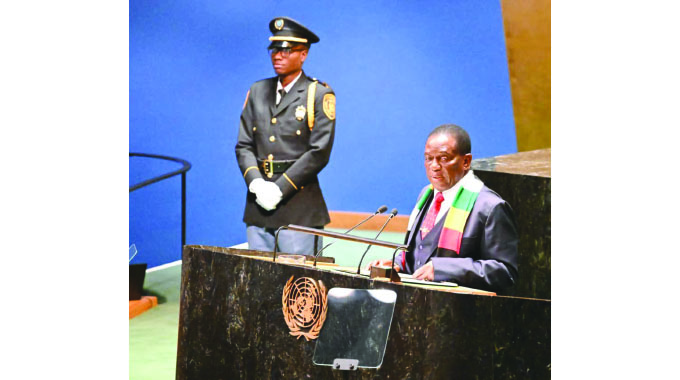
Paidamoyo Mutsvairo
Correspondent
Sanctions can have a devastating impact on any country’s economy. The impact is hefty, especially on developing countries that are still in the process of industrialising their economies.
Sanctions can make it difficult for the country to trade with other countries, access foreign investment and borrow money.
The adverse consequence of sanctions imposed on Zimbabwe is detrimental to its economic growth as it negatively affects the living standards of its citizens.
It is over two decades now since Zimbabwe was put under economic sanctions imposed by the European Union (EU), the United States and Australia.
Following the land reform of 2002, Government has been accused of unsubstantiated human rights violations by these western communities.
The EU and the US have been claiming that the economic embargoes were restrictive measures on the late former President, Robert Mugabe and some of Government and ZANU PF officials who were behind him.
However, contrary to the ridiculous proclamation that sanctions imposed on the country are ring-fenced and targeted at a small number of people, the truth is that the hard grip of the illegal economic sanctions is being felt all over the whole economy including critical sectors such as agriculture and mining.
The country’s economy is anchored on agriculture.
If farmers cannot export their produce, the country will not get the much needed foreign currency.
This will contribute to the suffering of the majority of citizens, particularly those that depend on agriculture for their survival.
Without any logical basis, the western communities have been arguing that sanctions were designed as a penalty imposed to ensure compliance with the law.
However, the taking over of President Mnangagwa, from the former President Mugabe was supposed to act as a new chapter, which should have motivated the West to remove the economic embargoes imposed on the country.
A number of social, political and economic reforms have been implemented under President Mnangagwa’s leadership.
The President has been accommodating many retrogressive elements, some of whom are violent, intolerant and destructive.
Such tolerance is a gesture or a testament to a positive development which US and its allies should appreciate.
As it stands, the Second Republic has been working on building close relationships with western countries through the engagement and re-engagement policy.
This is one of the country’s efforts to improve and maintain political, socio and economic relations with the international community.
Nonetheless, the illegal sanctions imposed on the country, like those imposed on Libya, Cuba and Iraq, will continue to harm and deteriorate vital economic institutions which are essential for the survival, sustenance and continuity of human and economic wellbeing of the majority.
On the other hand, the West which sympathises with opposition political parties, including CCC may have imposed the economic sanctions to cause pain on Zimbabweans such that they would revolt against Government.
For instance, the Southern African Development Community (SADC) Elections Observer Mission to Zimbabwe’s 2023 Harmonised General Elections, (SEOM) through its final report attempted to advance the Western agenda of regime change.
The report claimed that the elections were flawed, with the view of attracting foreign intervention or petitioning for more sanctions to be imposed on the country.
CCC in their naivety has been used by the West to front their agenda.
No wonder why then Movement Democratic Change (MDC), under its late founder, Morgan Tsvangirai’s leadership lobbied for sanctions in a drive to manipulate Zimbabweans for the maintenance of their objective of regime change.
Sanctions are often controversial.
While some schools of thoughts believe that there are effective ways to pressure countries to change their behaviour, it is imperative to note that they are counterproductive and can cause more harm than good.
The sanctions have failed to unseat a duly-elected Government for over two decades now, as anticipated.
It is high time those who imposed sanctions on Zimbabwe should remove them.
Every year, on October 25, the country, together with other progressive governments join hands in calling for the unconditional removal of sanctions.
President Mnangagwa’s speech at the 78th session of the United Nations General Assembly (UNGA) on September 21 focused on the negative impact of sanctions on Zimbabwe and other developing countries.
He called for the unconditional lifting of sanctions, arguing that they are illegal and counterproductive.
President Mnangagwa went on to list some of the negative consequences of sanctions, including reduced foreign investment and trade, high unemployment and poverty, shortages of essential goods and services and a decline in the quality of public services.
South African President, Cyril Ramaphosa called for the lifting of sanctions against Zimbabwe arguing that it was hindering investment in the country.
He said South Africa continues to call for the lifting of sanctions against Zimbabwe, citing that these restrictive measures had a devastating impact on the ordinary people of Zimbabwe and on the economies of neighbouring countries.
The Second Republic has, however, been working towards reviving the country’s economy despite illegal sanctions.
Government has implemented a number of reforms to try to mitigate the effects.
Zimbabwe’s economy has grown steadily in recent years, despite the sanctions.
According to the World Bank, in 2022, the country’s economy grew by 5,1 percent.
This growth has been driven by a number of factors, including increased investment in agriculture and mining.
Government has also invested heavily in infrastructure development in recent years. This includes the construction of new roads, bridges and power plants.
Government has also invested in the renovation of existing infrastructure, a move which has helped to improve the living standards of citizens.
Therefore, every progressive Zimbabwean and those outsiders who want to see the country prosper should stand up in fighting these illegal economic sanctions against our beloved nation.
The lifting of sanctions will help Zimbabwe to achieve its full potential.
This will also give the country access to more foreign investment and loans, which would boost economic growth and create jobs.
If these illegal sanctions are lifted, the country will be in a position to fully participate in the global economy.


 Online Reporter