Online Reporter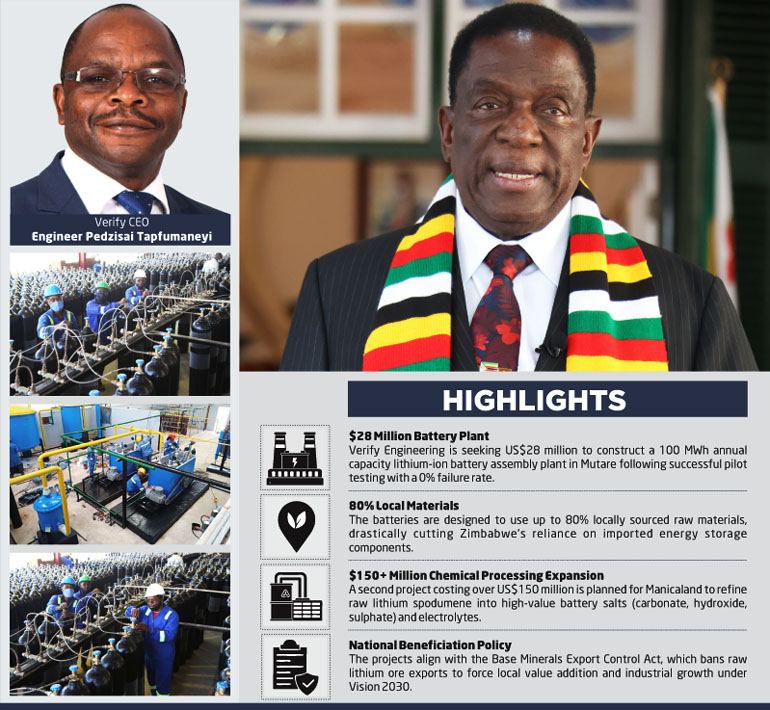
Ray Bande
Senior Reporter
ZIMBABWE’S drive to unlock value from its vast lithium reserves has taken another significant step forward, with State-owned technology innovator, Verify Engineering, seeking US$28 million to establish a large-scale lithium-ion battery assembly plant in Mutare.
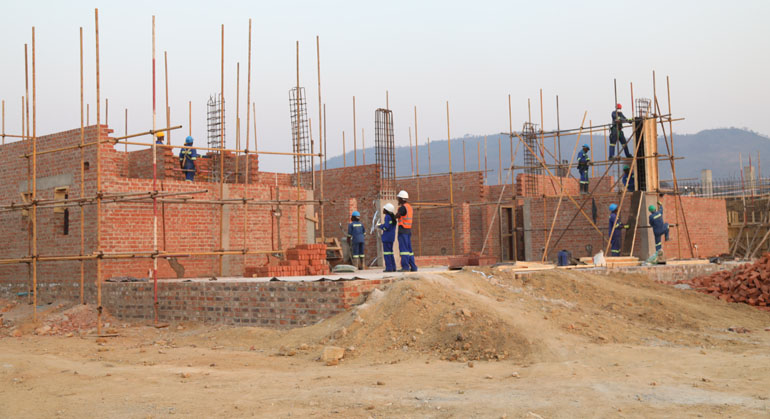
The ambitious project marks the transition from successful laboratory development to commercial-scale production, and positions Manicaland as a potential hub for battery manufacturing and green energy technologies.
Verify Engineering, a Government-owned company operating under the Ministry of Higher and Tertiary Education, Innovation, Science and Technology Development, is now actively courting both local and international investors to finance the venture.
The development follows a major breakthrough achieved in 2025 when the company successfully piloted locally manufactured lithium-ion battery cells.
A year-long testing programme recorded a zero percent failure rate, confirming the batteries’ reliability, stable performance and projected lifespan of up to 10 years.
The achievement came after Verify Engineering invested approximately US$500 000 in research and development.
The project is aligned with the Government’s mineral beneficiation agenda under the Base Minerals Export Control Act, which prohibits the export of raw lithium ore in a bid to encourage local value addition and industrialisation.
Engineered to utilise up to 80 percent locally sourced raw materials, the batteries are expected to significantly reduce Zimbabwe’s dependence on imported energy storage components while creating opportunities within the domestic manufacturing sector.
Verify Engineering chief executive officer, Engineer Pedzisai Tapfumaneyi, said the company is now focused on commercialising the technology.
“Following the prototype success, Verify Engineering’s immediate objective is now moving from laboratory success to large-scale commercialisation. The company has now completed a full feasibility study report for the manufacturing and distribution of lithium-ion batteries in Zimbabwe and beyond. Commercialisation is our next step,” he said.
Engineer Tapfumaneyi said the proposed facility will have the capacity to produce up to 100 megawatt-hours (MWh) of batteries annually.
“The company is actively looking for both technical and financial partners, locally and internationally, to construct this mass-production facility, which aims to supply consumer electronics, energy storage markets and, eventually, electric vehicle batteries,” he said.
Beyond battery assembly, Verify Engineering is also pursuing another major investment aimed at deepening Zimbabwe’s participation in the lithium value chain.
Engineer Tapfumaneyi revealed that a second feasibility study, which is nearing completion, focuses on processing lithium spodumene into high-value lithium salts and battery-grade chemical products.
“Another feasibility study report nearing completion is for the processing of lithium spodumene into lithium salts, namely lithium carbonate, lithium hydroxide and lithium sulphate, as well as electrolytes such as battery-grade lithium hexafluorophosphate. This project is earmarked for Manicaland Province and a plant costing in excess of US$150 million has been identified,” he said.
The proposed processing plant would enable Zimbabwe to move beyond mineral extraction into the production of critical battery materials used in global clean energy supply chains.
Verify Engineering currently operates a manufacturing facility in Feruka, Mutare, where it produces a range of industrial and medical gases, including oxygen, acetylene and liquid nitrogen.
The company has also expanded its footprint through distribution centres across Zimbabwe and is already exporting products to Mozambique, with plans to enter additional regional markets.
Its Feruka facility hosts a Technology and Innovation Support Centre where scientists and engineers continue to develop technologies aimed at advancing industrial production and import substitution.
The lithium battery project is widely viewed as a cornerstone of Zimbabwe’s broader ambition to leverage what are believed to be Africa’s largest lithium reserves and transform the country into a regional centre for green energy technology manufacturing.
Engineer Tapfumaneyi commended President Emmerson Mnangagwa for championing industrialisation and supporting innovation-driven enterprises.
He also acknowledged the support received from Higher and Tertiary Education, Innovation, Science and Technology Development Minister, Dr Frederick Shava and Permanent Secretary, Professor Fanuel Tagwira.
Engineer Tapfumaneyi said continued policy backing and investment in research and development have enabled Verify Engineering to convert scientific innovation into commercially viable products capable of contributing to Zimbabwe’s Vision 2030 and upper middle-income economy aspirations.
“Through policy and budgetary support, entities such as Verify Engineering have been able to deliver tangible results that are poised to drive the country’s industrial transformation agenda and economic growth,” he said.